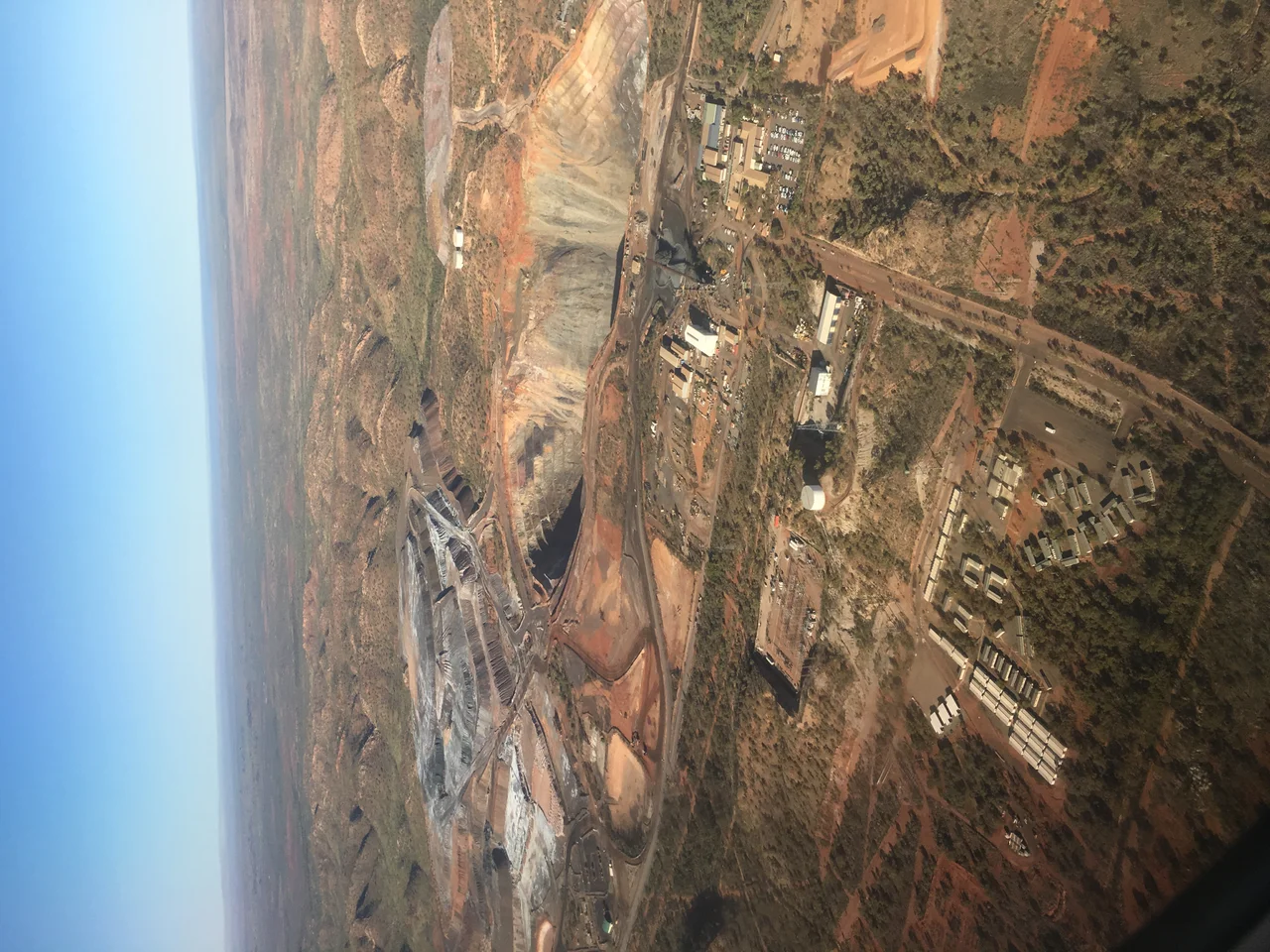

George Fisher mine
For decades, the ore body north of Mount Isa kept its riches behind a wall of water. Geologists knew it was there. As early as 1948 they had probed the ground near a place called Hilton and found tantalizing signs, and the shafts they sank in the 1950s confirmed plenty of ore. But they also confirmed plenty of water, gushing into the workings faster than the pumps of the day could clear it, and again and again the project stalled. It took half a century of patience, better ventilation, and the slow conquest of those flooded depths before the field gave itself up. The result is the George Fisher mine, one of the largest zinc, lead, and silver mines in the world.
The Patient Conquest of Hilton
The story begins with the Hilton ore body, discovered in 1947 by Mount Isa Mines geologist Sydney Carter, twenty kilometers north of the main field. Early exploration ran headlong into trouble. From 1950, shafts sunk to gauge the deposit hit heavy flows of water that drowned the work and suspended it. By the mid-1960s, with metal prices depressed and the existing Mount Isa mine still rich with ore, there was little reason to push on, and exploration shrank to a trickle. Yet the company never quite let go. Crews kept probing on a small scale, year after year, improving the pumping and ventilation, mapping the extent of the lode, and slowly learning to manage the water that had defeated their predecessors. Persistence, more than any single breakthrough, opened this ground.
A Chairman's Name on the Rock
In 1981, a similar ore body was found two kilometers north of Hilton, and it would become the heart of the operation that was officially opened in 2000, renamed George Fisher Mine in honor of the former chairman. The mine carries the name of Sir George Fisher, who joined Mount Isa Mines Holdings as deputy chairman in January 1952 and rose to chairman the following year, steering the company through the boom decades of the 1950s and 1960s. It is a fitting honor. The mine he lends his name to sits among the giants of its kind, holding estimated reserves on the order of 150 million ounces of silver alongside vast tonnages of zinc and lead, the metals that have always defined the Mount Isa field.
A Kilometer Down
George Fisher is a deep mine, and the engineering reflects it. Ore is hauled to the surface by a ground-mounted friction hoist that lifts it from more than 1.1 kilometers underground, a vertical journey longer than the height of most of the world's tallest towers, repeated load after load, around the clock. At that depth, every shift is a logistical feat: men, machines, air, and water all moving up and down a shaft that plunges far below the desert floor, the same water that once defeated the mine now pumped and managed rather than feared. The reserves have only grown with understanding. When Xstrata acquired the mine in 2003 through its takeover of MIM Holdings, the known zinc reserve stood at 33 million tonnes; by 2010 the estimate had more than doubled to 76 million tonnes. The deposit that water once guarded so jealously turned out to be even richer than the men who first drilled into it dared to hope.
The Future of the Field
Today George Fisher belongs to Glencore, inheritor of the Mount Isa empire after its 2013 merger with Xstrata, and it has become central to the region's future. As the older Mount Isa copper operations wind down, the long-life zinc, lead, and silver of George Fisher and neighboring Hilton represent the next chapter for a mining district that has been digging metal out of North West Queensland for a century. Out here, twenty kilometers of red dirt north of the smelter stacks, the headframe stands over a shaft that plunges into the dark, still pulling treasure from rock that took fifty years to claim.
From the Air
The George Fisher mine lies about 20 km north of Mount Isa at roughly 20.55 degrees south, 139.48 degrees east, in remote North West Queensland. From the air, look for the headframe, surface processing buildings, and pale tailings and waste-rock areas standing out against the red-earth ranges and spinifex, set apart from the larger Mount Isa smelter complex to the south. The 270-meter Mount Isa lead smelter stack, visible up to 40 km away, is the regional landmark for orientation; George Fisher sits roughly along the corridor north of it. Recommended viewing altitude 4,000 to 6,000 feet AGL. Mount Isa Airport (ICAO YBMA) is the nearest field, just south near the city; Cloncurry (YCCY) lies about 140 km southeast. Dry-season visibility is excellent; expect haze and thunderstorms in the summer wet.
Nearby Stories
- Mary Kathleen, Queensland 7.8 km away
- Kajabbi 23 km away
- Quamby 40 km away
- Mount Cuthbert Township and Smelter 61 km away
- Camooweal Caves National Park 74 km away
- Moonah Creek Hanging Tree 98 km away
- Community Hall, Camooweal 100 km away
- Glenormiston Station 242 km away