
Georgetown University
John Carroll signed the founding deed for Georgetown College on January 23, 1789, three months before George Washington was inaugurated as the first president. Carroll was a Maryland-born Jesuit, the cousin of Charles Carroll the Declaration signer, and the first Catholic bishop appointed in the United States. The Jesuit order had been suppressed by Pope Clement XIV in 1773 and would not be restored until 1814, but Carroll and other former Jesuits were determined to establish a Catholic college in the new American republic. They bought sixty acres on the heights above Georgetown, then a separate town two miles upriver from the Capitol building that did not yet exist. The first student, William Gaston, enrolled in 1791. Two hundred thirty-five years later, the institution is still here, still Catholic, still Jesuit, and still teaching from the same hill.
Carroll's College
John Carroll's project was politically delicate. Catholics in colonial America had been a tolerated minority at best, and in some colonies had been banned outright. Maryland, founded as a refuge for English Catholics in 1632, had become Protestant-dominated by the early eighteenth century. Carroll built Georgetown College to demonstrate that Catholics could participate fully in the new republic without compromising their faith. The original campus consisted of a single brick building, Old North, which still stands and which housed students, classrooms, dormitory, and chapel. The school admitted students of all religious backgrounds from the beginning. George Washington visited Georgetown in 1797. Thomas Jefferson, then Vice President, attended the cornerstone laying of Old North in 1791. The school received its formal congressional charter in 1815, the year after the Jesuit order's restoration, becoming the first federally chartered university in the United States.
The Civil War and 272 Souls
The Civil War nearly destroyed Georgetown. Enrollment collapsed as Southern students left to fight for the Confederacy. The school's finances had already been precarious. To raise emergency funds, the Maryland Jesuits who owned Georgetown sold 272 enslaved men, women, and children to two Louisiana plantation owners in June 1838 for about $115,000. The proceeds went toward paying the college's debts. The sale was one of the largest single transactions of enslaved people in United States history. In 2016, Georgetown formally acknowledged its complicity in this sale, after a multi-year process of research, listening, and dialogue with the descendants of the 272 enslaved people. The university offered preferential admission status to descendants, renamed two buildings that had honored the priests who arranged the sale, and committed to ongoing memorial and reconciliation work. The descendants community, organized as the GU272 Descendants Association, has continued to push the institution to do more.
Healy and the Spires
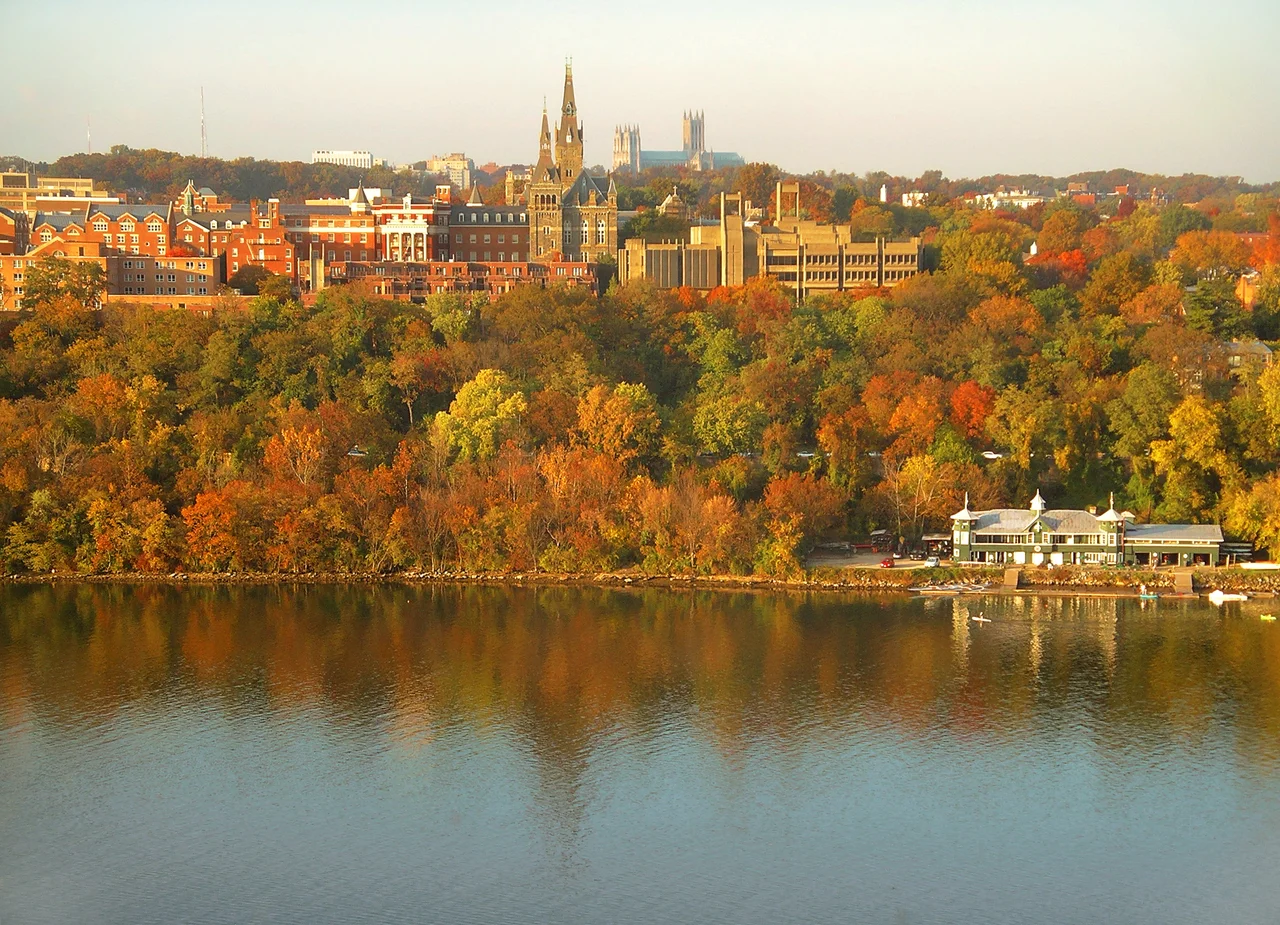
Healy Hall, the gothic spire that dominates the Georgetown campus, was completed in 1879 by architects John L. Smithmeyer and Paul J. Pelz and named for Patrick Healy, the Jesuit priest who served as president from 1873 to 1882 and who is considered the second founder of the university. Healy was born in Macon, Georgia in 1834 to an Irish immigrant father and a mother who had been born into slavery. Under American law of the period he was Black; he passed as white throughout his career and his Black ancestry was not publicly known until decades after his death. Healy expanded Georgetown from a small classical college into a modern university with graduate and professional programs. He oversaw construction of the building that bears his name and that defines the Georgetown skyline today. Healy was the first Black American to earn a Ph.D., the first to head a predominantly white college or university, and the first to be ordained a Jesuit priest. He lived until 1910.
Foreign Service and the Diplomatic Pipeline
The Edmund A. Walsh School of Foreign Service, founded in 1919, was the first school of international affairs at an American university. Walsh, another Jesuit priest, had served on the relief mission to Russia after the revolution and saw the need for trained American diplomats. The School of Foreign Service has educated more American ambassadors than any other institution. The list of Georgetown alumni reads like a glossary of recent American political life: Bill Clinton (class of 1968), Antonin Scalia (1957), Antonin Scalia's son Eugene, Tomislav Nikolic the President of Serbia, King Felipe VI of Spain, several heads of state of Caribbean and Latin American countries, and dozens of senators, representatives, governors, and Cabinet secretaries. Thirty-two Rhodes Scholars and forty-six Marshall Scholars. The Hoyas men's basketball team, which won the NCAA championship in 1984 under Patrick Ewing and John Thompson Jr., gave the school a national athletic identity at the same time.
Up the Hill
Today Georgetown enrolls about 7,500 undergraduates and 10,000 graduate students from more than 135 countries. The main campus occupies 104 acres on the bluff above the Potomac, with Healy Hall's clock tower visible from much of downtown Washington and from approaches on the river. The graduate schools of law, medicine, business, public policy, and continuing studies operate from separate Washington campuses. The Jesuit identity remains structurally important: the school's mission statement, its core curriculum requirements, and the cura personalis tradition of attention to the whole student all derive from Ignatian pedagogy. Almost ninety percent of full-time professors are not religious; the university has more Jewish students than Catholic students at the undergraduate level by some recent counts. The fit between Catholic founding and contemporary pluralism is not always comfortable, but the institution has been working at it for two hundred and thirty-five years.
From the Air
Georgetown University is at 38.9076 degrees north, 77.0723 degrees west, in the western part of the Georgetown neighborhood on a bluff above the Potomac. Best viewed at 1,500 to 2,500 feet AGL with Healy Hall's clock tower clearly visible. Reagan National (KDCA) is four nautical miles south. The site sits inside the P-56 prohibited area; viewing is from authorized riverside approaches.
Nearby Stories
- Gunston Hall 1.1 km away
- 2023 Baltimore Shooting 4.9 km away
- Battle of Middleburg 6.6 km away
- Crownsville Hospital Center 10 km away
- Battle of Loudoun Heights 13 km away
- First Battle of Rappahannock Station 20 km away
- Howard County, Maryland 21 km away
- Harriet Tubman Underground Railroad 50 km away