
German Archaeological Institute at Athens
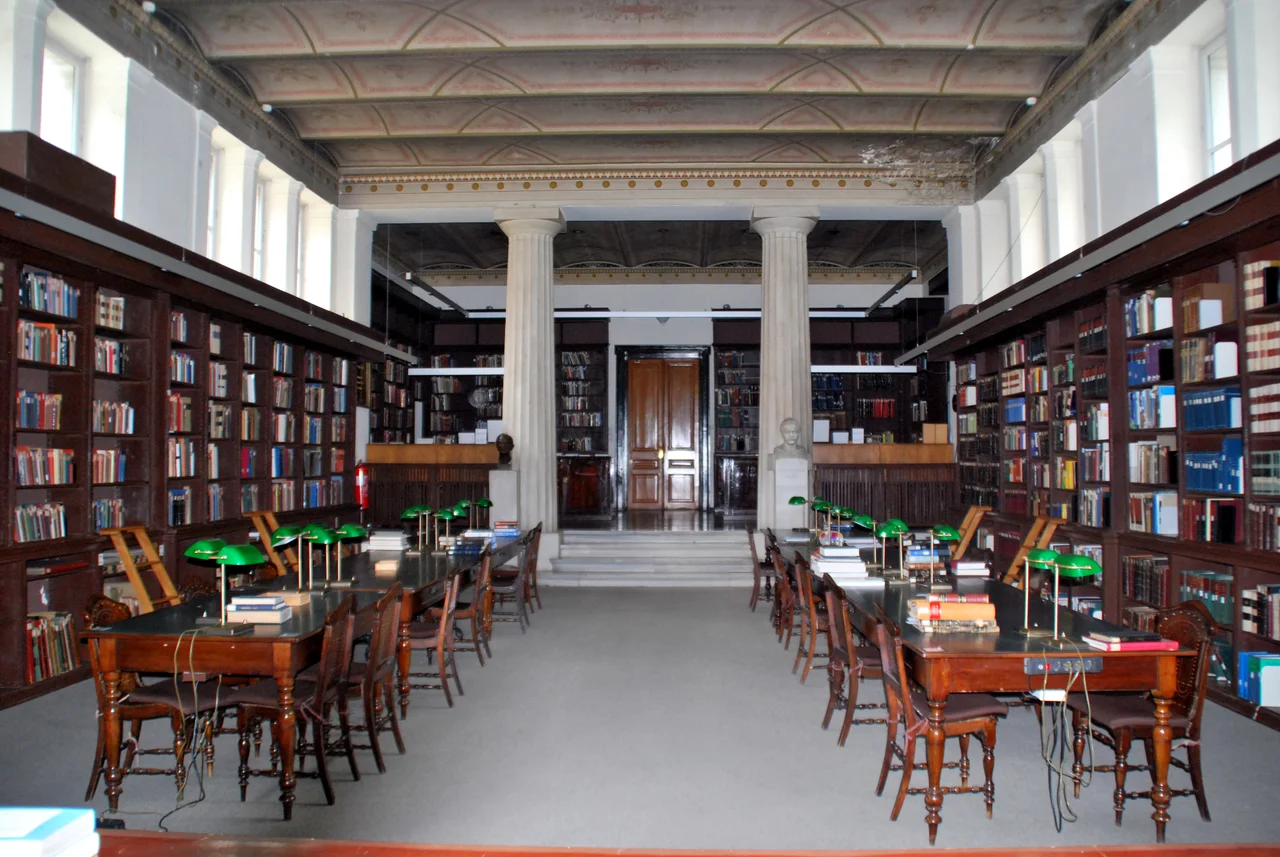
Heinrich Schliemann had already found his Troy and his Mycenae, his golden masks and his fortune, when he paid for a building on Fidiou Street in the center of Athens. The man who turned Homer's poems into excavation sites wanted German archaeology to have a permanent home in Greece. The late-classical building he funded, designed by Wilhelm Dorpfeld and Ernst Ziller and finished in the late 1880s, became the seat of the German Archaeological Institute at Athens, an institution that has spent a century and a half pulling the ancient world out of Greek soil.
Second After Rome
When the German Archaeological Institute opened its Athens department in 1874, it was only the institute's second branch, after Rome, and only the second foreign archaeological school in Athens, after the French had arrived first. Part of the operation was established on 17 March 1872 and formally inaugurated on 9 December 1874. Today it is one of nineteen foreign archaeological institutes working in the city, an extraordinary concentration of scholarship drawn to a single place by the density of the past beneath it. From its founding, the Athens department did more than dig for itself. It supported and promoted the work of German and Greek scientists alike, weaving itself into the wider community of researchers who pass through Athens, some for a season, some for a lifetime.
A Library of Images
Behind the institute's classical facade is a working archive that few outsiders ever see in full. Its library holds some 80,000 volumes. Its photographic collection is even more remarkable: more than 140,000 negatives, a visual record of Greek antiquity assembled over generations and consulted by scholars from around the world. Since 1876 the institute has published its journal, the Mitteilungen of the Athens department, every year without interruption, alongside a steady stream of monographs and excavation reports. For an archaeologist working anywhere in Greece, the institute's photographs and publications are not a convenience but a foundation, a deep memory of what has been found, where, and in what condition.
From Olympia to the Kerameikos
The institute's spade has reached nearly every corner of Greece. It has worked the Ionian Islands at Leukas and Ithaca, Boeotia at Orchomenos and Thebes, Attica at Menidi and Eleusis, and Laconia at Amyklai. Some of its most enduring projects are still running. At Olympia, the sanctuary where the ancient Games were held, German teams have been excavating since 1875, an unbroken effort approaching a hundred and fifty years. They dig at Tiryns in the Argolid, at Kalapodi in Boeotia, at the Heraion of Samos, and in Athens itself at the Kerameikos, the ancient cemetery whose grave monuments and burial roads they have steadily uncovered. Until the institute founded a separate Istanbul department in 1929, the Athens office handled fieldwork stretching even into western Asia Minor.
A Century of Directors
The institute's history can be read through the scholars who led it. Otto Luders opened the directorship in 1872. Wilhelm Dorpfeld, who had helped design the very building, ran the department from 1887 to 1912, bridging Schliemann's heroic age of treasure-hunting and the more careful, stratigraphic archaeology that followed. Georg Karo led it through the upheavals of two separate terms; Ernst Buschor, Emil Kunze, and Helmut Kyrieleis carried it through the twentieth century. Since 2014 the director has been Katja Sporn. Across all those names runs a single continuity: a building paid for by the most famous excavator of them all, still standing in the heart of Athens, still sending archaeologists out into the Greek countryside to find what the centuries buried.
From the Air
The German Archaeological Institute at Athens stands at approximately 37.982 N, 23.732 E, at Fidiou 1 in central Athens, a short distance north of the Acropolis. The Acropolis rock with the Parthenon is the dominant visual landmark; the institute sits in the dense urban core between it and the slopes of Lycabettus to the northeast. The nearest airport is Athens International (Eleftherios Venizelos), ICAO LGAV, about 29 km east-southeast. Attica's typically clear skies and strong light make the marble landmarks of central Athens, the Acropolis and Lycabettus, easy reference points for orienting over the city.
Nearby Stories
- Great Sand Beach 5 km away
- Battle of Delium 7.7 km away
- Tower of Aliartos 9 km away
- HMHS Britannic 10 km away
- Saronic Gulf 15 km away
- Sousaki Volcano 17 km away
- Sanctuary of Apollo Maleatas 24 km away
- Skyros 66 km away