.jpg)
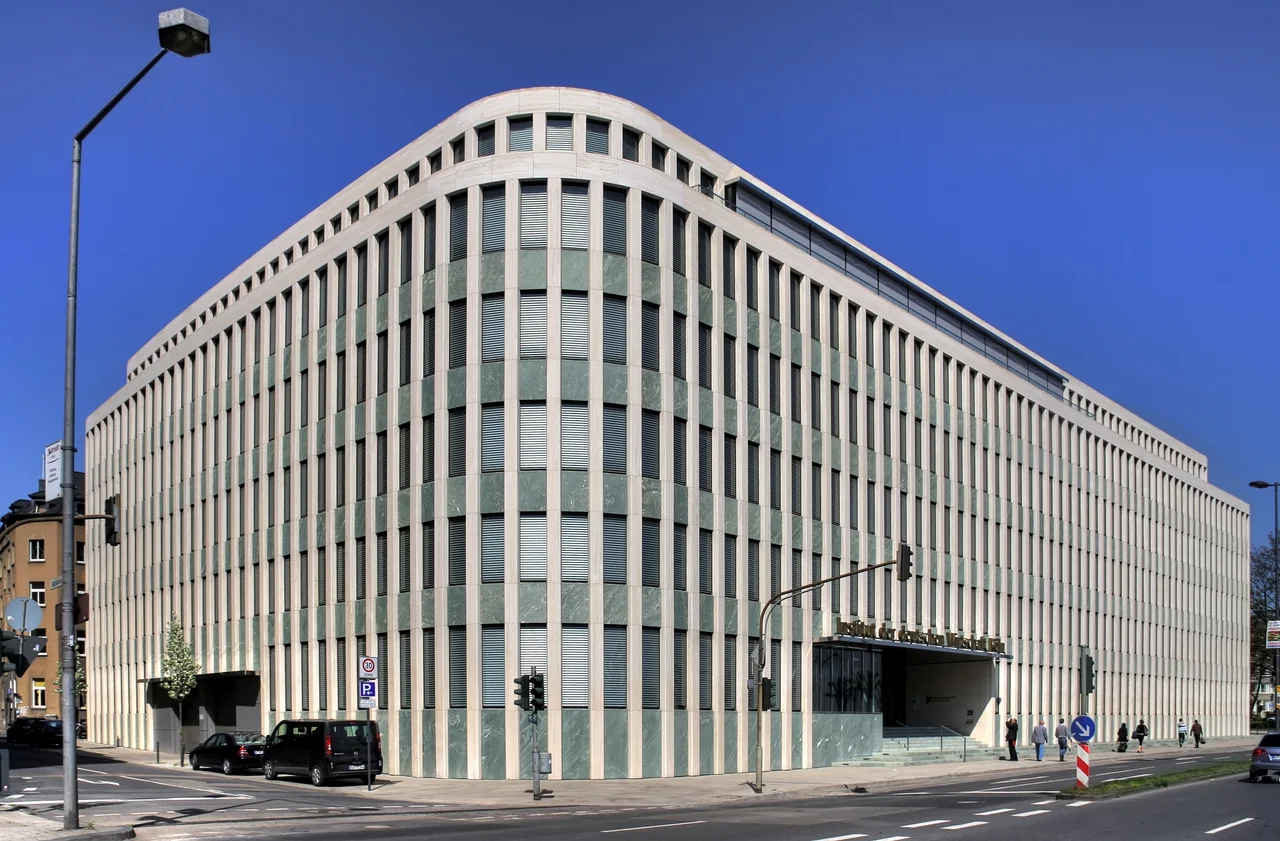
German Economic Institute
Germany came out of the Second World War with its industrial base ruined, its currency worthless, and a fierce debate ahead about what kind of economy it would build next. In 1951 - the same year the Federal Republic was settling into its new institutions and the first German Bundesliga clubs were forming and the country was beginning to be readmitted to international organisations - two umbrella groups of German business interests created a research institute in Cologne to make sure the voice of industry was heard. They called it the Deutsches Industrieinstitut. Today it goes by Institut der deutschen Wirtschaft Köln, abbreviated IW, in English the German Economic Institute. It is the largest privately funded economic think tank in Germany, and from a building on Cologne's Konrad-Adenauer-Ufer it has been making the case for an economically liberal order for over seven decades.
Founders and First Years
The institute's parents were the Confederation of German Employers' Associations (BDA) and the Federation of German Industries (BDI) - the two big federations that speak for German employers and German industry respectively. They wanted research that would push back against trade-union arguments in the columns of the West German press and in the corridors of Bonn ministries. From 1951 to 1953 the journalist Otto Mejer, who had cut his teeth at the wartime Deutsches Nachrichtenbüro, and Fritz Hellwig of the CDU served as managing directors. Hellwig would later become a member of the European Commission. The institute was structured as a registered association under German law - an e.V. - membership consisting of around 110 German business and employers' associations along with individual companies. Members pay fees that finance the research. Outside funders pay for specific studies.
What the IW Actually Does
Under its current director Michael Hüther - an economist who has led the institute since 2004 and is one of the most quoted commentators on the German economy - the IW publishes analyses on labour markets, vocational training, taxation, energy policy, monetary policy, real estate, demographics, and structural change. The research department alone is divided into eleven units. There is a unit on vocational rehabilitation and the employment of workers with disabilities. There is one on environment, energy and infrastructure. There is one on behavioural economics and business ethics. Two cross-functional groups handle big data analytics and macroeconomic forecasting. Reports go out under the IW name, get picked up by Frankfurter Allgemeine and Handelsblatt, and shape the way German policymakers - and increasingly EU policymakers - think about specific questions.
The IW Group
The German Economic Institute is not just one institute. Over the decades it has built out a family of subsidiaries, collectively called the IW Group. IW Consult is the commercial research arm, doing contract studies for companies and ministries; it also operates 'ecl@ss', a digital product classification standard used across European supply chains. IW Medien publishes a weekly newsletter, the iwd, which translates the institute's research into accessible articles on economics and social policy. IW Junior runs Germany's branch of the Junior Achievement programme, the international scheme that gives school students hands-on experience of running small businesses. IW Akademie offers executive education and a joint Master's programme in Behavioural Ethics, Economics and Psychology with the University of Cologne, the Cologne University of Applied Sciences, and Bonn-Rhine-Sieg University.
Cologne, Berlin, Brussels
The IW is headquartered in Cologne, but increasingly the action is elsewhere. Federal economic policy is made in Berlin, where the institute has an office under Knut Bergmann, providing rapid analysis for the lawmakers and journalists who congregate around the Bundestag. EU economic policy - monetary policy, trade rules, environmental regulation, the long-running argument about how to balance European integration against national interests - is made in Brussels, where the IW's EU Office opened in July 2015 under Sandra Parthie. Honorary president is Arndt Günter Kirchhoff, CEO of the family-owned KIRCHHOFF automotive group. The whole structure is a reminder that Germany's economic debates are not abstract: they are funded, staffed, and argued by people who get up every morning and go to specific buildings in specific cities to do the work.
From the Air
The German Economic Institute occupies its headquarters at Konrad-Adenauer-Ufer, on the west bank of the Rhine in central Cologne, at 50.9458° N, 6.9630° E. From the air it is in the dense urban centre of Cologne, north of the cathedral. Cologne Bonn airport (EDDK / CGN) is 14 km southeast. Düsseldorf (EDDL / DUS) is 40 km north. The Rhine itself is the unmistakable navigation landmark.
Nearby Stories
- Diamond Interchange: How a Simple Idea Reshapes Towns Like Julich 2.8 km away
- Dusseldorf-Unterbach 6.1 km away
- Baumwollspinnerei Ermen & Engels 11 km away
- RAF Bruggen 15 km away
- Hagen Open-air Museum 21 km away
- Belgium 130 km away
- Marcinelle Mining Disaster 173 km away
- Zwingenberg Castle 178 km away