
Giant's Causeway and Bushmills Railway
There is a sound the engines make on the return run that the volunteers describe with one word: bark. The two-mile descent from the upper terminus near the Causeway Hotel runs out across ancient sand dunes toward the River Bush, and the gradient is just steep enough that the steam engines have to work going back. The line is three feet wide. It is younger than it looks and older than it knows. It carried its first passengers at Easter 2002. It runs on the trackbed of a railway that opened in 1883 and called itself, with some justification, the first long electric tramway in the world.
The First Long Electric Tramway
The Giant's Causeway, Portrush and Bush Valley Railway and Tramway Company opened to Bushmills on 29 January 1883 and extended to the Causeway on 1 July 1887. Its promoter was W. A. Traill. Its power was hydroelectricity from the River Bush, delivered through an elevated third rail - although steam tram engines worked the line in its early years too. In 1899 the power supply was converted to overhead wires, the technology that would dominate twentieth-century trams. When it opened, observers called it the first long electric tramway in the world. Whether that exact claim is the truest superlative depends on what you count and where, but the Causeway tram was unquestionably among the pioneers, and it ran for sixty-six years. The last service ran on Friday, 30 September 1949. The line was dismantled.
A Tourist Line at Shane's Castle
Heritage railways are made from leftovers. The new line uses equipment that Lord O'Neill had originally assembled for a tourist railway at Shane's Castle, County Antrim, a private operation that closed in 1994. David Laing led the campaign to repurpose that material on the old Causeway trackbed. Volunteers cleared the trackbed at the end of 1999. The Giant's Causeway and Bushmills Railway Company is a not-for-profit charity. The first passengers boarded at Easter 2002 - one of those quiet anniversaries that the visitors at the Causeway barely notice as they queue for the visitor centre but that the people who built it remember exactly.
A DMU and a Pair of Locomotives
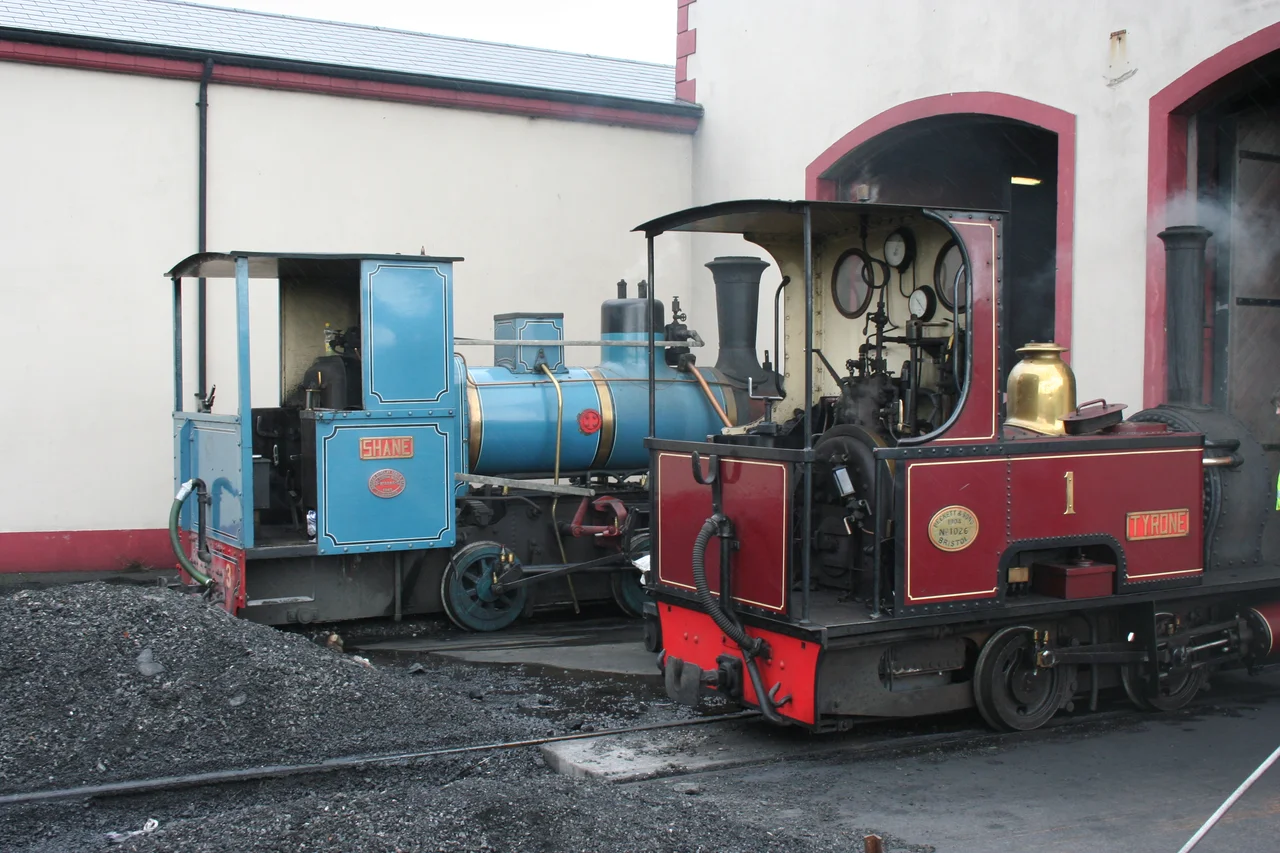
In July 2010 the railway took delivery of a specially built diesel multiple unit from Severn Lamb of the UK - four coaches, capacity for ninety passengers, powered by a Kubota engine. The unit was designed to recreate, as far as a modern build can, the passenger experience of the original hydroelectric tram. The DMU shares the rails with the steam locomotives and eight four-wheel coaches that were already running the line. The powered vehicle on the DMU faces the Causeway side and is shorter than its three trailers (four windows versus five) - the kind of detail that is invisible from a distance and obvious once you start to look.
Bushfoot Strand and the Golf Course
The upper station sits just below the Causeway Hotel with a single platform and traditional buildings. From there the line drops toward Bushfoot Strand, where the engines bark on the way home. It then runs through ancient sand dunes to the River Bush, where a newly installed bridge carries it across. There is a passing loop just before the bridge, not normally used. The track crosses Bushfoot Golf Course - golfers and trains share the same low ground - to meet Ballaghmore Road, the road from Bushmills to Portballintrae. The line follows that road to its lower terminus at the junction of the Portrush-Bushmills road. The Bushmills station here has one platform and no buildings. Beside the line runs a cycle track (National Cycle Network 93) and a footpath, so for two miles you can choose your speed: train, bicycle, or boot.
From the Air
The line runs between 55.21°N, 6.54°W (upper station near the Causeway) and Bushmills at 55.20°N, 6.52°W. From altitude, look for a narrow line cutting through dunes north of Bushmills, paralleling Ballaghmore Road. The River Bush bridge sits roughly midway. Nearest airport is City of Derry (EGAE), about 20 nautical miles west; Belfast International (EGAA) is 40 nautical miles southeast.
Nearby Stories
- River Bann 5.2 km away
- Glenarm Castle 6.1 km away
- Ballygroll Prehistoric Landscape 11 km away
- Mull of Kintyre 11 km away
- Attacks on Shipping in Lough Foyle (1981-82) 12 km away
- Achamore House 20 km away
- Port Ellen Distillery 22 km away
- German submarine U-155 (1941) 39 km away