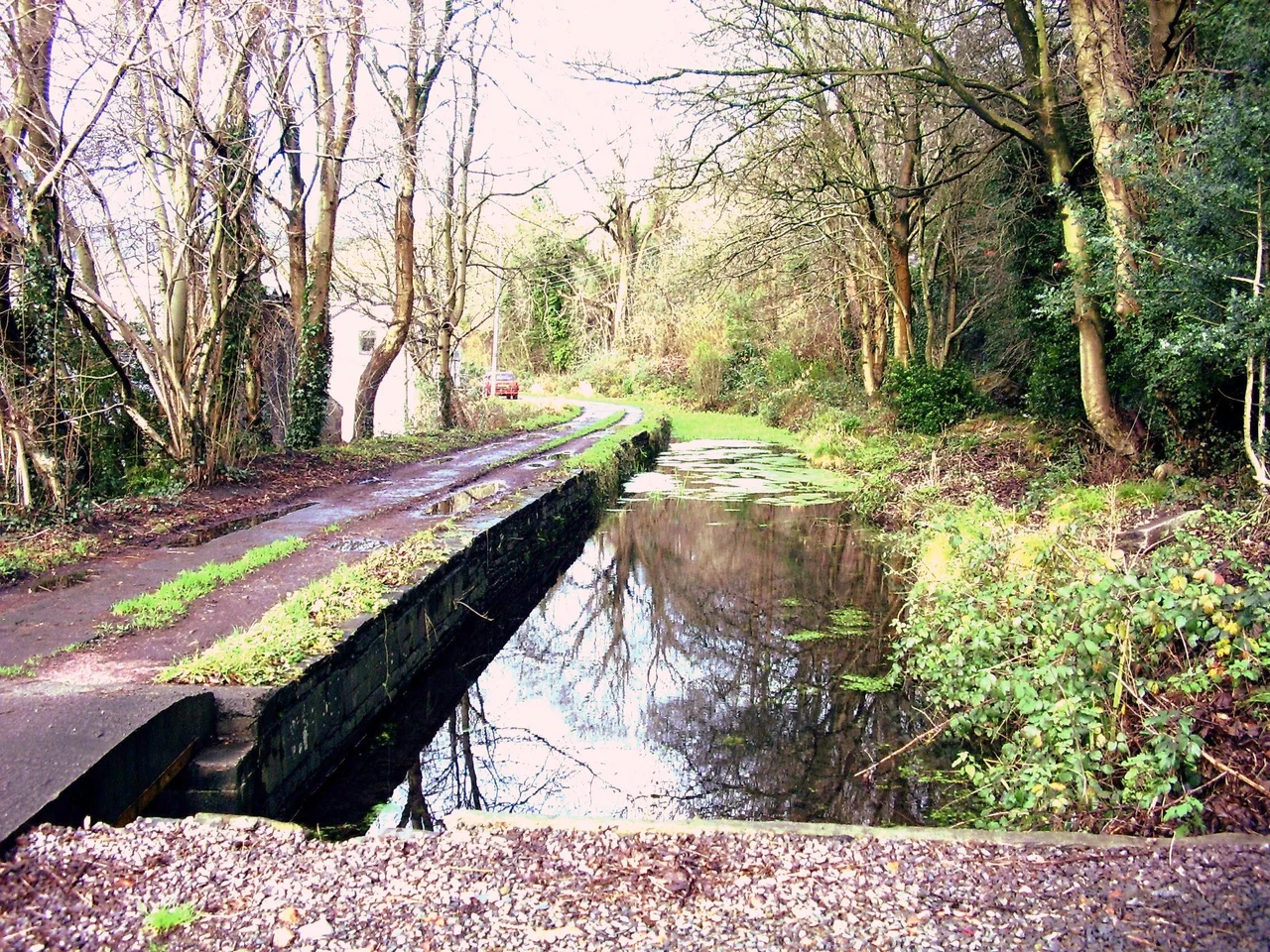

Glamorganshire Canal
There was once a canal that ran from the head of the Taff Valley down to the sea at Cardiff, twenty-five miles long, dropping five hundred and forty-two feet through fifty locks. It was built because the ironmasters of Merthyr Tydfil wanted to move their pig iron and cannon to the ocean without paying for horse trains. It was destroyed because the railways came, then the trains stopped using it, then the canal-side villages started slumping into the workings beneath them, and then nobody was watching. Today it is mostly a footpath. The Taff Trail between Abercynon and Merthyr Tydfil walks the line of the old towpath, and you can still find the lock walls in the bushes, and the occasional bridge, and a few stretches of standing water that have become a nature reserve.
The Idea
Construction began in 1790. The ironmasters of Merthyr Tydfil, Richard Crawshay of Cyfarthfa chief among them, were tired of horse-drawn wagons hauling their finished iron over poor roads to the docks at Cardiff. A canal could carry far more for less. With backing from Lord Cardiff, they got Parliament to authorise the project on 9 June 1790. £90,000 was raised. The engineer Thomas Dadford, a pupil of James Brindley, the founder of British canal engineering, arrived with his son Thomas Dadford Jr. and a man named Thomas Sheasby. They began at the Merthyr end and worked downhill toward Cardiff. The Merthyr to Newbridge section, twelve miles, was open by June 1792. Treforest by January 1793. Taff's Well by June 1793. The final section to Cardiff opened on 10 February 1794.
Fifty Locks Down the Taff
The canal clung to the western slope of the Taff Valley most of the way down, crossing the river on an aqueduct at Navigation, now called Abercynon, to ride the eastern slope into Cardiff. The fifty locks were necessary because the Taff drops sharply through the valley, more than five hundred feet from Merthyr to the sea. Each lock was a small ceremony of mathematics: open the gates, fill the chamber, raise or lower the boat, drain the chamber, close the gates, move on. Water came from the tail races of Cyfarthfa Ironworks, formerly fed back into the Taff to be reused by the Plymouth works downstream. The Plymouth ironmasters were not happy. There were lawsuits. There was occasional vandalism. The canal company and the iron company on the third lock argued about water for years.
A Hundred Years of Iron and Coal
For roughly seven decades the canal worked beautifully. Dividends were capped by Parliament at eight per cent, and in the prosperous years between 1804 and 1828 the profits were so high that the company refunded tolls to traders or charged nothing at all. Then in 1841 the Taff Vale Railway opened from Cardiff to Merthyr. Railways could carry more, faster, and uphill, and the canal began to slip. It clung to its business for another twenty years. But in the 1870s the ironworks themselves began to close, and what they replaced themselves with, the steelworks, used different processes and different supplies. 1876 was the first year the canal could not pay its full dividend. In 1885 the Crawshay estate sold it to the Marquess of Bute, who owned the Cardiff docks at the bottom of the line and wanted to keep the traffic coming.
The Subsidence at Aberfan
By the 1890s, six railway companies were running into Merthyr. The canal could not compete. Worse, the four-mile pound at Aberfan, the long lock-free section through the village that would become tragically famous seventy years later, was subsiding into the coal workings beneath it. To keep water out of Aberfan, the canal company closed the section from Merthyr to Abercynon on 6 December 1898. The rest of the canal kept going, slowly. A breach at Cilfynydd in 1915 was bypassed with a wooden flume rather than repaired. Another breach at Nantgarw in May 1942 was inspected and left. Cardiff Corporation bought the canal in August 1943 for £44,000, intending to close it on 1 January 1944. They were prevented by section 27 of the Act, which kept the sea lock open while sand traders still needed it. The sand traders held on until 1950, and the canal closed only after the war emergency was officially declared over on 8 October that year.
Walking the Line Today
Much of the Taff Trail follows the old canal between Abercynon and Merthyr Tydfil. The towpath has become a cycling and walking route, with the old locks visible as lines of dressed stone among the trees and the route of the canal traced as a green ribbon down the valley. The section from Tongwynlais to the Melingriffith Tin Plate Works at Whitchurch survives in water as the Glamorganshire Canal local nature reserve, full of moorhens and kingfishers. Locks 31 and 32 in Pontypridd hold water and may be restored. There is even a boat weighing machine, one of only four ever built in Britain, now displayed at the National Waterfront Museum in Swansea. The canal carried the metal that built the British Empire's railways. Now it is the slow shaded path you walk to remember that everything that was once new and necessary will, in time, become a footpath.
From the Air
The Glamorganshire Canal followed the River Taff from Merthyr Tydfil at 51.75 N, 3.38 W down to Cardiff at 51.48 N, 3.18 W. Best traced from 2,500 to 3,500 feet southbound down the Taff Valley. The Taff Trail follows the upper part of the route; the Cardiff end is harder to see as the canal is largely built over. Cardiff Airport (EGFF) is at the southern end of the route. Avoid low-level flying in the valleys themselves; orographic weather is rapid and unpredictable.
Nearby Stories
- Portishead Point Lighthouse 3 km away
- St Fagans National Museum of History 5 km away
- Museum of Cider 6.5 km away
- Monmouth 8.3 km away
- Carreg Cennen Castle 11 km away
- Builth Castle 14 km away
- Craig Gwrtheyrn 29 km away
- Ilfracombe Lifeboat Station 37 km away