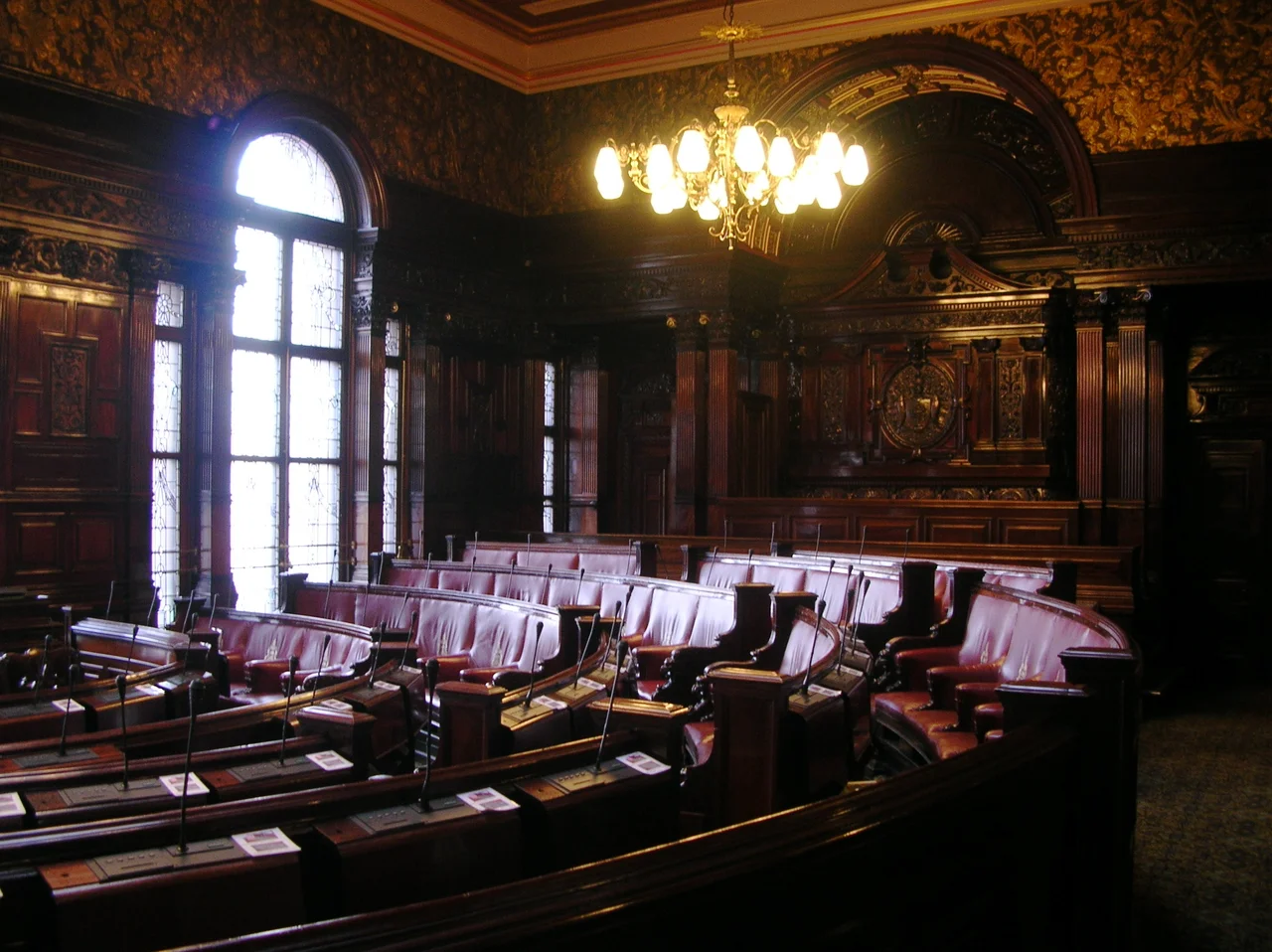

Glasgow City Chambers
Look up from the east side of George Square and you will see her: a figure in flowing robes, arm extended, perched at the apex of the Glasgow City Chambers' tower. Glaswegians call her Glasgow's Statue of Liberty, because she looks remarkably like the much larger one in New York harbour. Her real name is Truth. James Alexander Ewing sculpted her in the 1880s, alongside her companions Riches and Honour, to crown a Beaux-Arts palace built to announce, in stone and bronze, that Glasgow had become the Second City of the Empire.
Outgrowing the Tolbooth
By the early nineteenth century the old Glasgow Tolbooth at Glasgow Cross, with its medieval steeple still standing today, had become hopelessly too small for the city's swelling administrative ambitions. The Tolbooth was sold in 1814, except for the steeple. The council moved first to public buildings in the Saltmarket near Glasgow Green, and then in 1844 to the city and county buildings between Wilson Street and Ingram Street. Neither location felt suitable for what Glasgow was becoming. In the early 1880s, City Architect John Carrick was sent out to find a permanent home. He chose the east side of George Square, an open public space already at the city's symbolic centre, and the council bought the land. A design competition followed. The Scottish architect William Young won it. Construction started in 1882.
A Palace for the Second City
Queen Victoria inaugurated the building in August 1888. The first council meeting took place inside in October 1889. The Beaux-Arts style chosen by Young was an interpretation of Renaissance Classicism, layered with Italianate detail and dense with ornament, and it was meant to express one thing: civic wealth. Glasgow at this moment was at the peak of its industrial confidence, exporting locomotives, ships, sugar, and chemicals to every continent the British Empire reached. The central Jubilee Pediment, by Ewing, was originally intended to show Glasgow herself with the Clyde at her feet sending her manufactures to all the world. It was redesigned mid-build to mark Queen Victoria's Golden Jubilee instead. Victoria sits enthroned at its centre, with emblematic figures of Scotland, England, Ireland and Wales beside her, and figures representing the colonies of the British Empire arranged around. The pediment is honest about what it was built to celebrate.
Inside the Halls
Step through the main entrance and you stand on a floor inlaid with a mosaic of Glasgow's coat of arms, redone in the 1950s when the arms were last modified. The four emblems are St Mungo's bird, tree, bell, and fish, all from the legends of the city's patron saint. A double staircase climbs above. The Council Chamber, where the city's business still gets done, is clad in Spanish mahogany with windows of Venetian stained glass. The Banqueting Hall hosted Nelson Mandela when he received the Freedom of the City in 1993, and Sir Alex Ferguson when he received the same honour in 1999. Filmmakers regularly use the rooms as a stand-in for somewhere else: The House of Mirth shot scenes here in 2000, and the building has appeared in the television series Outlander. The interiors stand in well for any Gilded Age palace because they were, in their own way, a Gilded Age palace.
Still Working
An extension was added across John Street in 1912, linked back to the main block by twin archways. The building has housed Glasgow Town Council, then the Glasgow Corporation from 1895, then Glasgow District Council under the Strathclyde Region from May 1975, and since April 1996 the present Glasgow City Council. It has survived more than 130 years of political reorganisation without ever stopping being the city's town hall. It remains a Category A listed building. Most public buildings of this scale and ambition were torn down, repurposed, or turned into museums; the City Chambers is still doing the job it was built to do. From across George Square, with the long sandstone facade glowing in the late afternoon, you can see why successive councils have refused to leave.
From the Air
Located at 55.861 N, 4.249 W on the east side of George Square in central Glasgow. From altitude the City Chambers reads as a pale sandstone block with a distinctive corner tower topped by the apex statue of Truth, set against the open green rectangle of George Square. Glasgow Airport (EGPF) is 8 nautical miles west. A low overflight at 2,000 to 3,000 feet on a clear day reveals the building's long axis aligned with George Square, with the John Street extension visible behind it. The cathedral and Necropolis hill sit a kilometre to the east.
Nearby Stories
- Mauchline 3.6 km away
- Shotts 4.2 km away
- HMS Ulysses (1917) 7.7 km away
- Rothesay Castle 8.8 km away
- Inchcailloch 10 km away
- Strachur 14 km away
- Battle of Dollar 16 km away
- Crawford Castle 16 km away