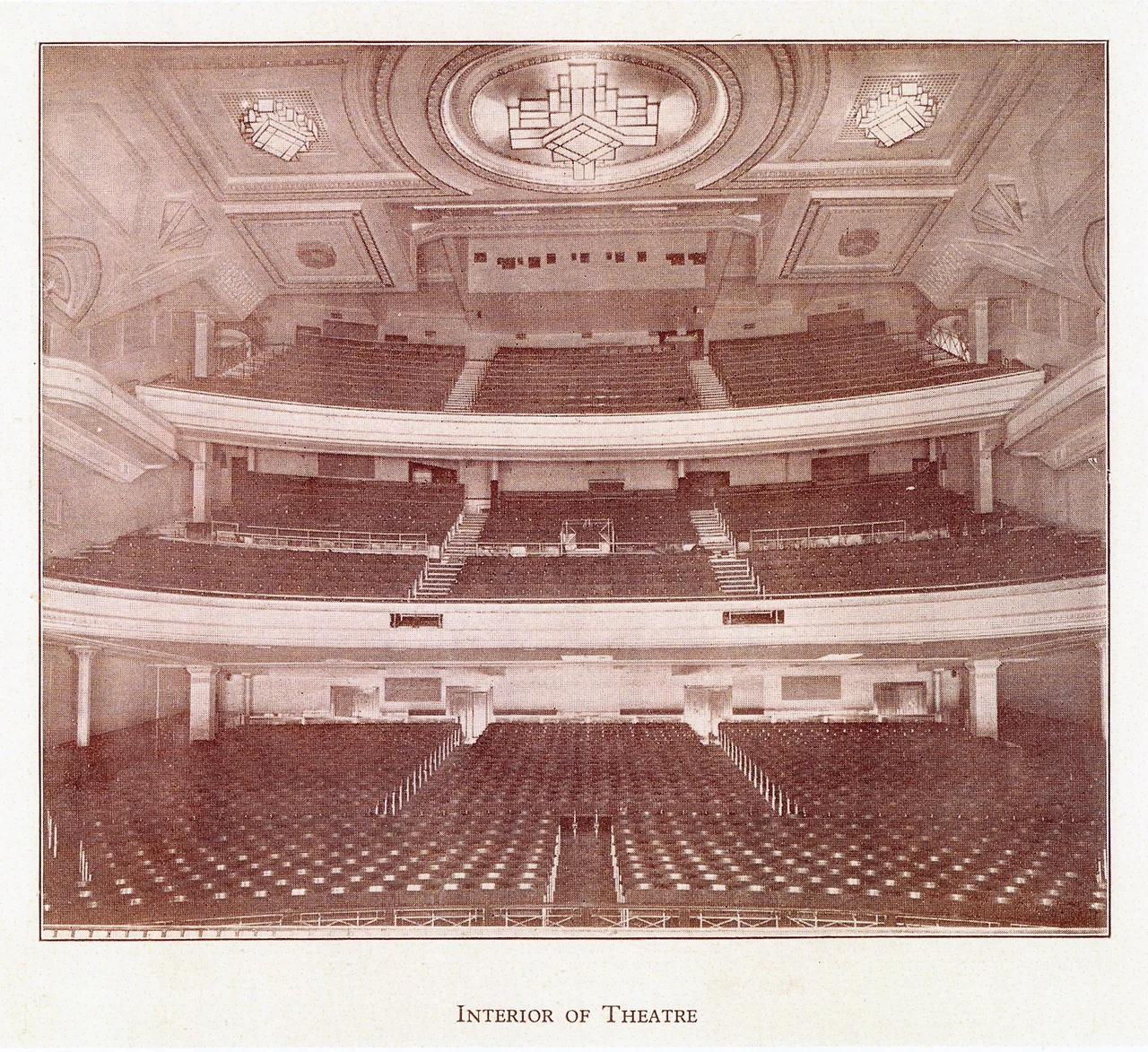

Glasgow Empire Theatre
Ken Dodd, the great Liverpool comedian, had a stock answer for anyone who wanted to apply Freudian theory to humour. 'The trouble with Sigmund Freud,' he would say, 'is that he never played second house at the Glasgow Empire after both halves of the Old Firm had just lost.' It was a joke, but it was also a memorial. By the time Dodd told it, the Empire on Sauchiehall Street had already closed. The theatre had been famous for half a century as the most difficult room in British variety. English comedians who could not connect with a Glasgow Saturday-night crowd, after their team had been beaten, were said to die there. The Empire was where the gravestones got carved.
Frank Matcham's Stage
The Empire opened in 1897 on the site of the older Gaiety Theatre at 31 to 35 Sauchiehall Street. It was known as the Glasgow Palace Empire until the early 1900s, then simply the Empire. The architect was Frank Matcham, the most prolific and accomplished theatre designer of late Victorian Britain, whose work shaped variety theatres in cities across the United Kingdom. The Moss Empires chain owned it, run by Sir Edward Moss, who had served his apprenticeship as a young man in Greenock down the Clyde. Vesta Tilley, the great male-impersonator and music-hall star, topped the opening bill. By 1931 the building had been expanded westwards toward Renfield Street and given a major Art Deco redesign by the Sunderland architects W & TR Milburn, reopening with 2,100 seats and Jack Payne and the BBC Dance Band on the bill.
Everyone Played There
Across six decades the Empire booked nearly everyone of note in entertainment. The Russian ballerina Pavlova danced there. The Andrews Sisters and Billy Eckstine crossed the Atlantic to play it. Fats Waller made his European debut at the Empire in 1938, sitting at the piano under a Glasgow spotlight. Frank Sinatra played. So did Judy Garland, Bob Hope, Eartha Kitt, Howard Keel, Liberace, Mel Tormé, and a young Tony Bennett. Ella Fitzgerald spent a full week at the theatre in September 1948. Among the British stars the bills carried Lillie Langtry, Laurel and Hardy, Sir Harry Lauder, and the Welsh singer Shirley Bassey, who made her Empire debut in 1959. The local press recorded that Bassey was given a hard time at first; she stopped the show, asked the audience to give her a chance, and finished her set to warm applause. By the end of the night she had won them over. Not everyone managed it.
The English Comic's Grave
The reputation came from real evenings in front of real audiences, and it is worth saying plainly: working that crowd was hard, and the performers who failed there were not failures in any other sense. They were professionals having a bad night in front of a sceptical room. Among those judged to have died on the Empire's stage were Bob Monkhouse, Tommy Cooper, Bernie Winters, and even Morecambe and Wise, who became one of the greatest double acts in British television. Des O'Connor, when the audience began to jeer, pretended to faint and was dragged off, escaping the room with his dignity and his career intact. Roy Castle, whose stage skills extended to playing several instruments and tap dancing, survived because the audience could not deny his versatility. Glaswegians of the era did not heckle out of cruelty. They simply knew good entertainment when they saw it, and would not pretend otherwise when they did not.
Final Curtain
The longest run in the Empire's history belonged to The Andy Stewart Show, which played twice nightly with a fresh programme every six weeks, for 26 weeks straight in 1961 and again in 1962. Each year the show sold 400,000 tickets. It was the kind of variety juggernaut that television was already in the process of killing. The final curtain came down on 31 March 1963. The closing-night cast brought together the Red Army Choir, Duncan Macrae, Robert Wilson, Iain Cuthbertson, Albert Finney, Rikki Fulton, and Andy Stewart himself: a bill that ranged from Soviet baritones to Glasgow's own Hogmanay favourite. The building came down soon after. Empire House, an office and retail block at the corner of West Nile Street and Sauchiehall Street, now occupies the site. Walk past it today and you would not know what had been there. But every Scottish comedian who ever played a difficult room knows exactly what Ken Dodd was talking about.
From the Air
The site of the former Glasgow Empire Theatre is located at 55.864 N, 4.254 W on Sauchiehall Street in central Glasgow. The theatre itself was demolished in 1963; Empire House, an office and retail block, now stands on the site. From altitude this part of Sauchiehall Street reads as a dense band of commercial buildings running east to west through the city centre, with Glasgow Cathedral about a kilometre east and the green dome of GoMA's cupola visible a few blocks to the south-east. Glasgow Airport (EGPF) is 8 nautical miles west; the city centre lies under the approach to runway 23.
Nearby Stories
- Mauchline 3.6 km away
- Shotts 4.2 km away
- HMS Ulysses (1917) 7.7 km away
- Rothesay Castle 8.8 km away
- Inchcailloch 10 km away
- Strachur 14 km away
- Battle of Dollar 16 km away
- Crawford Castle 16 km away