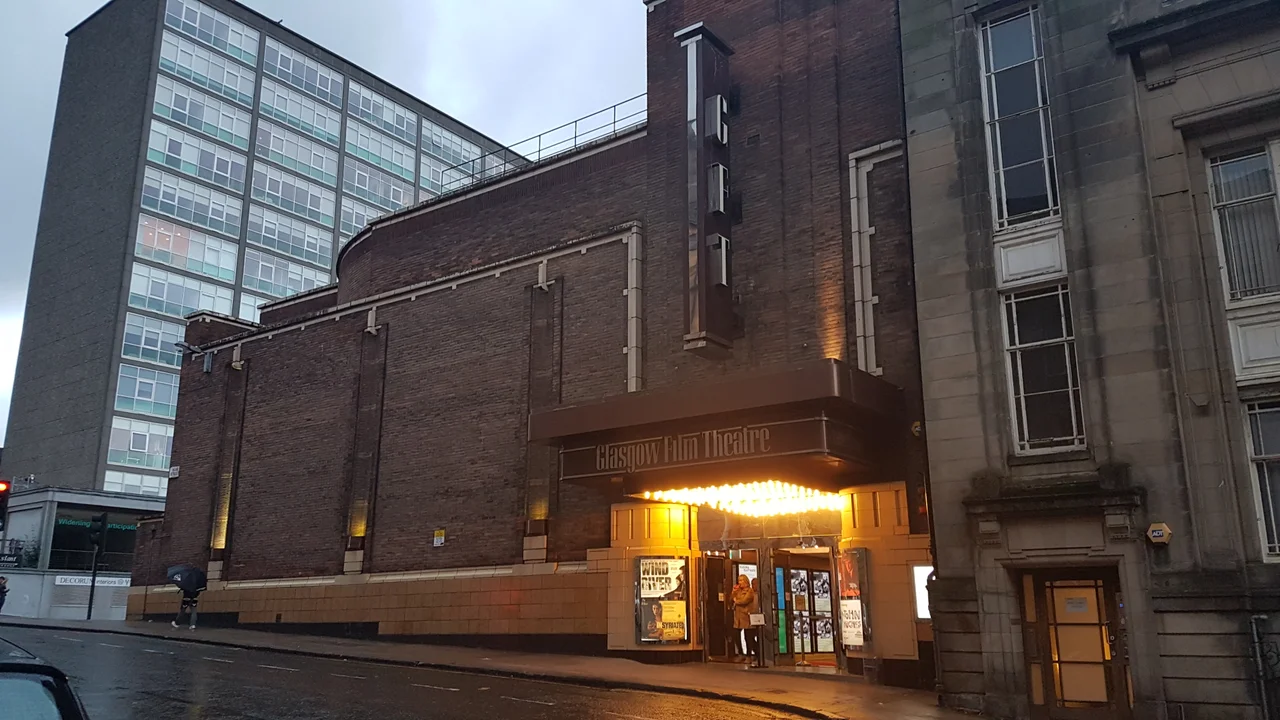

Glasgow Film Theatre
In 1939, Glaswegians went to the pictures 51 times a year. The rest of Scotland managed 35 visits. England averaged 21. Glasgow had 114 cinemas with over 175,000 seats between them, and on the night of 18 May that year a new one opened on Rose Street: a windowless geometric block clad in Ayrshire brick and Swedish granite, with a globe over the stalls entrance and a single auditorium for 850 people. The opening screening was Julien Duvivier's French drama Un Carnet de Bal. The Cosmo was Scotland's first arts cinema, only the second purpose-built arthouse in Britain after the Curzon Mayfair in London, and the last cinema built in Glasgow before the war shut the country down.
The Singleton Vision
The Cosmo was the project of George Singleton, a cinema owner who already ran a chain of elegant Art Deco picture houses across the west of Scotland designed for him by the architect James McKissack. Singleton was not just a businessman. He would go on to co-found the Citizens Theatre with the playwright James Bridie and the gallery director Tom Honeyman, and he had a clear conviction that Glasgow could and should sustain a serious appetite for world cinema. The Film Society of Glasgow, founded in 1929 as the first cultural film group in Scotland, had already shown that the audience was there. With the arrival of sound film in the early 1930s, language had become a barrier; continental cinema had quietly disappeared from mainstream British screens. Singleton wanted to bring it back. The name Cosmo, short for cosmopolitan, was chosen because it fit on a sign. It also made a quiet promise.
A Building of Globes and Granite
Singleton hired McKissack and his partner WJ Anderson II to design the cinema. They drew inspiration from the Dutch modernist Willem Marinus Dudok, and gave the Cosmo a clean geometric façade that turned its back on the street. Ayrshire brick was finished with faience cornices and set on a base of black Swedish granite. Inside, a globe was installed above the stalls entrance, fixing the international theme in plaster. The opening night also introduced Mr Cosmo, a dapper bowler-hatted cartoon figure based on Singleton himself, drawn by Charles Oakley, the chair of the Film Society and of the Scottish Film Council. Mr Cosmo appeared on posters, on press adverts, and on screen before each main feature in a different pose, sometimes solemn, sometimes silly. Generations of Glaswegians grew up with him, and his image can still be glimpsed around the GFT building today.
Cosmopolitan Even in Wartime
Programming was deliberate from the start. Charles Oakley pre-read the international film catalogues to help Singleton pick the season. The summer of 1939 brought Jean Renoir's La Grande Illusion and Jacques Feyder's La Kermesse Heroique. War cut the supply of continental films, and the Cosmo fell back on English-language fare for the duration. The recovery was eager. In February 1946, the Cosmo became the first cinema in the United Kingdom to screen a French film made during the German Occupation. Cosmo audiences also saw wartime German features, including The Adventures of Baron Munchausen of 1943, which arrived in startling Agfacolour. Other long runs settled in: Laurence Olivier's Hamlet played for eleven straight weeks in 1948, Marcel Carné's Les Enfants du Paradis became a touchstone, and Disney's Fantasia turned into a perennial Cosmo Christmas. A members-only Cosmo Club opened in 1960 to show films that the Censor had refused to certify.
Becoming the GFT
By the early 1970s the Cosmo could no longer support itself in its original form. On 21 April 1973 the building was sold to the Scottish Film Council. It reopened the following year as the Glasgow Film Theatre, with the old auditorium divided in two: a 404-seat cinema in the former balcony, now Screen 1, and a conference and exhibition space in the stalls. Mr Cosmo bowed out at a gala screening of Fantasia, where he announced he would 'watch with pride and affection this new development of the old tradition.' Historic Scotland B-listed the building in 1988. The GFT has been Glasgow's home for world cinema ever since, screening over 600 different films each year, 60 per cent of them foreign-language. Since 2005 it has hosted the Glasgow Film Festival every February. The guest list across the years has included Sean Connery, Martin Scorsese, Tilda Swinton, Ken Loach, Quentin Tarantino, David Lynch, Max von Sydow, and the Italian director Giuseppe Tornatore. The cinema that opened weeks before a world war ended has outlived nearly every other picture house in Glasgow. And it still leads with the same idea Singleton started with: that this city has an appetite for the wider world, and is worth feeding.
From the Air
Located at 55.866 N, 4.261 W on Rose Street in Glasgow city centre, just north of Sauchiehall Street. From altitude the GFT sits within the dense central grid of Glasgow, with the Mitchell Library and Charing Cross to the west and George Square a few blocks east. Glasgow Airport (EGPF) is 7 nautical miles west; approach paths into EGPF runway 23 cross the western edge of the city centre. The cinema's modest profile makes it hard to pick out individually from above; better identified by reference to the broader Sauchiehall Street corridor running east to west.
Nearby Stories
- Mauchline 3.6 km away
- Shotts 4.2 km away
- HMS Ulysses (1917) 7.7 km away
- Rothesay Castle 8.8 km away
- Inchcailloch 10 km away
- Strachur 14 km away
- Battle of Dollar 16 km away
- Crawford Castle 16 km away