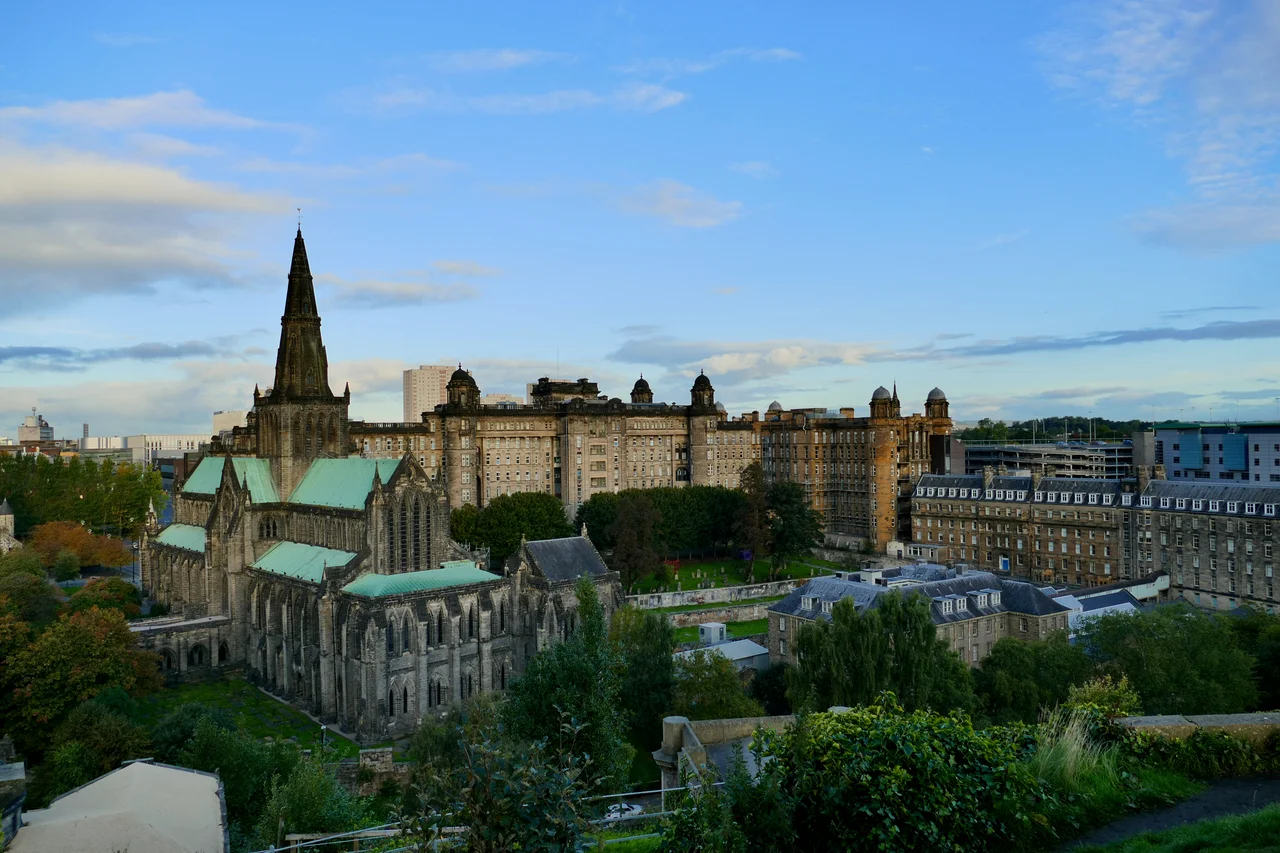

Glasgow Necropolis
'Glasgow's a bit like Nashville, Tennessee,' the comedian Billy Connolly once said. 'It doesn't care much for the living, but it really looks after the dead.' He was joking about the Glasgow Necropolis. The joke lands because the cemetery is enormous, and immaculate, and built on a hill behind Glasgow Cathedral that has been sacred ground since long before the Victorians arrived to formalise it. Fifty thousand people are buried here. Only about 3,500 of them have monuments. The rest lie under the grass, anonymous, the way the working poor have always lain in cities. The Glaswegian writer James Stevens Curl called it 'literally a city of the dead'. From the foot of the John Knox column at the summit, you can see why.
Borrowed From Paris
The Necropolis was Glasgow's answer to Père Lachaise. The Parisian cemetery, opened in 1804, had set a new template for urban burial: a landscaped garden of monuments, run for profit, open to all faiths and to the public as a place of contemplation. British cities took notice, but British law stood in the way. Burying the dead was the parish church's responsibility, and the church could not run a cemetery for profit. Glasgow's growing population, with fewer and fewer attending kirk, made the old system unworkable. Led by Lord Provost James Ewing of Strathleven, the Merchants' House of Glasgow began planning the new cemetery in 1831, ahead of any legal change. The Cemeteries Act passed in 1832, and the Glasgow Necropolis opened formally in April 1833. The first burials had already taken place the previous September, in a small Jewish ground set aside in the north-west corner of the site.
Bridge of Sighs
The main approach to the Necropolis crosses the Molendinar Burn on a stone bridge designed by David Hamilton and completed in 1836. Funeral processions used it to carry their dead from the cathedral side over to the cemetery, and the bridge soon picked up the nickname Bridge of Sighs, after the famous Venetian bridge that connected the Doge's Palace to the prisons. The ornate gates at the cemetery end, designed by both David and James Hamilton, were added in 1838. Walk in through them today and you pass three modern memorials between the gates and the bridge: one to stillborn children, one to the dead of the Korean War, and one to Glaswegian recipients of the Victoria Cross. The original plan beyond was to bring visitors into the grounds through a tunnel. The tunnel proved unworkable. The 1836 entrance has been the way in ever since.
Climbing to John Knox
At the top of the hill, predating the cemetery itself, stands a column from 1825 carrying a statue of John Knox, the firebrand of the Scottish Reformation. The Victorian cemetery was laid out around him, in the loose informal landscape style of early garden cemeteries rather than the rigid grids that came later. Paths curve uphill. Monuments cluster at the summit, clustered most densely around the Knox column. Alexander Thomson, one of Glasgow's great Victorian architects, designed several of the tombs. So did John Bryce and David Hamilton. The result is an open-air gallery of Victorian funerary sculpture, ranging from Greek temples to weeping angels to one famously coloured grave designed to look like a Templeton carpet, in honour of the carpet-making family buried beneath it. Lord Kelvin lies here. So do shipbuilders John Elder and Charles Connell, the brewer Hugh Tennent of Wellpark whose grave faces the brewery, the surgeon Thomas Kennedy Dalziel who first described Crohn's disease, and ten Lord Provosts of Glasgow.
The People in the Earth
The famous names are a small fraction of the story. Most of the fifty thousand buried at the Necropolis have no monument and no inscription. Three modest headstones mark the graves of sixteen nurses and domestic staff of the Glasgow Royal Infirmary, women from Aberdeenshire, the Hebrides, and Ireland whose families lived too far away to arrange burials of their own; the hospital paid for the plots and the stones. The oldest of the three headstones lists women who died between 1872 and 1887, five of them in their twenties. The Jewish ground that was the first part of the cemetery to be used holds 57 burials, the result of a time when Jewish Glaswegians could not be interred in Christian ground. The original Jewish ground filled by 1851; later burials moved to the Eastern Necropolis. The site was restored in 2015. Nineteen Commonwealth war graves lie here too, fifteen from the First World War and four from the Second, maintained by the Commonwealth War Graves Commission. The highest-ranking is Lieutenant-General Sir James Moncrieff Grierson, who died in France in August 1914 and whose body was repatriated.
Still a Working Place
The Friends of Glasgow Necropolis, founded in 2005, has 140 volunteer members and has raised over £100,000 toward conservation. The organisation runs private tours and quietly looks after monuments that would otherwise weather away. The cemetery is also still part of an active civic conversation. In 2025, Glasgow City Council proposed a new pedestrian entrance from Firpark Street as part of a Learning Quarter regeneration plan, intended to improve access for residents of Dennistoun and the East End. Local councillors and community groups including Dennistoun Community Council supported the proposal. Friends of Glasgow Necropolis publicly opposed it, citing concerns about heritage and antisocial behaviour. The debate, in its careful Glaswegian way, was about who the dead belong to and how the city looks after them. Billy Connolly's joke holds. The Necropolis is taken very seriously here.
From the Air
Located at 55.863 N, 4.231 W on a low but very prominent hill east of Glasgow Cathedral. From altitude the Necropolis reads as a distinctive green dome rising out of the city's east side, with the cathedral immediately to the west and the dense East End neighbourhoods of Townhead and Dennistoun beyond. The John Knox monument at the summit is the highest point on the hill and can be picked out as a silhouette in clear light. Glasgow Airport (EGPF) lies 9 nautical miles west; the Necropolis is roughly a kilometre east of George Square. A low overflight at 1,500 to 2,500 feet on a clear day shows the cemetery's relationship to the cathedral precinct and the M8 motorway running just to the north.
Nearby Stories
- Mauchline 3.6 km away
- Shotts 4.2 km away
- HMS Ulysses (1917) 7.7 km away
- Rothesay Castle 8.8 km away
- Inchcailloch 10 km away
- Strachur 14 km away
- Battle of Dollar 16 km away
- Crawford Castle 16 km away