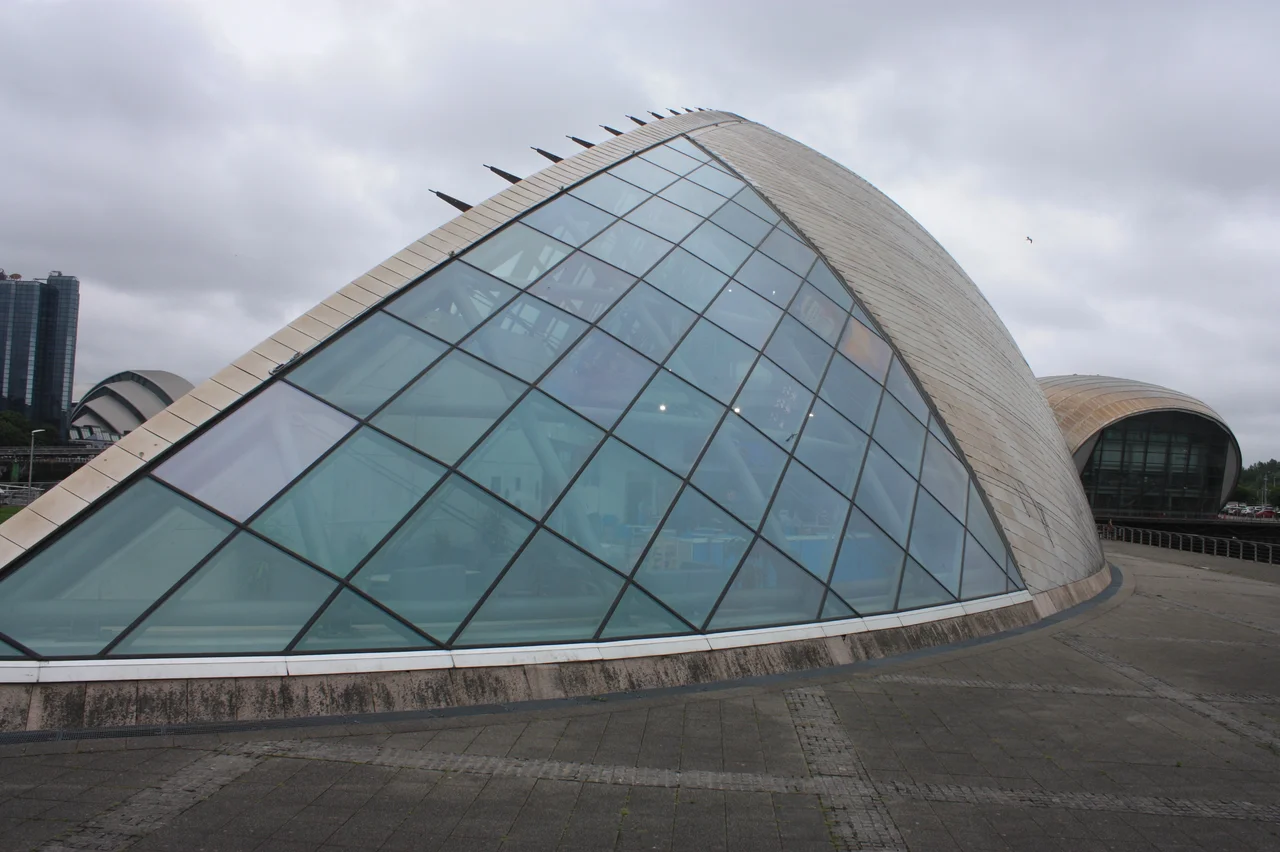

Glasgow Science Centre
There is a building in Glasgow that briefly melted. In the summer of 2018, on what was at the time the hottest June day ever recorded in the city, the bituminous waterproof membrane under the titanium shingles of the Glasgow Science Centre's Science Mall warmed up, slipped, and started oozing out between the metal panels. The story made the BBC. The roof was eventually replaced with stainless steel, with the work completed in 2023. Everyone in the city had a quiet laugh and a quiet thought: Glasgow had built itself a building that could not handle Glasgow weather, but only on a day when Glasgow weather stopped being Glasgow weather. The Science Centre, that strange titanium dolphin lying on the south bank of the Clyde, has been like that since the day it opened: ambitious, faintly absurd, and beloved.
From Garden Festival to Pacific Quay
The land the Science Centre sits on was once Prince's Dock, a working cargo basin on the south side of the river. By the 1980s the docks were closed and the site was derelict. Glasgow used it in 1988 for the National Garden Festival, the fourth and most successful of the Thatcher-era festivals that tried to regenerate industrial sites through landscape design and visitor attractions. The festival lasted a single summer. The 100-acre site was meant to be sold for housing, but a 1987 housing slump made the developers walk away, and most of the land stayed derelict for over a decade. Pacific Quay grew up around it in stages. Headquarters for BBC Scotland and Scottish Television opened in 2006 and 2007 just along the river. The Science Centre itself, designed by Building Design Partnership, was the project that got Pacific Quay moving. Queen Elizabeth II officially opened it on 5 July 2001.
Three Buildings, Three Metals
The Centre is not a single building but three. The Science Mall is the main exhibition space, with floors of interactive displays and a planetarium projecting onto a fifteen-metre dome. The IMAX cinema next door was the first IMAX built in Scotland, with a single auditorium seating 370 in front of a rectangular screen and the capability to show both 2D and 3D films. The Glasgow Tower, designed separately by the architect Richard Horden with engineering by Buro Happold, was conceived as the tallest freely rotating tower in the world. Each building is clad in a different metal. Titanium covers the IMAX. Stainless steel sheaths the Science Mall after its 2023 reroofing. Aluminium wraps the Tower. The Centre opened only four years after the Guggenheim Museum in Bilbao, and was the first building in Britain to be clad in titanium panels — a deliberate echo of the moment that Frank Gehry's museum, the first in Europe to use the material, kicked off a global appetite for shiny architectural metal. The whole complex cost around £75 million to build, with £37 million coming from the Millennium Commission, and £10 million spent on the Tower alone.
The Difficult Tower
The Glasgow Tower was the most ambitious idea in the project, and the one that gave the Centre its longest stretch of bad press. It missed its 2001 opening date entirely. It was repeatedly closed for repairs after opening late. From August 2010 until July 2014, it was shut entirely. The full-rotation bearing at its base, which let the entire tower turn into the wind, was the source of most of the difficulty. The Glasgow Tower is a building that wants to do something that no building should reasonably want to do, and the engineering of letting a 127-metre tower swivel on a single axis has been, in the most British sense, a learning experience. The Tower stands on roughly the same spot as the Clydesdale Bank Tower of the 1988 Garden Festival, which was dismantled and rebuilt in Rhyl in north Wales. Glasgow's tower has stayed in Glasgow, which is itself an achievement.
Floors of Wonder
Inside the Science Mall, the floors stack up like chapters. The ground floor holds the ticket desks, café, gift shop, and access to the IMAX and the Tower. Floor 2 is given over to a 'Powering the Future' exhibition about energy and sustainability, alongside the Idea No 59 space about innovation and The Lab for educational workshops. Floor 3, refurbished in 2012 and reopened in March 2013, is BodyWorks: 115 interactive exhibits, research capsules, and live laboratory experiences about human health. There is an area specifically for very young children called The Big Explorer. The Centre also manages the visitor centre at the Whitelee Wind Farm, which opened to the public in 2009. VisitScotland rates it five stars in its visitor attraction category. The CBeebies television presenter Katrina Bryan plays Nina, a neuroscientist who works at the Science Centre in the children's show Nina and the Neurons; in reality, the Centre is not her employer, though it has been very good to her. The Science Centre remains one of Scotland's most popular paid-for attractions, and the silvery building lying along the Clyde has become one of the city's defining riverside profiles.
From the Air
Located at 55.859 N, 4.294 W on the south bank of the River Clyde at Pacific Quay. From altitude the Science Centre is one of the most distinctive structures on the Glasgow waterfront: a long shining hull of metal cladding alongside the slim aluminium spike of the Glasgow Tower and the squarer IMAX cinema next to it. BBC Scotland's pacific quay headquarters and STV's studios sit immediately to the west; the Finnieston Crane and the SEC Armadillo arena are visible across the river to the north. Glasgow Airport (EGPF) is 6 nautical miles to the west. Approach paths into runway 23 pass north of Pacific Quay. A low overflight at 1,500 to 3,000 feet gives an excellent view of the whole Clyde Waterfront Regeneration corridor.
Nearby Stories
- Mauchline 3.6 km away
- Shotts 4.2 km away
- HMS Ulysses (1917) 7.7 km away
- Rothesay Castle 8.8 km away
- Inchcailloch 10 km away
- Strachur 14 km away
- Battle of Dollar 16 km away
- Crawford Castle 16 km away