.jpg)
Glasgow Subway
Late on the evening of 14 December 1896, the first day of the Glasgow District Subway's commercial life, one of its cable-hauled carriages was rammed by another under the River Clyde. The car had been carrying 60 passengers. Four people were injured, one seriously enough to be sent to the infirmary. The Subway closed the next day and stayed closed until 19 January 1897. It was an inauspicious beginning for a piece of engineering that would, against the odds, still be running 130 years later, on the same circular loop, in the same impossibly narrow tunnels, doing the same job for the same city. It is the third-oldest underground metro in the world, after London's Metropolitan Railway of 1863 and the Budapest Metro that opened earlier in the same year.
Built for One Loop
The Glasgow District Subway Company was incorporated by Act of Parliament in 1890 and began tunnelling in 1891. The line opened on 14 December 1896 as the world's first urban transit system to be called a 'Subway'. It was a circular loop almost ten and a half kilometres long, crossing the Clyde twice, with fifteen stations and a tunnel diameter of just 11 feet. The gauge of the tracks was a peculiar 4 feet, narrower than the British standard and unique among working metros. The whole thing was driven by a cable system: a continuous steel cable, one for each direction, dragged by a steam plant between Govan and Scotland Street, with each carriage gripping or releasing the moving rope to start and stop. There were no points anywhere on the system. Trains were lifted onto and off the running lines by crane at the Govan workshops. The original 20 wooden-bodied carriages, built by the Oldbury Railway Carriage and Wagon Company in Worcestershire, lasted, with upgrades, until 1977.
Cable to Current
Glasgow Corporation bought the Subway from its private operator in 1923 for £385,000. By the mid-1930s the cable system was old, slow, and tired, and Corporation engineers converted the trains to electric traction. A third rail was installed at 600 volts direct current. The last cable-drawn car ran on 30 November 1935, driven by a man named Robert Boyd. The trains lost their plum and cream liveries and gained red and white, then later all-red livery somewhere close to the colour of a London bus. They kept running. During the Second World War, according to the historian Keith Anderson, the Subway saw an unprecedented level of use, much of it from the swelling shipyard workforce. On 18 September 1940 a German bomb, dropped during a night raid and possibly intended for nearby naval facilities, landed on a bowling green next to Merkland Street station. The blast damaged both tunnels. Repairs took until January 1941. No other wartime damage was recorded.
Modernisation and the Orange Years
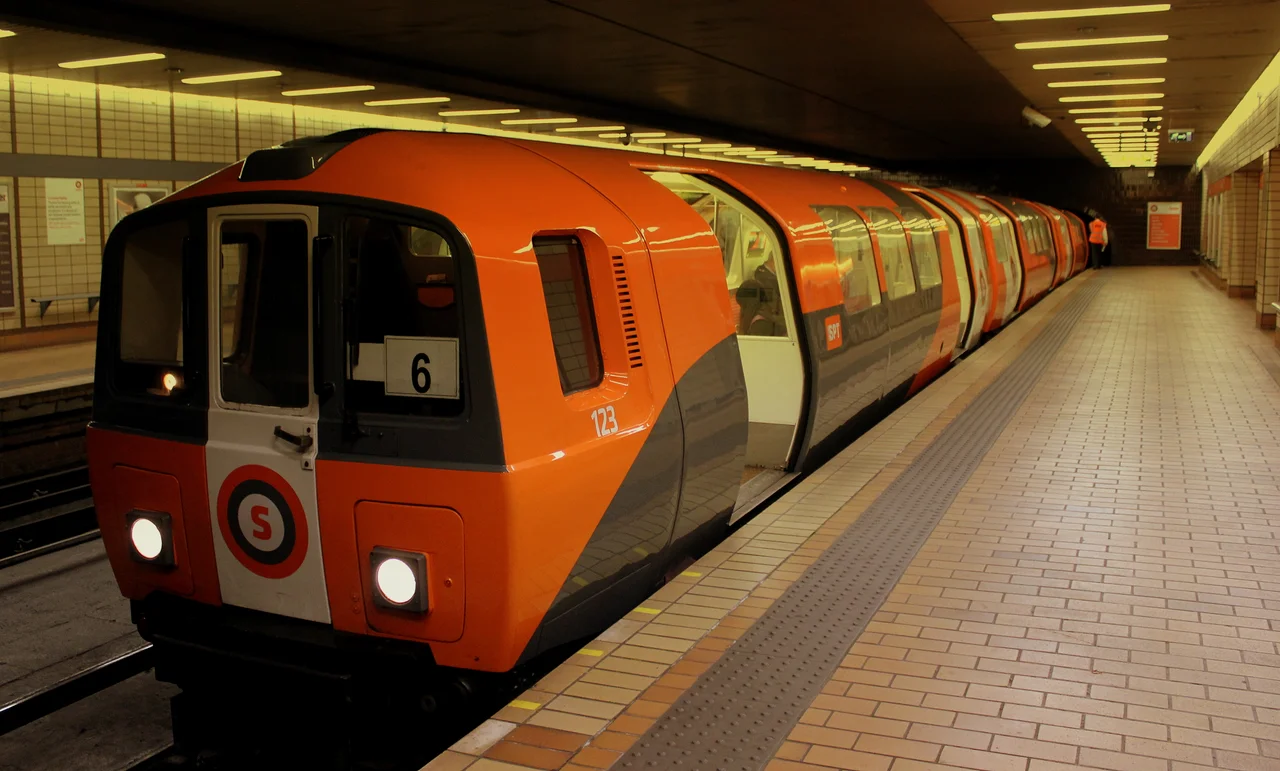
By the early 1970s the Subway was tired. Stations had been built into the ground floors of tenements that the slum clearances were demolishing; the original 1896 carriages were still in service, electric-converted but increasingly fragile; breakdowns were frequent. The Greater Glasgow Passenger Transport Executive took the line over and announced a full modernisation in January 1974. The system closed on 21 May 1977 — eight days earlier than planned, after cracks appeared in the Govan Cross station roof. The shutdown ran for three years. Stations were rebuilt and enlarged. The 1896 stock was retired. Merkland Street station was closed and replaced by a new Partick interchange with the suburban rail network. New trains by Metro-Cammell entered service in 1980, painted bright orange with white stripes in step with the corporate identity of the time. Glasgow School of Art helped with the exterior styling. The press christened the new look 'The Clockwork Orange', a phrase popularised, according to one account, when British Rail's chairman Sir Peter Parker called the new trains 'the original Clockwork Orange' in a publicity video. The nickname stuck in tourist guidebooks; locals continued to call it 'the Subway' or 'the Underground' and largely still do.
Driverless and Still Going
The trains painted bright orange were not technically called orange. Strathclyde's transport agency referred to the colour as 'Strathclyde PTE red' because the word 'orange' carried sectarian connotations in Glasgow and the agency wanted no part of any side. Such are the considerations of running public transport in a divided city. The Subway carries on. Strathclyde Partnership for Transport, which owns and operates it today, recorded 12.7 million passenger journeys in 2019–20. The British Transport Police have policed the system since 2007. A £290 million upgrade was approved in 2010 and signed off by the Scottish Government in 2011. New driverless trains, built by Stadler Rail at their factory in Altenrhein in eastern Switzerland and signalled by Ansaldo STS, were ordered in 2016. The first arrived in 2019. The first passenger service with the third-generation trains ran on 11 December 2023. The last second-generation Metro-Cammell carriages were withdrawn from service on 28 June 2024. The Subway remains the only metro system in the world that has never been extended beyond its original route. Plans have come and gone since 1937. The Clyde Metro proposals published by Transport Scotland in 2022 retain the Subway as a core part of the city's future transit network. It will keep its narrow gauge. It will keep its loop. It will keep going.
From the Air
The Glasgow Subway is an underground loop under the city centre and west end. Coordinates 55.862 N, 4.283 W mark roughly the central point of the loop near the city's west end. The loop crosses the River Clyde twice and is entirely underground except for the Broomloan Road depot between Govan and Ibrox stations on the south side, which is the only above-ground rolling-stock facility on the network. From altitude the Subway itself is invisible, but its surface markers — the modernised station entrances at St Enoch, Buchanan Street, Hillhead, Partick, Govan and Ibrox — sit at known points around the city centre and west end. Glasgow Airport (EGPF) lies 8 nautical miles west; approaches to runway 23 cross the line of the Subway's western leg. The Stadler factory that built the new third-generation trains is at Altenrhein on Lake Constance, Switzerland, near LSZR.
Nearby Stories
- Mauchline 3.6 km away
- Shotts 4.2 km away
- HMS Ulysses (1917) 7.7 km away
- Rothesay Castle 8.8 km away
- Inchcailloch 10 km away
- Strachur 14 km away
- Battle of Dollar 16 km away
- Crawford Castle 16 km away