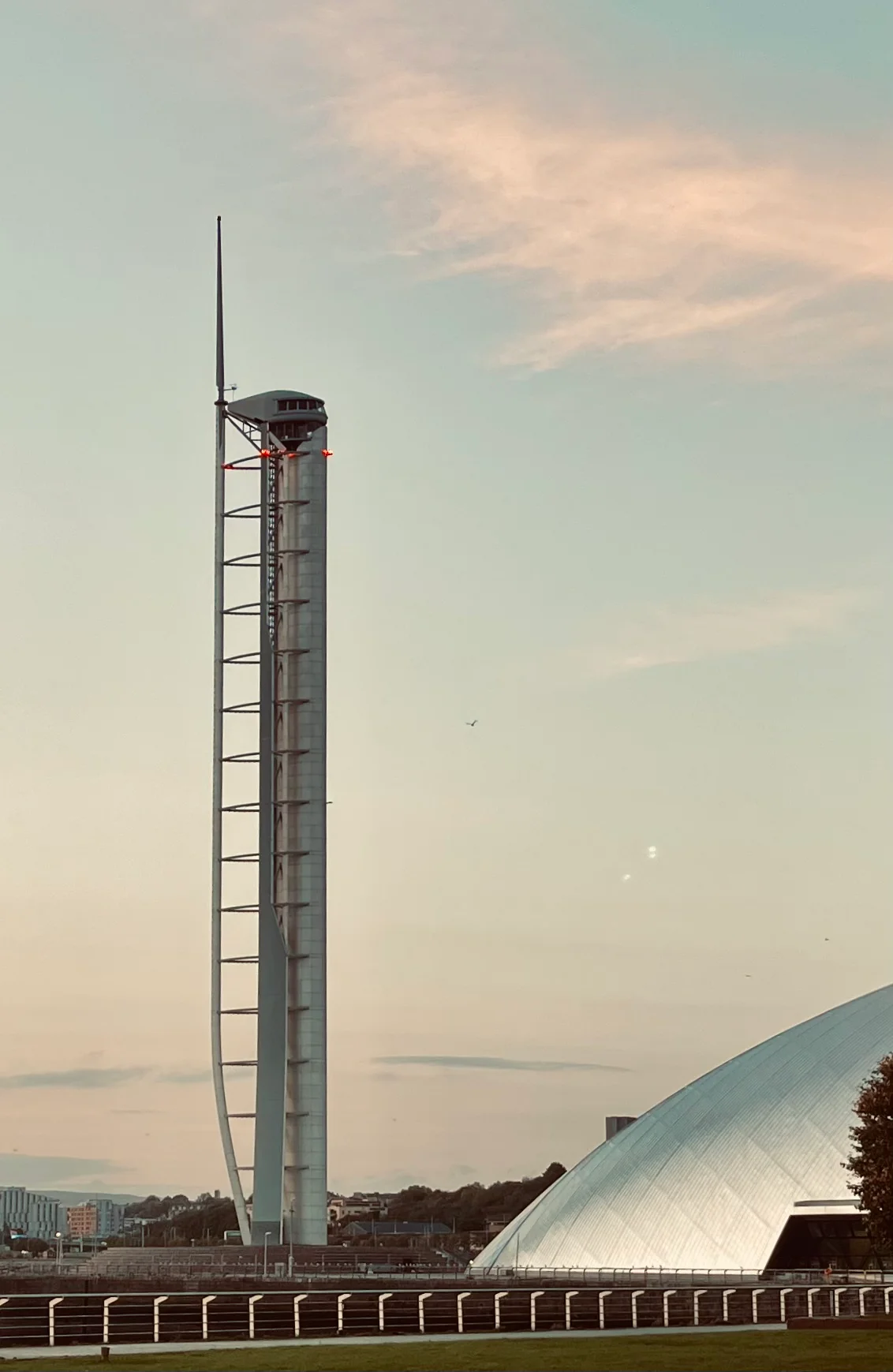

Glasgow Tower
Picture a 127-metre tower shaped like an aircraft wing standing on end, supported not by direct connection to its concrete foundation but by 24 rubber-sprung roller bearings that let the entire structure pivot 360 degrees into the wind. That is Glasgow Tower, and it holds a Guinness World Record as the tallest fully rotating freestanding structure on Earth. It is also, by some measures, Scotland's most spectacular engineering misadventure - a £10 million landmark whose mechanical complexity has kept it closed more often than open since it first refused to launch on schedule in 2001.
A Wing Set on End
The tower's aerofoil profile is no architectural conceit. Architect Richard Horden and engineers at Buro Happold designed Glasgow Tower as if a symmetrical aircraft wing had been planted vertically into the south bank of the Clyde. Four manually operated six-kilowatt motors turn the entire 127-metre structure to face the prevailing wind. The split airflow then applies equal force to both flanks, holding the building rigid against the gusts that funnel along the river valley. The whole tower rests on a single bearing - originally a Nigerian-made 65-centimetre thrust bearing, later replaced with a phosphor-manganese-bronze alloy ball and cup - sitting at the bottom of a 15-metre caisson. Above that, the ring of 24 rubber-sprung roller bearings at podium level allows the rotation. Two Alimak Hek lifts climb the spine in two and a half minutes using a rack-and-pinion system, with a 523-step emergency staircase as backup.
The Tallest Almost-Building
Glasgow Tower has held the title of Scotland's tallest tower since it was completed in 2001, and since late 2015, when the Red Road Flats and the Bluevale and Whitevale Towers came down, it has been the tallest structure in Glasgow full stop. Yet the Council on Tall Buildings and Urban Habitat refuses to classify it as a building at all. The observation deck sits at 100 metres, but the floors do not continue down through the structure to the ground. So the tower's website hedges with the phrase "tallest freestanding building in Scotland," and the international arbiters quietly disagree. The site itself has a tower-shaped history. In 1988, the Clydesdale Bank Tower stood here for the Glasgow Garden Festival, a temporary structure with a rotating gondola climbing a central spine. After the festival closed, it was dismantled, shipped to Rhyl in Wales, and re-erected as the Rhyl Sky Tower, where it operated until 2010.
Plagued by Engineering
The trouble began before opening. The tower missed its planned 2001 debut, then on 30 January 2005, ten people were trapped in the lifts and the rescue took over five hours. Glasgow City Council eventually sued contractors Carillion over the quality of the work and won. The tower reopened in December 2006, only to close again in August 2010 because of what the operators delicately called "technical issues stemming from its original design." It reopened in July 2014 with new safety features, an updated interior, and a strict wind-speed cutoff of around 11.2 metres per second above which the lifts will not run. Three days after that reopening, a capacitor bank at the base produced smoke that was misidentified as a fire. The tower closed once more in 2020 for the pandemic, reopened on 26 May 2023 after refurbishments, and shut yet again in 2025 and remained closed through 2026, with updates on reopening expected in spring 2027.
Why People Still Climb It
Despite everything, 65,000 people have made it to the observation deck during the tower's intermittent operating windows. The view rewards the patient and the lucky: on a clear day you can see the Campsie Fells to the north, the Renfrewshire hills rolling south, the great arc of the Clyde unwinding past Govan's shipyards, and the SEC Armadillo crouching on the opposite bank like a metal beetle. The tower's silhouette - thin, elegant, weirdly nautical - has become as much a part of Glasgow's skyline as the cathedral spire to the east. People in this city are willing to forgive a great deal in something that tries to be the only one of its kind in the world.
From the Air
Glasgow Tower sits at 55.8585 N, 4.29325 W on the south bank of the River Clyde at Pacific Quay, part of the Glasgow Science Centre complex. At 127 metres, it is the tallest structure in Glasgow and Scotland and stands directly across the river from the SEC Armadillo. Nearest airports are Glasgow International (EGPF) about 7 nautical miles west and Glasgow Prestwick (EGPK) about 28 nautical miles southwest. The Clyde corridor and the Armadillo's curved roof make the tower easy to identify from the air at altitudes of 2,000-5,000 feet.
Nearby Stories
- Mauchline 3.6 km away
- Shotts 4.2 km away
- HMS Ulysses (1917) 7.7 km away
- Rothesay Castle 8.8 km away
- Inchcailloch 10 km away
- Strachur 14 km away
- Battle of Dollar 16 km away
- Crawford Castle 16 km away