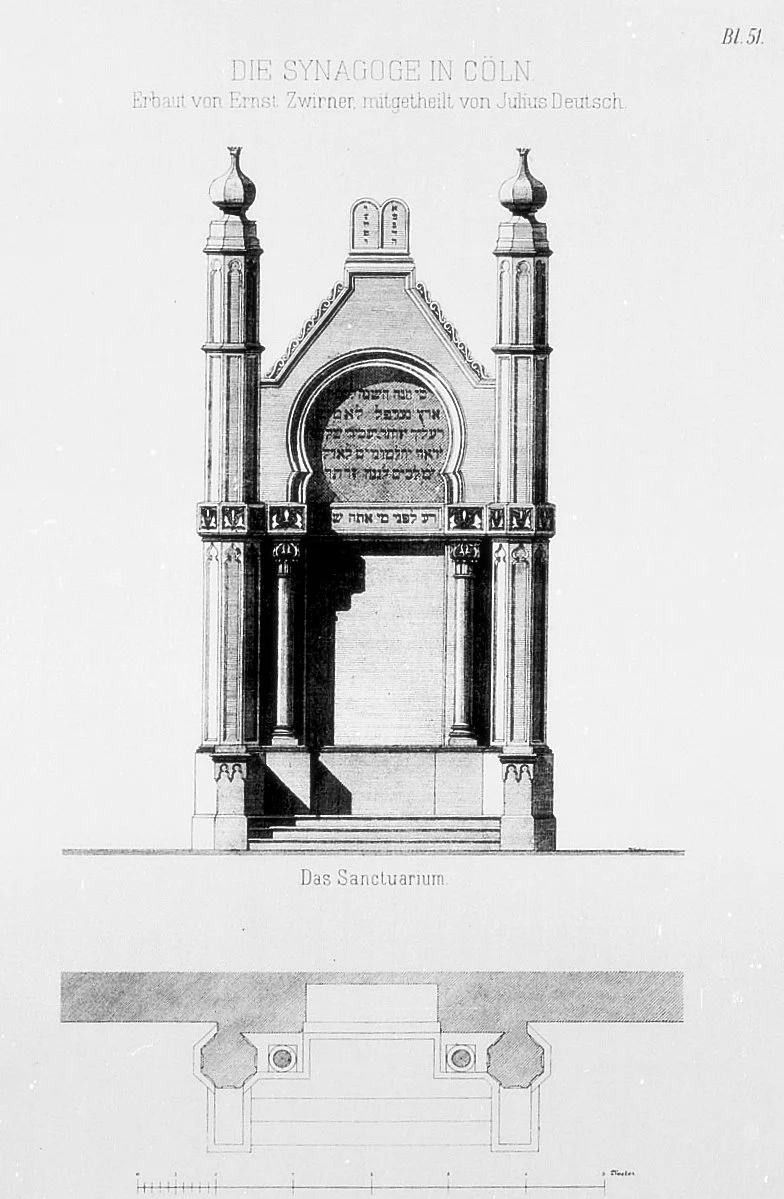

Glockengasse Synagogue
There is no synagogue at Glockengasse in Cologne any more. The site is occupied by the modernist Cologne Opera House on Offenbachplatz, and on the façade is a bronze plaque that tells passers-by what used to be there. In 1861, on the site of the former Monastery of St. Clarissa, the architect Ernst Friedrich Zwirner - the same man whose plans were then crowning the long-stalled Cologne Cathedral - completed a synagogue for the Jewish community of Cologne. It had a forty-metre dome, four minaret-shaped towers, a horseshoe-arched Torah ark in white Carrara marble, and stucco work modelled on the Alhambra in Granada. It stood for seventy-seven years. On the night of 9 November 1938, during the Nazi pogrom now known as Kristallnacht, it was destroyed.
A Gift from the Oppenheims
The community had been meeting in a small prayer hall on the same site since the years of the French occupation, but the building was declared unsafe and closed in 1853. In June 1856 the Jewish communal executive board debated whether to rebuild on Glockengasse or move elsewhere. Abraham Oppenheim, son of the great Cologne banker Salomon Oppenheim Jr., resolved the question by offering to pay for a new synagogue out of his own pocket. The Oppenheim banking family had risen from modest beginnings under Napoleon to become one of the most prominent Jewish families in the Rhineland, and Abraham's gift was a statement: the community of Cologne was here, and intended to stay. The cornerstone went down on 23 June 1857. Four years later, on 29 August 1861, a procession wound from the provisional synagogue on St. Apernstrasse through Breitestrasse and Kolumbastrasse to the finished building, where Rabbi Israel Schwarz dedicated it.
Moorish Cologne
Zwirner had designed something extraordinary. The floor plan was a Greek cross under a central dome - the first synagogue in this form, recalling Byzantine churches but adapted to Jewish use, with the bimah placed under the dome in the centre of the room as Orthodox tradition required. Outside, four small minaret-shaped towers rose from the corners, each topped with a small cupola. Above the crossing soared a dome forty metres tall and ten metres across, with an onion-domed lantern at its peak. Inside, cast-iron columns held up two storeys of women's galleries on three of the four arms. Stucco by Josef Hartzheim and painting by Friedrich Petri of Gießen covered the walls in blue, red, and gold patterns adapted from the Alhambra. The Cologne sculptor Stephan carved the Aaron haKodesch - the Torah ark - in white Carrara marble, set with capitals from Alhambra and topped with minarets and onion cupolas. The dome was painted blue and covered in golden stars. Coloured glass in round and trefoil windows filtered the daylight.
The Night of November Ninth
On the evening of 9 November 1938 and into the early hours of the tenth, organised mobs across Germany and Austria attacked synagogues, Jewish-owned shops, homes, and schools. The pogrom was directed from Berlin, carried out by SA paramilitaries and ordinary citizens, and tolerated by police and fire services that stood by while buildings burned. In Cologne, the Glockengasse Synagogue was among those destroyed. So was the Roonstrasse Synagogue. So was nearly every place of Jewish worship in the city. The roughly 11,000 Jews of Cologne who would be deported in the years that followed were largely sent to Łódź, Theresienstadt, Minsk, Riga, and finally to the death camps in occupied Poland. Most were murdered. The Jewish community of Cologne, one of the oldest in Europe with roots in Roman Colonia Claudia, was effectively annihilated. The Glockengasse Synagogue was not just a building. It was the spiritual centre of a community that the Nazi state set out to destroy and largely succeeded in destroying.
What Remains
After the war the rubble was cleared, the site rebuilt, and in 1957 the modernist Cologne Opera House by Wilhelm Riphahn opened on Offenbachplatz, occupying part of the synagogue's footprint. A bronze plaque on the opera house façade marks what stood there. The synagogue has been reconstructed in virtual form by researchers; floor plans, sections, drawings, and photographs from the 1860s survive. The Jewish community of Cologne also survives - smaller, rebuilt by post-war returnees and later by immigration from the former Soviet Union, gathered now around the restored Roonstrasse Synagogue across the city. Glockengasse itself, the narrow street with the bell-foundry name, runs through the heart of Cologne's altstadt. Most passers-by do not notice the plaque. Those who do are reading a memorial to people who lived here, prayed here, and were taken away.
From the Air
The site of the former Glockengasse Synagogue - now occupied by the Cologne Opera House on Offenbachplatz - sits at 50.9382° N, 6.9528° E, in central Cologne about 600 metres south-southwest of the cathedral. From cruising altitude the cathedral is the navigation landmark; the opera house is two long blocks behind it inland from the Rhine. Cologne Bonn airport (EDDK / CGN) is 13 km southeast. Düsseldorf (EDDL / DUS) is 40 km north. Visitors to Cologne can find the bronze memorial plaque on the opera house exterior facing Offenbachplatz.
Nearby Stories
- Diamond Interchange: How a Simple Idea Reshapes Towns Like Julich 2.8 km away
- Dusseldorf-Unterbach 6.1 km away
- Baumwollspinnerei Ermen & Engels 11 km away
- RAF Bruggen 15 km away
- Hagen Open-air Museum 21 km away
- Belgium 130 km away
- Marcinelle Mining Disaster 173 km away
- Zwingenberg Castle 178 km away