.jpg)
Gode Wind Farm
On a clear day from the dunes of Norderney, you can sometimes glimpse them on the horizon — a line of pale shapes that look like geometry homework drawn on the sky. Gode 1, 2, and 3. Three wind farms, one cluster, 120 turbines, and a project that took so long to finish that the turbines at the end were nearly twice as powerful as the ones at the beginning. Building offshore in the German Bight rewards patience. The companies that started this cluster aren't even called by the same names they were when it began.
From PNE to Orsted to Anyone Watching
The Gode permits originally belonged to PNE Wind AG, a Cuxhaven developer that had spent years coaxing approvals out of Germany's Federal Agency for Marine Shipping and Hydrography. In August 2012, the projects were sold to DONG Energy — the Danish state utility that, in 2017, would publicly shed its oil-and-gas legacy and rebrand itself as Orsted, after the physicist who first demonstrated electromagnetism. By the time Gode Wind 1 and 2 were commissioned in June 2017, that rebranding had just happened. The wind farms became the public proof of what an Orsted was supposed to look like: a former petroleum company that had pivoted into the most aggressive offshore wind builder in the world.
A Two-Billion-Euro Bet on Wind
On 18 November 2013, Orsted's predecessor announced it would invest €2.2 billion to build Gode 1 and 2. The German regulatory environment made that calculable: the Stauchungsmodell support regime guaranteed a fixed electricity price for ten years, removing the market risk that has killed so many offshore projects elsewhere. Bladt Industries in Denmark supplied the foundations — monopile piles six metres in diameter, hammered into the seabed in 28 to 33 metres of water. Onto these went 97 Siemens SWT-6.0-154 turbines — direct-drive machines with 154-metre rotor diameters, then among the largest in commercial operation. The total nameplate capacity reached 582 megawatts.
Gode 3 and the Eleven-Megawatt Generation
Gode Wind 3 didn't enter commercial operation until March 2025 — eight years after its siblings. The wait was worth it. Where Gode 1 and 2 use six-megawatt turbines, Gode 3 deploys 11-megawatt machines, a near-doubling of per-turbine output achieved by simply making everything bigger: longer blades, taller towers, more rotor swept area. One Gode 3 turbine in good wind produces as much electricity as a small Danish town consumes. The cluster's three farms now show a rough timeline of offshore wind's adolescence — same patch of sea, different decade's machinery.
Hazards of an Industrial Sea
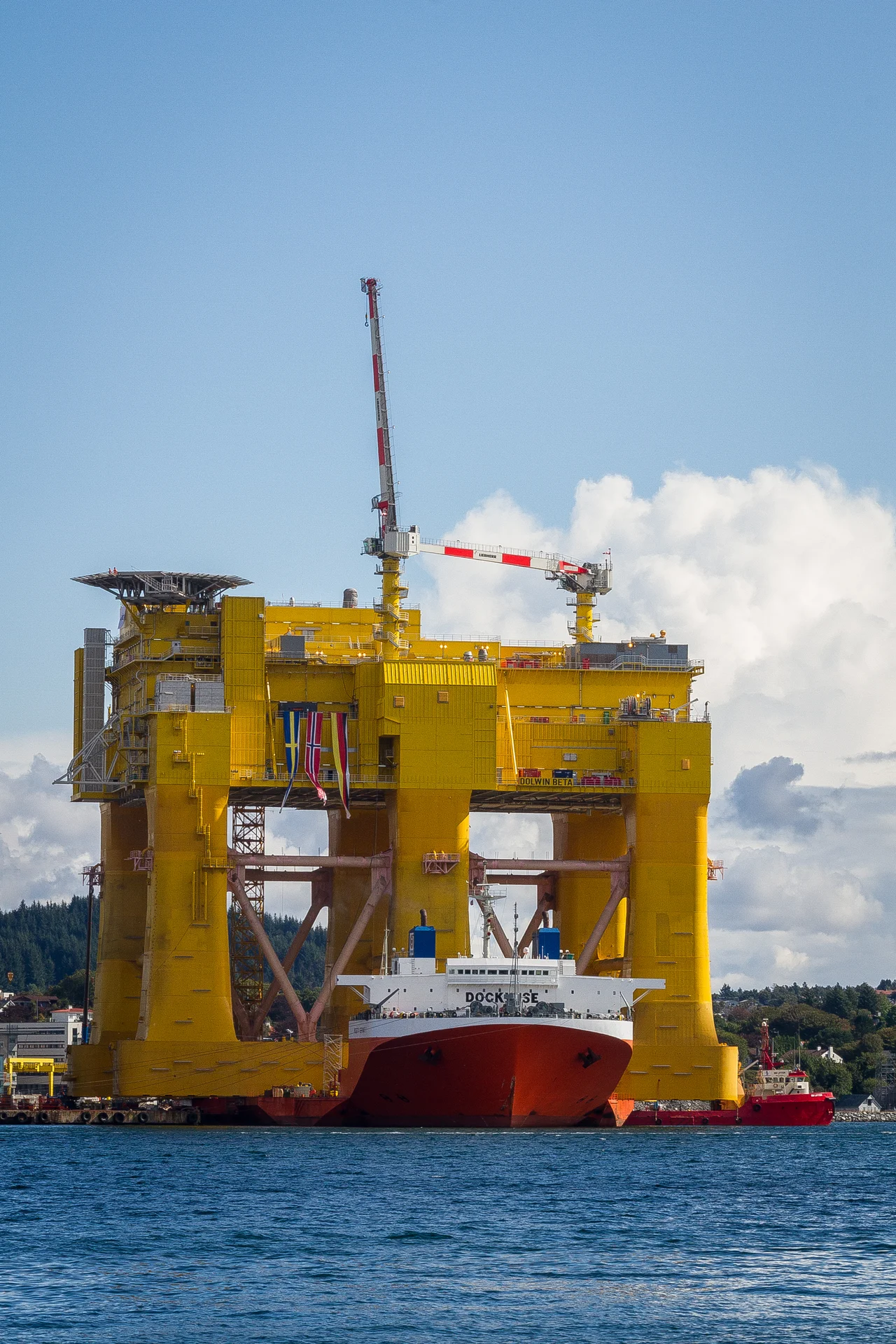
The North Sea is not empty. In April 2023, a cargo ship struck one of the Gode Wind 1 turbines, sustaining massive damage to its own hull. The turbine remained standing. Routine maintenance, helicopter visits, and crew-transfer vessels keep technicians shuttling between Norderney and the platforms; the DolWin Beta converter platform, installed at the cluster's edge in August 2015, gathers all the AC current and pushes 900 megawatts of DC south through buried cable. From above, the geometry feels orderly. From a wheelhouse at sea level, it is a forest of steel that ships now have to plot around — a permanent change to charts that used to show only open water.
From the Air
Coordinates 54.05°N, 7.03°E, north-west of Norderney in the German sector of the North Sea. From 2,000-3,000 ft the three sub-arrays read as nested rectangles. The 154-metre rotors of Gode 1 and 2 are visible from a long way off; Gode 3's 11-MW turbines are noticeably taller. Nearby airports: Norderney (EDWY), Bremen (EDDW), Wilhelmshaven (EDWI). Watch for restricted areas and helicopter traffic supporting the cluster.
Nearby Stories
- Tiefwasserreede 5.2 km away
- East Frisian Islands 6.6 km away
- Offshore wind farm He Dreiht 9.1 km away
- Schule am Meer 15 km away
- Gemini Wind Farm 24 km away
- HMS Sunfish (81S) 27 km away
- Amrumbank West 31 km away
- Schiermonnikoog National Park 34 km away