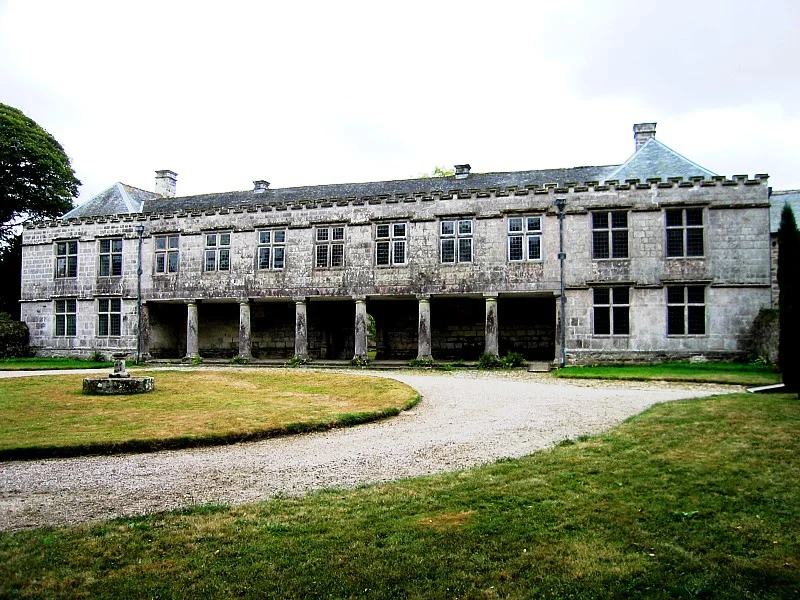

Godolphin Estate
Every Candlemas day, from at least 1700 onwards and possibly as early as the 1300s, the reeve of Lambourne walked up the drive to Godolphin Court, banged on the door of the great hall, climbed onto a table and demanded the rent: a large quart of strong beer, a loaf of wheaten bread and a piece of cheese of equal value, plus two shillings and eight pence. The custom continued until 1921. It commemorated the time a Godolphin lost his entire estate to a neighbour, the Lord of St Aubyn at St Michael's Mount, in a wager on a snail race - and then cheated by pricking his snail to make it move, which it did, the wrong way. Out of pity, St Aubyn declined to claim the land and instead imposed the modest annual rent forever. This is the kind of story Godolphin invites. The house and its 550 acres have been collecting them since before the Wars of the Roses.
The Tin Family
The Godolphins were tin. Long before the engine houses of nineteenth-century Cornwall, this family was working the stream tin out of the brooks below Godolphin Hill, smelting it in blowing houses on their own land. By the seventeenth century, Sidney Godolphin, 1st Earl of Godolphin (1645-1712), born here, would rise to become Lord High Treasurer of England under Queen Anne, the man who financed Marlborough's wars and effectively ran the country. His grandson Francis Godolphin married into the Osborne family, Dukes of Leeds, and from 1786 the estate passed to that line - dukes who, in over a century of ownership, never once chose to live in the house. They had grander seats elsewhere. Godolphin slowly slipped from working manor to forgotten possession.
What Survives of the House
What you see today is not the whole house. The present mansion, with its colonnaded north range built around 1635, is the surviving fragment of something far larger. Earlier wings, courtyards, gatehouses - documented in seventeenth-century estate maps - were demolished in the eighteenth and nineteenth centuries when the Dukes of Leeds had no use for them. The Tudor and Stuart core, dating from around 1500, includes the great hall where the reeve of Lambourne once demanded his snail-race rent. The Elizabethan stables, built around 1600, are Grade I listed in their own right, as is the forecourt wall and the blowing house where Godolphin tin was smelted. It is the rare English country house where the working buildings of the estate carry the same protection as the residence.
An Artist Saves the House
By 1920 the Dukes of Leeds had had enough and sold the house and estate to their tenant farmer, Peter Quintrell Treloar. After Treloar died in 1922 the property passed through two more local owners and might have decayed into ruin. Then in 1937 the American Impressionist painter Walter Elmer Schofield - a Philadelphia-born artist who had fallen in love with Cornwall during his early career - bought the entire estate. His architect son Sydney was given the house as a wedding present and devoted years to restoring its tumbling stonework. The Schofield family lived here, on and off, for the rest of the twentieth century. In 2000 Sydney's widow Mary sold the wider estate to the National Trust, and in 2007 the Trust acquired the house, gardens and farmyard as well. A major conservation project then stabilised the historic North Range to prevent its collapse.
The Layered Land
The estate measures 550 acres and includes Godolphin Hill, rising to 162 metres with sweeping views west across the Penwith peninsula. National Trust archaeologists have recorded more than four hundred features on the land, spanning roughly four thousand years: Bronze Age field enclosures, Iron Age round huts, medieval blowing houses where tin was first smelted, Tudor garden terraces still readable in the turf, Victorian engine houses from the second wave of tin mining in the 1800s. The estate sits inside the Cornwall and West Devon Mining Landscape UNESCO World Heritage Site, recognised specifically for this overlay of mining history on one piece of working ground. Walk the field above the house and you cross between centuries with every step.
Visiting Now
The house opens to the public on certain days through the year, managed by the National Trust, with the gardens accessible more widely. Inside, the great hall and the sequence of paneled rooms are preserved largely as the Schofields kept them, with later National Trust interpretation showing the older fabric beneath. Outside, Sydney Schofield's restored stable block is the visitor entry, and the formal terraces - some of the earliest surviving in England - run down toward the King's Garden, planted with seventeenth-century varieties. Godolphin Hill is open all year for walkers, with the path climbing through gorse and granite to a summit cairn that on a clear day gives a 360-degree view from St Ives Bay in the north to Mount's Bay and St Michael's Mount in the south. The snail race is no longer enacted. The view, and the layered land below it, do not need it.
From the Air
Located near Godolphin Cross at 50.138 N, 5.358 W, approximately 7 km north-west of Helston. The estate covers 550 acres of moor and farmland between Townshend and Breage in west Cornwall. Best viewed from low altitude in clear weather, with Godolphin Hill (162 m) the most visible feature. Land's End airfield (EGHC) is 16 nm west; Newquay (EGHQ) 22 nm north. The estate sits within the Cornwall AONB and inside the UNESCO Mining Landscape boundary, with the engine houses of the Tregonning and Gwinear Mining District visible to the south-east.
Nearby Stories
- Wadebridge 8.1 km away
- Caerhays Castle 8.1 km away
- Sevenstones Lightship 16 km away
- Battle off Lizard Point 20 km away
- MV Cita 22 km away
- Carnewas and Bedruthan Steps 30 km away
- 1979 Fastnet Race 71 km away
- HMS Affray 108 km away