
Goldfish Street
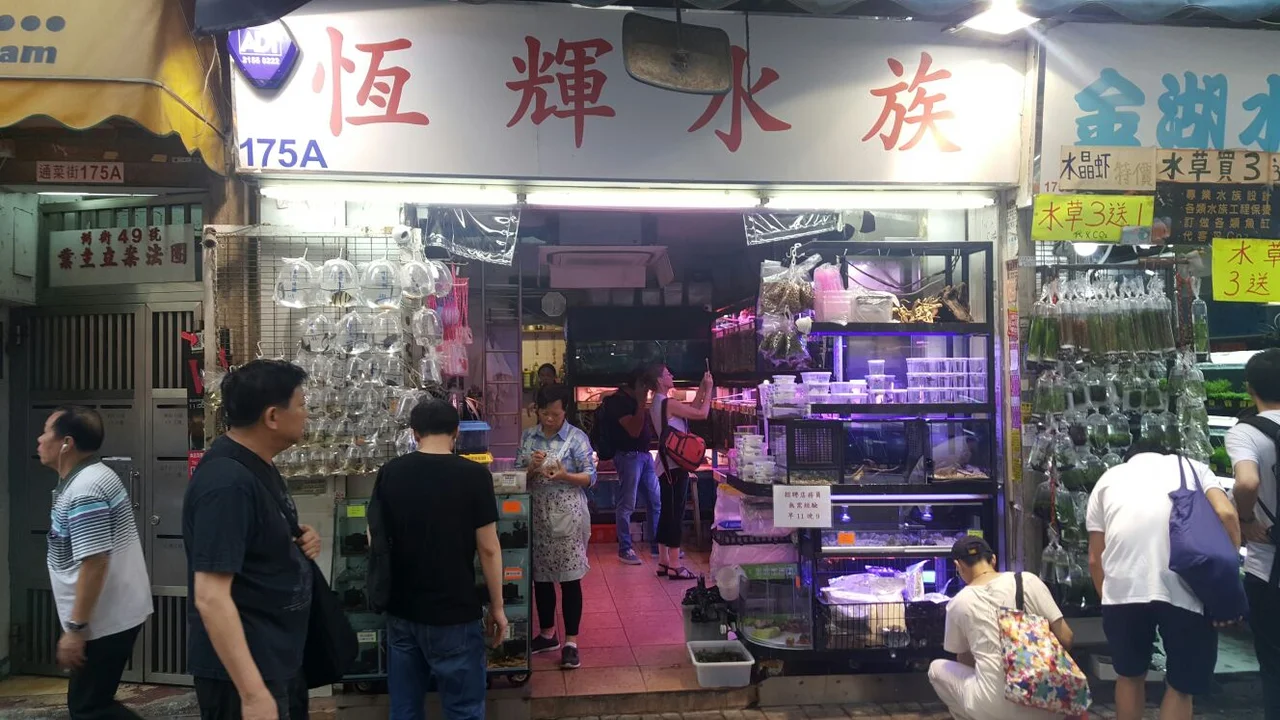
Step onto the right stretch of Tung Choi Street in Mong Kok any morning after eleven and the street transforms. Hundreds of clear plastic bags hang from shop fronts and awnings, each one filled with water and a fish — goldfish, of course, but also koi, tropical specimens in electric blues and yellows, pufferfish, marine creatures that look out of place this far from the sea. The bags catch the light like lanterns. The effect is somewhere between market stall and art installation. This is Goldfish Street, and it has been selling aquatic life from this stretch of road in Kowloon for long enough that the city now regards it as part of its own texture.
The Street in Mong Kok
Goldfish Street occupies a section of Tung Choi Street, north of Bute Street, in Mong Kok — one of the densest neighbourhoods on Earth, a district where retail markets and street life operate at an intensity that feels perpetual. The shops here sell freshwater and marine fish, reptiles, vivariums, aquarium equipment, and the full infrastructure of keeping aquatic life in a Hong Kong apartment. They open around eleven in the morning and the street fills quickly, with locals buying fish as gifts (goldfish are considered auspicious in Chinese culture, associated with prosperity and good luck) and tourists who came to look and found themselves wanting to stay. Street food vendors and restaurants are woven into the block, making it a place to spend time rather than just pass through.
Neighbours Worth Knowing
Goldfish Street sits within walking distance of two other famous markets that have defined this part of Mong Kok for generations. The Flower Market, along Flower Market Road, is a dense, fragrant corridor of florists selling cut flowers, potted plants, and decorative blooms; it operates at its most spectacular around Chinese New Year, when demand for lucky flowers surges and the street becomes almost impassable. The Yuen Po Street Bird Garden, sometimes called the Bird Market, is a collection of stalls selling songbirds, ornate wooden cages, and live insects for feeding — a market that feels like a slower, quieter world tucked behind Mong Kok's commercial noise. Together, the three markets form an informal cluster of living-things commerce that has no real equivalent elsewhere in the city.
Prosperity in a Plastic Bag
Goldfish hold a particular place in Hong Kong's commercial and domestic culture. The Cantonese word for goldfish is *gam yue* (金魚), where *gam* means gold and *yue* sounds like the word for abundance or surplus. Keeping goldfish in a home or shop is considered an invitation to wealth and prosperity; the size of the tank, the number of fish, and the species all carry their own significance in popular belief. This is not simply tradition for tradition's sake — it is a living practice, present in offices and restaurants and living rooms throughout the city. Goldfish Street is the supply chain for that practice, which explains why a single block of Kowloon has sustained dozens of specialist shops selling nothing but aquatic creatures for decades.
Pressure on a Place
Goldfish Street is not without its complications. Proposals to redevelop the surrounding area have periodically threatened the market's future — Mong Kok's land is valuable, and the economics of retail fish-selling are not easily adapted to a modern mixed-use tower. There have also been documented concerns about the sale of threatened or endangered species among the market's offerings. These are real issues, and they sit alongside the market's colour and character. Conservation organisations have raised alarms about the exotic trade more broadly in Hong Kong, and Goldfish Street is part of that trade. The market is charming and economically important and historically rooted in the neighbourhood — and those facts coexist with questions about what it sells and what it costs.
From the Air
Goldfish Street sits at 22.3232°N, 114.1698°E in Mong Kok, on the Kowloon Peninsula. Approaching Hong Kong International Airport (VHHH) from the west over Lantau Island, the Kowloon grid becomes visible to the northeast — a tightly packed urban plain backing up against Lion Rock and the Kowloon Hills. Mong Kok is the densest part of that grid, visible at 4,000 feet as a near-solid mass of mid-rise buildings. The area lies approximately 7 km northeast of Tsim Sha Tsui and about 30 km east of VHHH. Nearest ICAO airport: VHHH (Hong Kong International). The nearby Flower Market and Bird Garden are within a few blocks of the same coordinates.
Nearby Stories
- Lok Ma Chau Loop 2.3 km away
- Portas do Cerco 2.3 km away
- Kweilin Incident 17 km away
- Wanshan Archipelago Campaign 34 km away
- Nanxiong Formation 115 km away
- Battle of Nanpeng Island 148 km away
- Heyuan 169 km away
- Cape Maobitou 632 km away