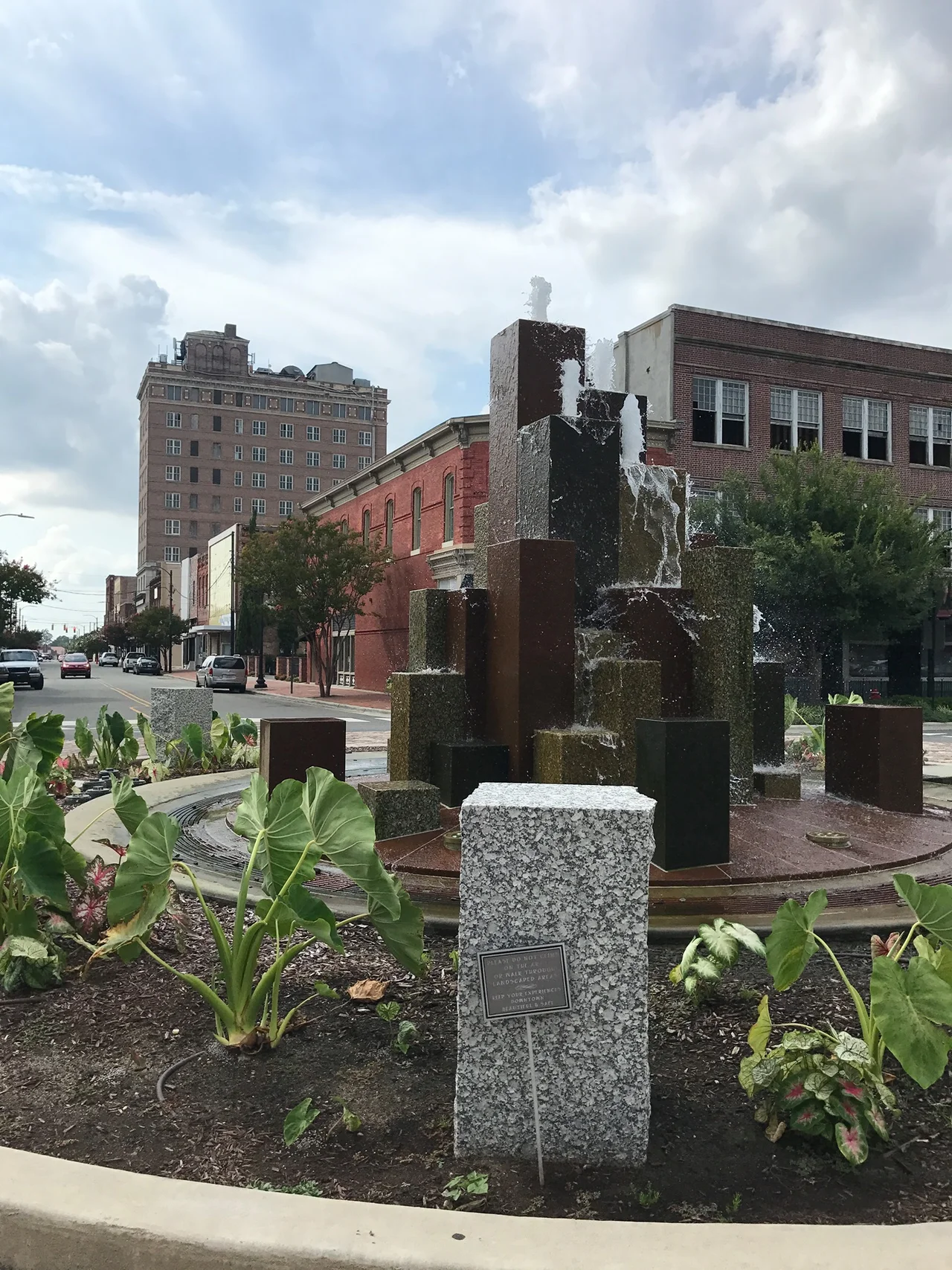

Goldsboro, North Carolina
On January 24, 1961, a B-52 Stratofortress broke up in mid-air over Faro, North Carolina, twelve miles north of Goldsboro. Two hydrogen bombs fell out of the disintegrating aircraft. Each carried a yield of 3.8 megatons — roughly 250 times the destructive power of the Hiroshima bomb. One parachuted to the ground partly armed. The other crashed into a soybean field and broke apart; most of it was recovered, but the piece containing uranium sank into the swampy earth and stayed there. In 2013, a declassified document revealed that on one of the bombs, three of four safety mechanisms had failed in flight. A single low-voltage switch was the only thing left between Goldsboro and a thermonuclear detonation. The Air Force eventually bought the land where the second bomb lies, so that no one would dig.
From Waynesborough to Goldsborough's Junction
Wayne County was formed in 1779, and the first county seat — a town called Waynesborough — grew up around the courthouse on the east bank of the Neuse River. It thrived through the 1830s. Then the Wilmington and Weldon Railroad came through in the early 1840s, several miles away, and people drifted toward the new line. A hotel built at the intersection of the railroad and New Bern Road became the nucleus of a settlement first called Goldsborough's Junction, after Major Matthew T. Goldsborough, an assistant chief engineer with the railroad. The town incorporated in 1847. Local legend insists that supporters spiked the town well with moonshine on election day to encourage votes for the move. By 1861, the new Goldsborough held about 1,500 people. In 1869 the spelling was officially shortened to Goldsboro.
The Railroad That Brought the War
The railroad gave Goldsborough its livelihood and its strategic importance. The Wilmington and Weldon line ran supplies from the Atlantic port at Wilmington northward to Confederate armies fighting in Virginia. Both sides knew it. In December 1862, Union General John Foster led troops out of New Bern with orders to destroy the bridge at Goldsborough. He succeeded on December 17, burning the bridge and overpowering its small Confederate garrison. The bridge was rebuilt within weeks. In March 1865, General Sherman's army — having burned its way through Georgia and the Carolinas — converged on Goldsborough with the forces of General Schofield. For three weeks, more than 100,000 Union soldiers occupied the city. Some never left, settling in town after Appomattox.
The Black Second and the State Hospital
After Reconstruction, Wayne County sat inside what political historians remember as the Black Second — North Carolina's 2nd congressional district, named for its majority-Black population. The Second elected four Republican African Americans to Congress in the 19th century, three of them after Reconstruction had formally ended. George Henry White was the last, an attorney elected in 1896 who served two terms before disenfranchisement laws drove Black voters off the rolls. As the legal architecture of segregation hardened in the 1880s, the state authorized a psychiatric facility in Goldsborough to serve Black North Carolinians — a separate hospital that became Cherry Hospital and operated as the only mental health institution available to Black citizens until the 1960s. The history of Cherry Hospital is told separately, but it cannot be separated from Goldsboro's own.
Seymour Johnson and the Bomb
In April 1942, the US Army Air Forces opened Seymour Johnson Field on the eastern outskirts of Goldsboro. The base was named for a Navy pilot from Goldsboro who had been killed in 1941. It became Seymour Johnson AFB in 1947 when the Air Force became an independent service. The base reshaped the city. Population grew. Businesses followed. Today the 4th Fighter Wing flies F-15E Strike Eagles from Seymour Johnson; the boom of afterburners is part of life in Goldsboro. The 1961 Faro incident — the broken-apart B-52 and its two hydrogen bombs — happened on a flight that originated from this base. A highway historical marker on US 70 remembers what almost happened. The unrecovered uranium remains, fenced off, in the soil twelve miles north.
Pork, Pulpits, and Andy Griffith
Goldsboro Milling Company is now among the largest pork producers in the United States. The city is also a major turkey producer. The Borden Manufacturing Company, the First Presbyterian Church, the L. D. Giddens jewelry store, Goldsboro Union Station, and several private homes are listed on the National Register of Historic Places. The Oheb Sholom synagogue's Romanesque Revival building, completed in 1886, is one of fewer than a hundred 19th-century synagogues still standing in the United States — the second oldest synagogue building in North Carolina. Andy Griffith taught English, drama, and music at Goldsboro High School before he was anyone famous. Anne Jeffreys, born here in 1923, made her way to Broadway and Hollywood. Mark O'Meara, who won the 1998 Masters and British Open, came from here. So did Coby White, who played for the Chicago Bulls before being traded to the Charlotte Hornets. The Cliffs of the Neuse rise 90 feet above the river just south of town, in a state park that preserves the kind of geological feature most of the coastal plain lacks.
From the Air
Located at 35.38N, 78.00W in Wayne County, on the Neuse River about 50 miles southeast of Raleigh. Seymour Johnson AFB (KGSB) sits immediately east of downtown. The Faro nuclear incident site is about 12 miles north of the city; the recovered bomb site is marked with a historical marker on US 70. Other nearby airports include Wayne Executive Jetport (KGWW) for general aviation. The 4th Fighter Wing's F-15E operations make this Class D airspace busy during weekday daylight hours.
Nearby Stories
- Wilson, North Carolina 7.4 km away
- 2009 ConAgra Foods Plant Explosion 18 km away
- Bryan-Bell Farm 19 km away
- Duplin County, North Carolina 25 km away
- Tar River 28 km away
- Battle of Averasborough 30 km away
- Cumberland County, North Carolina 41 km away
- Bertie County, North Carolina 54 km away