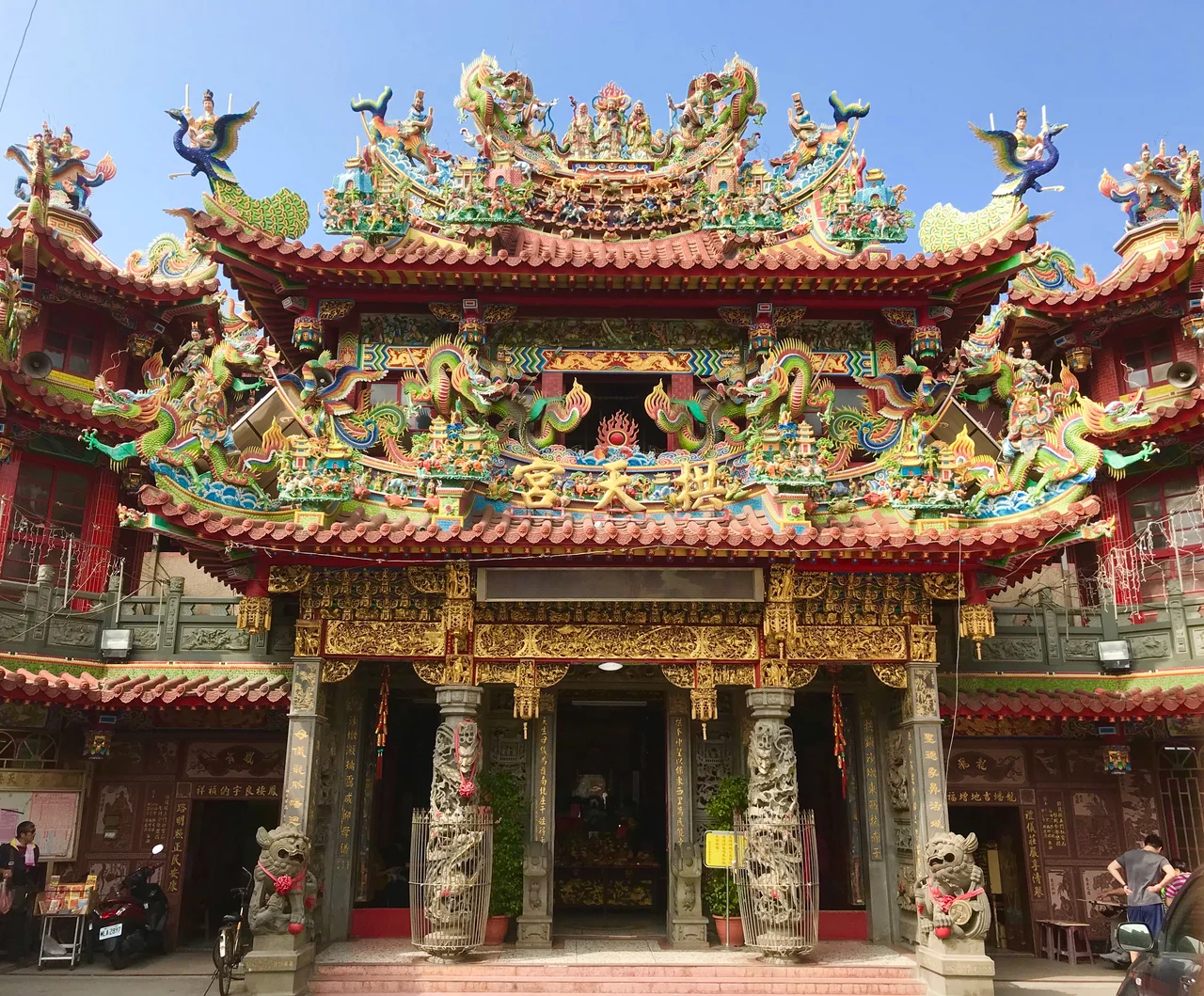

Gongtian Temple
Nobody tells Mazu which road to take. That is the point. Every spring, tens of thousands of pilgrims set out from the coastal village of Baishatun in Miaoli County carrying Gongtian Temple's principal Mazu statue toward Chaotian Temple in Beigang, over 400 kilometers to the south — and the route is never decided in advance. The bearers read subtle movements of the palanquin, the twitches and turns that devotees interpret as divine instruction, and the procession pivots accordingly. Roads close. Families set out food and incense on sidewalks. Strangers become community.
A Fishing Village Builds Its Goddess a Home
Baishatun sits at the edge of the Taiwan Strait, where the green hills of Miaoli County flatten into a narrow coastal plain before meeting the sea. During the reign of the Qianlong Emperor in the eighteenth century, the first settlers built a simple shrine here to Mazu — the deified form of Lin Moniang, a young woman from Fujian province revered as protector of seafarers. Fishermen prayed for safe return; the goddess listened. By the early years of the Tongzhi Emperor's reign, the village had grown prosperous enough to replace that humble structure with a proper brick temple, completed in 1863. That building was renovated twice more — in 1936 and again in 1990 — becoming the three-story reinforced concrete structure that stands today. The road to reach it was, for generations, a puzzle of railway crossings and narrow alleys prone to congestion. In 2019, a dedicated tourist overpass finally connected Provincial Highway 1 directly to the temple's parking lot, a modest infrastructure triumph that locals found long overdue.
Three Floors, Many Faces of the Divine
Gongtian Temple is organized vertically, each floor assigned to a different presence. On the ground level, Mazu holds court — her altar the spiritual heart of the entire building and the city around it. Climb to the second floor and you meet Guanyin, the bodhisattva of compassion. The third floor belongs to Jimu Niangniang. Tucked among the main altars are shrines to Shennong, the divine farmer, and Guan Yu, the deified general whose red-faced image appears in countless temples and police stations across Taiwan. The temple also houses two additional Mazu statues with distinct identities: Erma, whose face is painted black, and Sanma, whose complexion is skin-toned. Neither joins the long pilgrimage south to Beigang. Erma circulates through Baishatun itself during local processions; Sanma presides over festivals in the temple. Three goddesses, three roles, three itineraries — the logistics of devotion have always been more intricate than outsiders expect.
The Pilgrimage That Makes Its Own Map
The Baishatun Mazu Pilgrimage predates the current temple. Long before the brick structure was completed in 1863, Baishatun residents were already making the journey south on foot to venerate the goddess at Chaotian Temple in Beigang. What distinguishes this pilgrimage from the better-known Dajia Mazu Pilgrimage is the absence of a predetermined route. No map is printed. No schedule is published weeks in advance. Instead, the palanquin bearers follow the statue's perceived instructions, turning left or right based on the motion of the sedan chair they carry. Villages along every possible path keep food and incense ready, not knowing whether the procession will arrive or pass them by. In 2010, the Taiwan government recognized the pilgrimage as a national cultural asset — an acknowledgment that what looks like spontaneity is actually one of the most disciplined acts of collective faith the island performs.
Baishatun's Rhythms, Felt Year-Round
Outside pilgrimage season, Gongtian Temple anchors daily life in Baishatun with a steadiness that is easy to miss unless you slow down long enough to notice. The incense is lit before dawn. Vendors set up noodles and scallion pancakes along the lanes leading to the main gate. Older residents come not for festivals but for habit — the same route they have walked for decades, the same prayer offered in the same language their grandparents used. The coastal light here is particular: flat and silver in the mornings, turning amber in the late afternoon when the mountains to the east catch the last of the sun. Tongxiao Township sits just north, and the coast road winds between fishing harbors and tea farms. For a place that once had trouble managing the traffic to its own parking lot, Baishatun has figured out something more elusive — the reason people keep coming back.
From the Air
Gongtian Temple is located at 24.5717°N, 120.7092°E in the coastal village of Baishatun, Tongxiao Township, Miaoli County, Taiwan. From the air at 3,000–5,000 feet, the Taiwan Strait coastline is visible to the west, with the temple compound visible as a prominent red-roofed structure near the coast. The green hills of Miaoli County rise to the east. Nearest major airport: RCMQ (Taichung International Airport), approximately 50 km to the south. The route south along the coast traces the very road the Mazu pilgrimage follows toward Yunlin County.
Nearby Stories
- Fengyuan Museum of Lacquer Art 1.6 km away
- Chiang Kai-shek Statues 6.3 km away
- Smangus 7.6 km away
- Taroko National Park 11 km away
- Hsinchu Museum of Military Dependents Village 21 km away
- Taiwan Strait 31 km away
- Taixi, Yunlin 62 km away
- China Airlines Flight 611 82 km away