
Goodwick
On 22 April 1912, Denys Corbett Wilson nudged his Bleriot XI down the slope above Goodwick's Harbour Village, opened the throttle, and lifted into the air over Fishguard Bay. One hour and forty minutes later he came down in a field near Enniscorthy in County Wexford. It was the first successful aeroplane flight between Britain and Ireland, and it lasted about as long as a modern Stena Line ferry takes to cross the same stretch of sea today. The bay he climbed from is sheltered on its southeast side by a wooded hillside that the Vikings, looking for a calm anchorage in the late tenth century, called godr vik.
Good Bay or Good Wood
The Norse origin of Goodwick's name is the more famous theory: godr meaning good, vik meaning bay or cove, a formation identical to Reykjavik's smoking bay. There is, however, a competing Welsh etymology. The hillside above the town is naturally well-wooded because it faces southeast and is sheltered from the salty southwest winds that strip greenery off the more exposed headlands. Many older Goodwick developments carry the name Goedwig, the Welsh word for forest: Goedwig Terrace, Goedwig Villas, Goedwig Chapel. Perhaps the Vikings did name it, perhaps the Welsh did, and perhaps the two words simply happened to land in roughly the same place. The town stayed a small fishing village in the parish of Llanwnda until 1887, when the railway changed everything.
The Sands and the Surrender
Goodwick Sands sit at the head of the bay, a curve of beach where today's holidaymakers walk dogs. On 24 February 1797 this was where the last hostile foreign army on mainland British soil stacked its weapons. A French force of 1,400 men under the Irish American Colonel William Tate had landed two days earlier at Carreg Gwastad Point, three miles to the west. By the morning of the twenty-fourth, the convict portion of his troops was drunk, mutinous, or already gone. Lord Cawdor had ridden up from Haverfordwest with 600 men. Tate marched his force down to the sands and surrendered unconditionally at four in the afternoon. The legend, almost certainly apocryphal but durable, says that women of Goodwick in their red flannel shawls and tall black hats stood on the cliffs above and were mistaken from the beach for British redcoats. The mistake, if it was made, helped Cawdor's bluff.
The Harbour That Almost Was
In 1887 work began on a railway and harbour, and Goodwick went from sleepy fishing village to building site. The Great Western Railway blasted 1.6 million tonnes of rock from the hillside to construct a 1,000-yard breakwater, and the quarried-out area became the quay. The harbour opened on 30 August 1906 with grand ambitions: this was meant to be Britain's western gateway, drawing trans-Atlantic liners away from Plymouth and Southampton. The GWR ordered three new steamers for the Rosslare run, named St David, St George, and St Patrick. The Cunard liner RMS Mauretania called in September 1909 and her passengers came ashore by tender. The smaller inner breakwater, sometimes called the Mauretania Mole, was built to encourage future visits. But the harbour kept silting up, and the liners stopped coming. Goodwick's brief Edwardian heyday left behind a fashionable cluster of shops and houses now protected as a conservation area, and a town that has never been quite the same since.
Today and Tomorrow
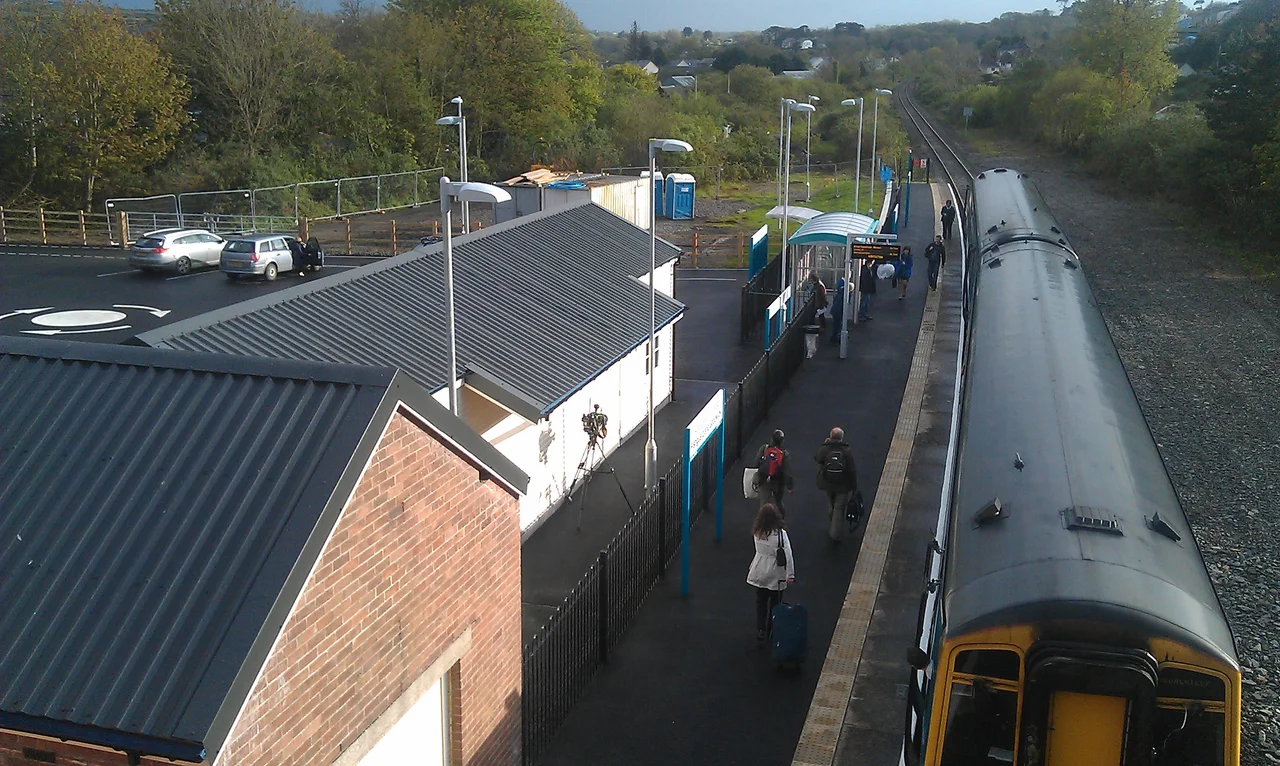
The harbour now serves two Stena Line sailings a day to Rosslare on the MS Stena Nordica, alongside the all-weather lifeboat Blue Peter VII at the foot of the North Breakwater. Goodwick's railway station, closed to local passengers in 1964 and reopened in 2012, sits within walking distance of the Stop-and-Call settlement up the hill, a place named on the 1841 census and largely contiguous with Goodwick now. A 100-million-pound marina proposal from the developer Conygar in 2011 would have brought 450 berths and 253 flats, but Stena Line withdrew from the partnership in January 2018 and the plan died. Goodwick remains what it has always quietly been: a working port, a small community wrapped around a sheltered bay, a launching place for things that go somewhere else.
From the Air
Goodwick sits at 52.00 degrees north, 4.99 degrees west on the northwest corner of Fishguard Bay. From altitude the town shows as a cluster of streets behind the modern ferry terminal and the long arm of the North Breakwater; the older Lower Town Fishguard harbour is visible to the southeast. Haverfordwest (EGFE) lies fifteen miles south; Swansea (EGFH) fifty miles east. The hillside above Goodwick rises 330 feet to the Stop-and-Call settlement and is wooded enough to be visible as a distinct dark patch against the surrounding open headlands.
Nearby Stories
- RAF Angle 0.9 km away
- Cardigan Bay Special Area of Conservation 5.4 km away
- Abercych 11 km away
- Cantre'r Gwaelod 12 km away
- Burry Port Lifeboat Station 22 km away
- Johnstown Castle 61 km away
- Hook Lighthouse 92 km away
- 1979 Fastnet Race 157 km away