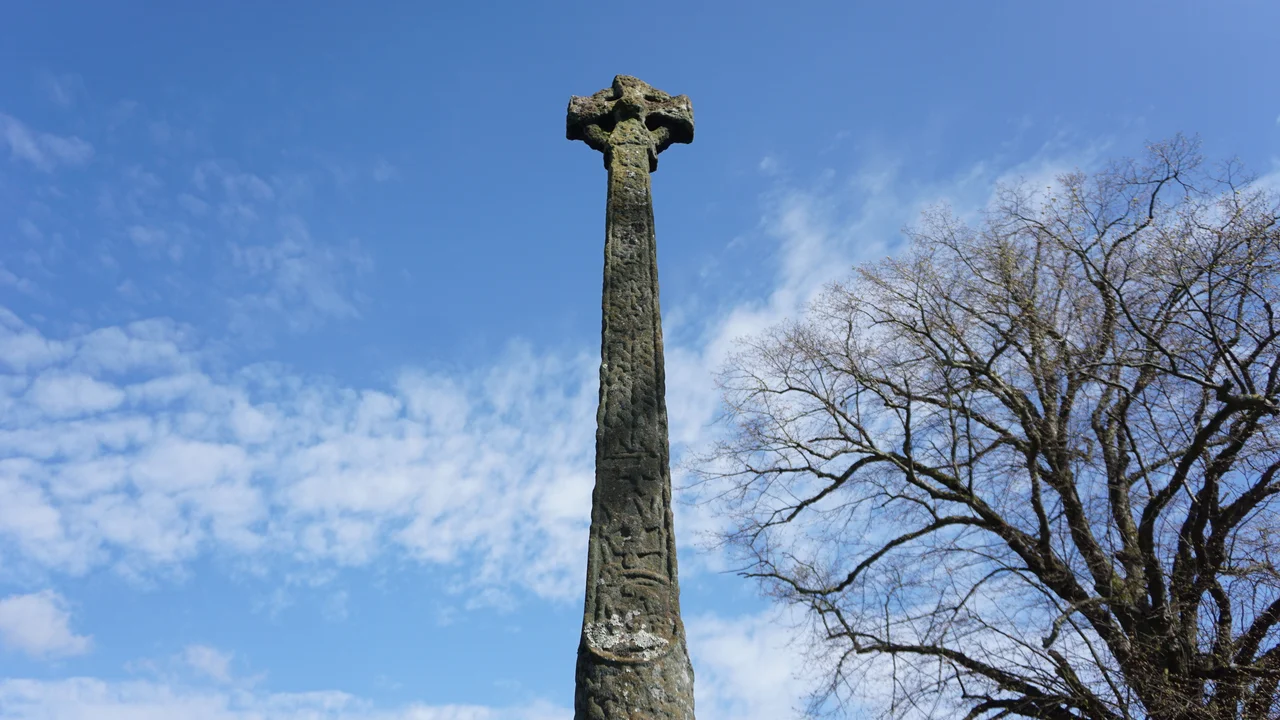

Gosforth Cross
Look closely at the slender sandstone column rising in St Mary's churchyard at Gosforth, and you'll notice something unusual for a Christian monument. Halfway up, a god with a horn is on the lookout. Lower down, a great wolf opens its jaws around a man's foot. And on another face, Christ is being crucified - watched, in this version, by a Norse goddess holding a bowl over her bound husband. The Gosforth Cross is what happened when two religions stood close enough to share a stone.
A Borderland in Stone
By the time this cross was carved, sometime in the first half of the 10th century, the area around Gosforth had already changed hands more than once. It had been part of the kingdom of Northumbria, then settled by Scandinavians moving in from Ireland and the Irish Sea coast during the 9th or 10th century. These newcomers brought their own gods, their own poetry, and within a generation or two, their own Christianity. The cross stands as physical evidence of that crossover moment - the period historians call the Christianization of Scandinavia, lived not in distant Denmark or Norway but on a slope of green Cumbrian field, in a community that knew both the Poetic Edda and the Gospel of John. The cross's tall, slim form is a tradition learned from Christian Ireland; the figures carved into it are something else entirely.
Reading the Carvings
The amateur antiquarian Charles Arundel Parker was the first to identify the figures, in his 1896 book on the ancient crosses of Gosforth and Cumberland. What he found, scene by scene, was a small storybook of Ragnarok - the Norse end of the world. Loki lies bound while his loyal wife Sigyn holds a bowl above him to catch the venom dripping from a serpent above; the moment her bowl fills and she turns to empty it, the poison falls on Loki and he writhes, and the world shakes. Heimdall stands ready with his horn, the one he will blow when the giants come. Vidarr braces a foot inside the wolf Fenrir's lower jaw and tears the upper one apart, avenging his father Odin. And Thor, in a famous scene from the Edda, hauls on his line, hoping to drag the Midgard Serpent Jormungandr up from the sea. The serpent slips the hook. The world goes on, for now.
Two Apocalypses, One Stone
Why mix Norse gods with Christ on a church cross? Scholars are still debating. One reading is that the carvers were Viking-descended Christians who refused to let go entirely of their old stories - clinging to identity even as they took the new faith. Another reading sees the carvings as deliberate theological parallel. Loki bound is Satan bound. Baldr's death, witnessed by Hod and Nanna, mirrors Christ's crucifixion, watched by Longinus and Mary Magdalene. Odin's last battle with the fire-giant Surtr maps onto Christ's final conquest of the Devil. Read this way, the cross is not a compromise but a conversion sermon in stone: your old gods, the carving says, were telling the same story all along. They just did not know the ending yet.
Yggdrasil's Bark, the Hogbacks Inside
The base of the cross is carved to look like tree bark, possibly invoking Yggdrasil, the world tree of Norse cosmology - or the Tree of Life from the Book of Genesis. The Victorian period brought the cross a wider audience. The Victoria and Albert Museum had replicas cast in 1882; in 1887 the Rev. William Slater Calverley commissioned a life-sized copy and put it up in the churchyard at Aspatria. Inside St Mary's itself, more carved stones survive: hogback tombs, those distinctive house-shaped graves that Scandinavian settlers in northern England favoured, and a fragment of what may be a second cross showing Thor in the act of fishing. They stand together in dim light, ten centuries old, still telling stories nobody alive heard the first time.
Flight Context
The Gosforth Cross stands in St Mary's churchyard in the village of Gosforth, west Cumbria, near 54.42 degrees north, 3.43 degrees west - inland from the coast at Ravenglass, on the western edge of the Lake District National Park. Best viewed from low altitude; the cross itself, slim and stone-coloured at about 4.4 metres tall, is hard to spot from cruising height, but the church and village green make a clear landmark. Nearest airfield is Carlisle Lake District (EGNC) about 35 nm to the north. Coastal weather is changeable and mountain rotor turbulence is common to the east toward Scafell.
From the Air
St Mary's Church, Gosforth, sits at 54.42 N, 3.43 W in west Cumbria. View the village and church from low altitude; the cross itself is small but the church serves as a landmark. Nearest airfield: Carlisle Lake District (EGNC) about 35 nm north. Expect changeable coastal weather and mountain rotor turbulence eastward toward Scafell.
Nearby Stories
- Isel Hall 3.3 km away
- Walney Island 7.1 km away
- Kendal 9.7 km away
- Lancaster Priory 10 km away
- Raeberry Castle 15 km away
- Cross Fell 21 km away
- Ramsey Bay 29 km away
- Santon Railway Station 47 km away