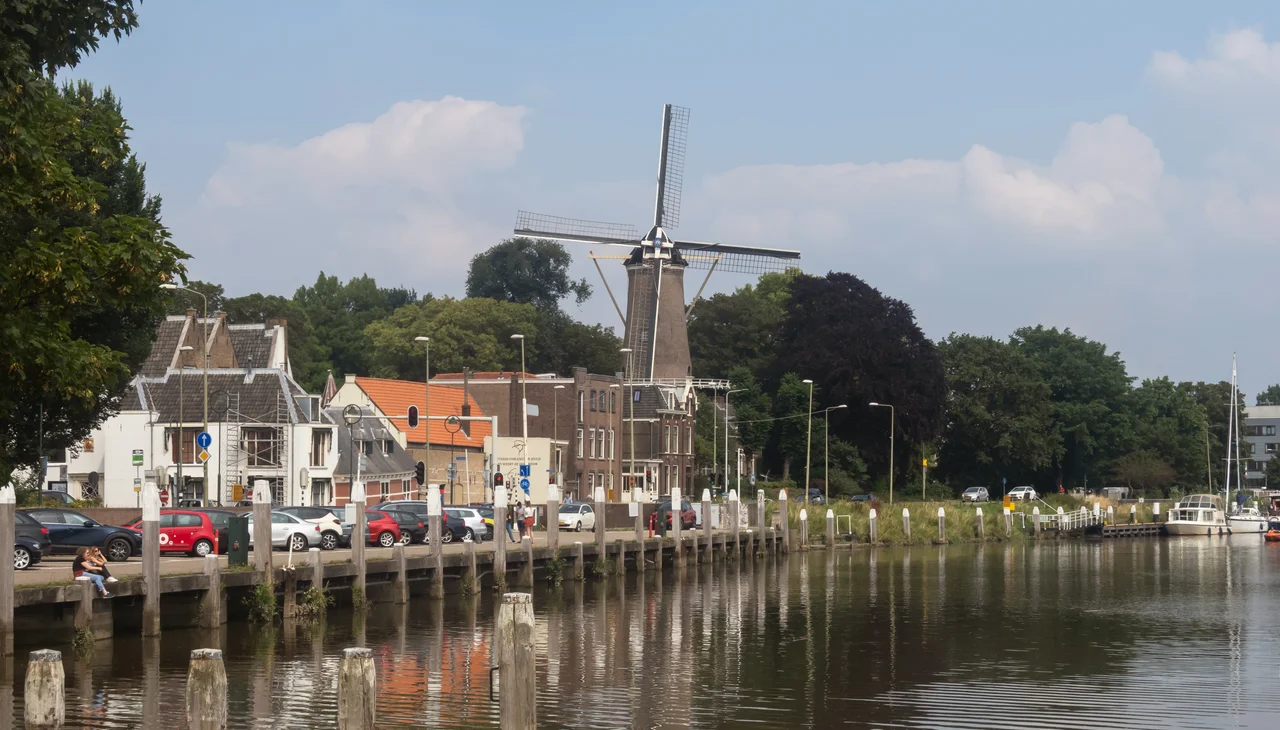

Gouda
The cheese is not made here. This is the first thing to understand about Gouda. The wheels of yellow rind that fill the Markt every Thursday morning come in from farms scattered across the surrounding polders. What Gouda did was weigh them, tax them, certify them, and stake its name on their quality so thoroughly that 'Gouda' became shorthand for an entire category of cheese on supermarket shelves from Tokyo to Toronto. The Waag, a stone weighing house from 1667, still stands across from the 15th-century Gothic city hall as a monument to that arrangement: the city collected its tribute, the countryside made the product, and a brand was born four centuries before anyone had a word for branding.
Peat, Canal, and a Lucky River
Around 1100 the spot was swamp and peat forest, threaded by a small creek called the Gouwe. People began harvesting the peat for fuel. In 1139 the name 'Gouda' first appeared in a document of the Bishop of Utrecht. The transformation came in the 13th century, when somebody had the idea of digging a canal to link the Gouwe to the Oude Rijn, the Old Rhine. Suddenly a sleepy creek became a shortcut. Cargoes from Flanders and France could now reach Holland and the Baltic without risking the open sea, and Gouda sat right on the new route. In 1272 Count Floris V granted city rights, which is the medieval equivalent of being incorporated. The canals dug to carry trade still define the city's shape today, a perfect circular oval of water around the historic core.
The Crabeth Windows
Walk into Sint-Janskerk, the Great or Saint John's Church, and look up. The longest church in the Netherlands at 123 meters holds 72 stained-glass windows, most of them made between 1530 and 1603 by an extraordinary string of craftsmen including the brothers Dirk and Wouter Crabeth. They tell stories from the Bible and from Dutch history, scenes of John the Baptist and of the Spanish king Philip II, all rendered in light that has barely faded in five centuries. It is considered the most significant stained-glass collection in the country. The windows survived the Reformation, when iconoclasts smashed Catholic imagery across the Low Countries, because Gouda's city fathers quietly negotiated with the rebels. Even in the 17th century, travelers were detouring to see them. The church was already a tourist attraction four hundred years ago.
Plague, Pipes, and Persistence
The city has a hard streak under its picture-postcard surface. Great fires gutted Gouda in 1361 and again in 1438. In 1572 the rebels known as les Gueux occupied the place and committed arson of their own. Plague came in 1574, 1625, 1636, and most cruelly in 1673, when 2,995 people, fully a fifth of the population, died in a single epidemic. The smoking-pipe industry that had become a Gouda specialty staggered. The city was so poor by the 18th century that 'Goudaner' and 'beggar' were used as synonyms in Dutch. Yet the city kept going. The Stearine Candle Factory opened in the 19th century. The railway arrived in 1855. And the stroopwafel, the chewy syrup-filled waffle that is now sold worldwide, was invented here in the late 18th or early 19th century, supposedly by a Gouda baker using up the scraps and crumbs left at the end of the day.
Cheese Theater on the Markt
Every Thursday from April through August, the Markt square fills with farmers and wheels of cheese stacked in pyramids. The cheese market is partly working, partly performance: actors in traditional dress haggle and clap hands, the ritual of striking a deal called handjeklap. Roughly 60,000 tourists a year come to watch. It is the kind of staged authenticity that is easy to mock but hard not to enjoy, especially with a stroopwafel softening over a cup of coffee at one of the cafes ringing the square. Behind the spectacle is something real. The cheese trade still happens, the Waag still levies its informal tribute in the form of museum admissions, and the city still profits from a 14th-century deal between farmers and a market town that nobody ever bothered to break.
By Candlelight
Each December, Gouda performs its other set piece. The Gouda by Candlelight festival turns out the electric lights around the Markt, sets thousands of locally made candles glowing in every window of the old city hall and the houses facing it, and lights a Christmas tree sent each year from the Norwegian sister city of Kongsberg, a gift dating to 1956. Choirs sing carols, the candle flames double in the dark canal water, and for one evening the late-medieval town looks more or less the way it must have looked when the windows of Sint-Janskerk were still new. It is a small city, only 75,000 people, easily covered on foot in an afternoon. It does not need to try very hard. The cheese sells itself.
From the Air
Coordinates 52.018°N, 4.706°E, in the western Netherlands midway between Rotterdam and Utrecht. Best identified from altitude by the perfectly oval ring of canal that surrounds the historic core, with the long roof of Sint-Janskerk forming a dark line just southwest of the Markt. Nearest airports: Rotterdam The Hague (EHRD) about 20 km west, Schiphol (EHAM) about 35 km north. Gouda sits in the flat Green Heart (Groene Hart) of Holland, so landmarks include the Hollandse IJssel river to the south and the A12 motorway running east-west just north of the city.
Nearby Stories
- Baarn 1.1 km away
- Oud Herlaer 3.5 km away
- Battle of the Slaak 5.5 km away
- Dorestad 5.8 km away
- Holland 7.2 km away
- Polanen Castle 9.8 km away
- Breda 11 km away
- Hollandse Kust Zuid Offshore Wind Farm 19 km away