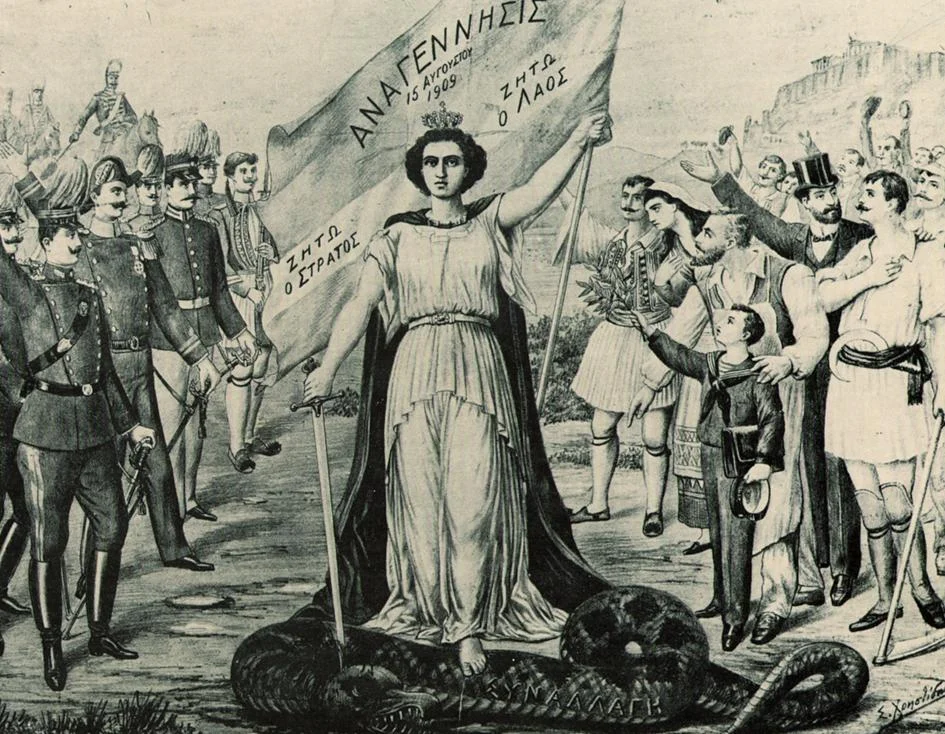

Goudi Coup
They did not march. They did not seize the palace or arrest the king. On the night of 28 August 1909 (15 August by the old calendar), a few hundred junior officers, sergeants, and ordinary soldiers simply assembled at the Goudi barracks on the eastern edge of Athens and refused to disperse. Then they sent a letter. The document, a Spanish-style pronunciamiento, listed their demands and warned that if Athens did not listen, they would march into the capital. It was one of the quietest revolutions in modern European history, and one of the most consequential.
A Country Out of Patience
To understand why men in uniform staged a near-bloodless mutiny, you have to feel the humiliation that hung over Greece at the turn of the century. The disastrous war with the Ottomans in 1897 had ended in a month of defeat, crushing reparations of four million Ottoman pounds, and the indignity of foreign financial overseers seizing control of state revenues to pay creditors. Emigrants were leaving in droves; the number bound for America jumped from roughly 1,100 in 1890 to nearly 40,000 in 1910, out of a population of just 2.8 million. A new urban middle class looked at the wreckage and asked a simple question: why was a country with so much promise governed so badly? The army, full of young officers who had bled in the guerrilla struggle over Macedonia, asked it loudest of all.
The Military League
Founded in secret in October 1908, the Military League drew inspiration from the Young Turks across the border, who had just forced reforms on their own sultan. Its founders were not generals but men on the way up, frustrated by a promotion system that rewarded royal favor over merit. Among them were officers whose names would dominate Greek history for decades: future strongmen Nikolaos Plastiras, Georgios Kondylis, and Theodoros Pangalos. By the summer of 1909 the League numbered around 1,300. When the government began arresting its members for insubordination in August, the conspirators faced a stark choice, act now or be dissolved. They acted, gathering at Goudi and naming the respected Colonel Nikolaos Zorbas as their public figurehead.
What the Soldiers Wanted
The remarkable thing about the Goudi manifesto is how restrained it was. The insurgents did not demand the abolition of the monarchy or a military dictatorship; they swore loyalty to King George I and to parliamentary government itself. What they wanted was reform: a modernized army and navy, an end to clientelism, lower taxes, and the removal of the royal princes, above all Crown Prince Constantine, whom they blamed for the catastrophe of 1897, from their commands. When a stalemate set in, the officers turned the people loose. On 14 September 1909 a vast crowd from Athens and Piraeus, organized and supervised by the soldiers, filled the streets demanding tax fairness, job security for civil servants, and an end to usury. The king, remembering how his predecessor Otto had been driven from the throne in 1862, gave way.
The Cretan Who Took the Stage
The League had toppled a government but had no idea how to govern. Its leaders, in the words of the moment, were soldiers ill at ease outside their barracks. So they looked to Crete, where a lawyer-politician named Eleftherios Venizelos had built a reputation for brilliance and for defying the very princes the officers despised. When they invited him to simply become prime minister, Venizelos refused the shortcut. He would not be the soldiers' puppet. Instead he insisted on legitimacy through the ballot box, brokering new elections and persuading the Military League to dissolve itself. The gamble worked. After his allies' victories in the elections of August and November 1910, Venizelos became prime minister with an overwhelming majority and a free hand.
The Long Shadow of Goudi
What followed was one of the great reforming governments of the era. Child labor was abolished, a minimum wage and compulsory free primary education introduced, the franchise of land reform opened, the army retrained by a French mission and the navy by a British one. Greece, modernized and confident, would soon double its territory in the Balkan Wars. Yet Goudi also planted a poisonous seed. Venizelos's towering popularity eventually collided with the crown, splitting the nation into Venizelists and anti-Venizelists, liberal republicans against conservative monarchists, a rift known as the National Schism that would convulse Greek politics for half a century. The quiet mutiny at Goudi had not just changed a government. It had set the stage for everything that came after.
From the Air
The Goudi district sits on the eastern edge of Athens at roughly 37.99 degrees N, 23.78 degrees E, beneath the western slopes of Mount Hymettus, the long ridge that walls off the Attic basin from the sea. The old barracks grounds are now parkland and university campuses; from the air the green wedge of Goudi Park stands out against the dense city grid. Athens International Airport (LGAV, Eleftherios Venizelos, named for the very man this coup brought to power) lies about 20 km to the east. Best viewed from 3,000 to 5,000 feet on the clear, dry days of an Attic summer, when Hymettus glows violet at dusk.
Nearby Stories
- Great Sand Beach 5 km away
- Battle of Delium 7.7 km away
- Tower of Aliartos 9 km away
- HMHS Britannic 10 km away
- Saronic Gulf 15 km away
- Sousaki Volcano 17 km away
- Sanctuary of Apollo Maleatas 24 km away
- Skyros 66 km away