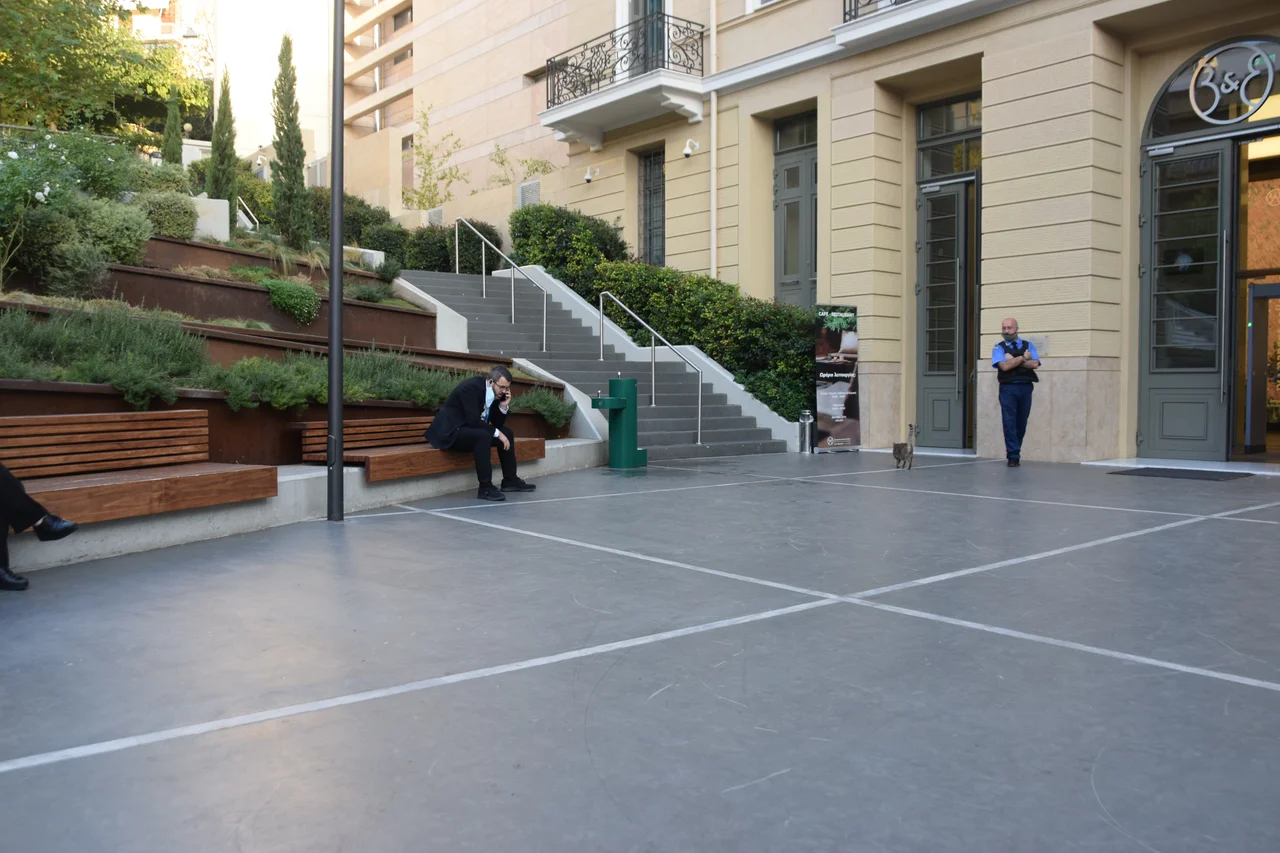

Goulandris Museum of Contemporary Art
For more than twenty years it was the great unseen treasure of Athens: a private art collection worth around three billion dollars, hung in apartments and held in storage, while a museum to house it stalled in legal limbo. When the Basil and Elise Goulandris Foundation finally threw open its doors in the Pangrati district in October 2019, Greeks could at last walk in off the street and stand face to face with Van Gogh, Picasso, Monet, and Cezanne, masterpieces that had spent a generation waiting in the wings.
A Shipping Fortune Turned to Art
The collection belonged to Basil Goulandris and his wife Elise Karadontis, members of the same storied Greek shipping dynasty that gave Athens two other museums. Across their lifetimes the couple assembled one of the most formidable private holdings of modern art anywhere in the world. Basil died in 1994 and Elise in 2000, but their vision of sharing the art with the public survived them, carried forward by the foundation that bears their names. The museum that finally opened in 2019 is the fulfillment of a promise long deferred, and a reminder that great collections are rarely the work of a single moment.
A Mansion That Goes Underground
The building itself is a clever piece of architecture. From the street it appears to be a restored 1920s neoclassical mansion in the heart of residential Pangrati, but it conceals a ten-storey extension, five of those floors burrowing below ground. In all the museum offers some 7,250 square meters of space. The permanent collection occupies four above-ground floors, while a lower level hosts temporary exhibitions of Greek and international artists. Beneath the galleries lie a library of around 4,500 volumes, a children's workshop, and a 190-seat amphitheatre, a museum built as much for learning as for looking.
Walking Through Modern Art
The roll call of artists reads like a survey of modern art itself. Cezanne and Van Gogh, Monet and Degas, Picasso and Matisse, Chagall, Miro, Kandinsky, Giacometti, hang alongside Jackson Pollock, Francis Bacon, and Roy Lichtenstein. Van Gogh alone is represented by several works, including Olive Picking from 1889 and two still lifes from 1888. There is a 1907 Picasso nude from the very moment Cubism was being born, a Monet from his famous Rouen Cathedral series, and Degas's haunting Little Dancer Aged Fourteen. To move through the rooms is to watch European art transform across a single century.
The Greek Thread
Yet this is not only a museum of famous foreigners. Basil Goulandris collected Greek modern painters with the same passion he brought to the great names of Paris, and the museum gives them pride of place: Konstantinos Parthenis, Yiannis Tsarouchis, Yannis Moralis, Nikos Hadjikyriakos-Ghika, and others who built modern Greek art in dialogue with the wider movements of Europe. Hanging Greek modernists beside Picasso and Matisse makes a quiet but pointed argument, that the story of twentieth-century art runs through Athens too, not just Paris and New York.
Three Museums, One Family
It is easy to confuse the Goulandris museums of Athens, and worth untangling them. This one, the Museum of Contemporary Art in Pangrati, springs from Basil and Elise Goulandris and their modern masters. It is distinct from the Museum of Cycladic Art, founded by Nikolaos and Dolly Goulandris around ancient Aegean figurines, and from the Natural History Museum in the suburb of Kifisia, founded by Angelos and Niki Goulandris. Three branches of one family, three different passions, three gifts to a single city. Together they form an extraordinary act of cultural philanthropy, the kind that turns private fortune into public inheritance.
From the Air
The museum stands on Eratosthenous Street in the Pangrati neighborhood of central Athens, at roughly 37.97 degrees N, 23.74 degrees E, just east of the marble Panathenaic Stadium and the National Garden. Those two landmarks, along with the Acropolis to the west and the long ridge of Mount Hymettus to the east, make useful navigational anchors. Athens International Airport (LGAV) lies about 25 km to the east. Best viewed from 3,000 to 5,000 feet on a clear day, when the dense Athenian grid spreads from the foot of Hymettus toward the shimmer of the Saronic Gulf.
Nearby Stories
- Great Sand Beach 5 km away
- Battle of Delium 7.7 km away
- Tower of Aliartos 9 km away
- HMHS Britannic 10 km away
- Saronic Gulf 15 km away
- Sousaki Volcano 17 km away
- Sanctuary of Apollo Maleatas 24 km away
- Skyros 66 km away