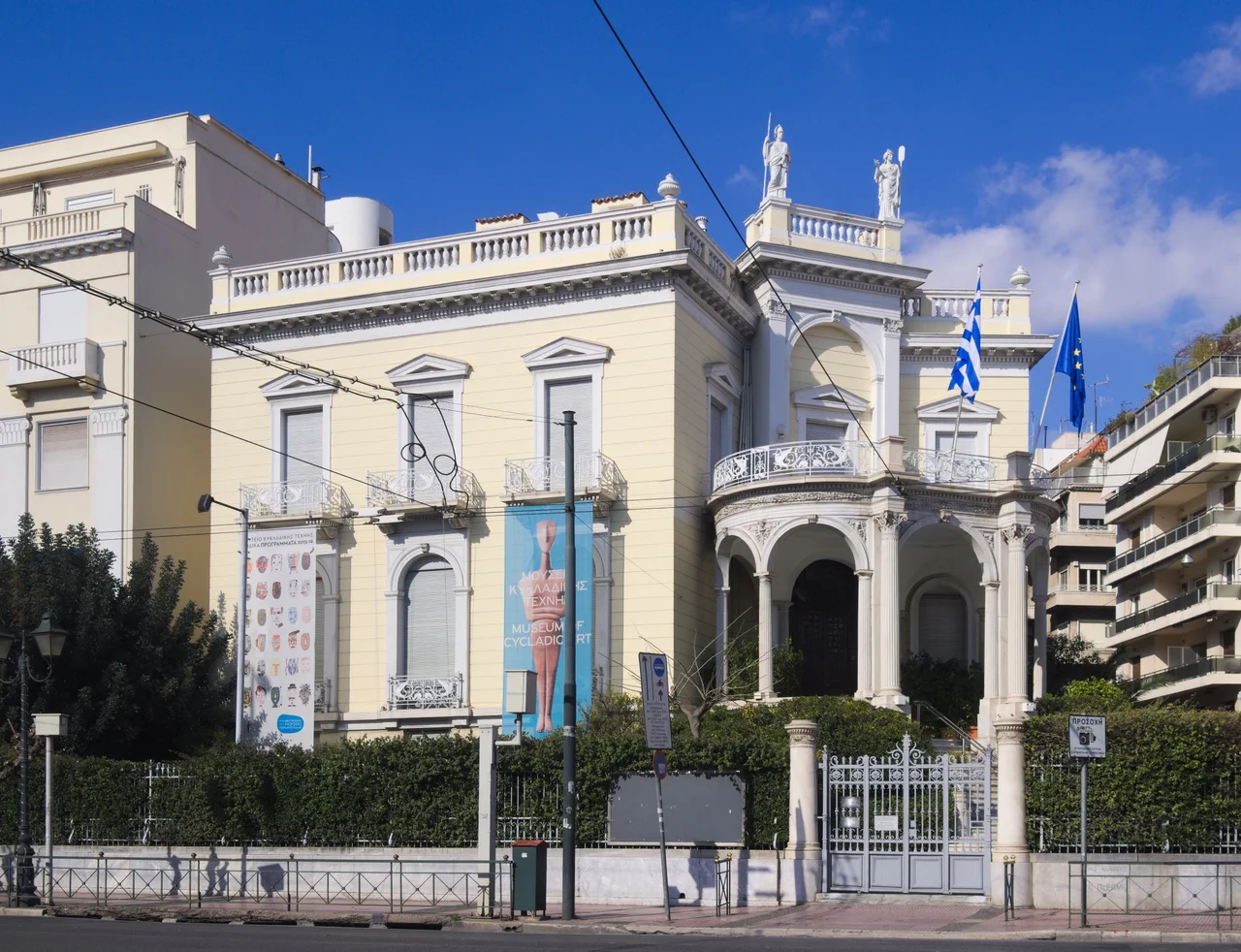

Museum of Cycladic Art
Stand before a Cycladic figurine and you may forget you are looking at something nearly five thousand years old. The folded arms, the long blank face tilted slightly upward, the cool white marble pared down to pure form, all of it looks startlingly modern, the kind of thing Brancusi or Modigliani might have carved. Sculptors did indeed copy them in the twentieth century, after the rest of the world finally caught up to what Aegean islanders had figured out in the Bronze Age. The Museum of Cycladic Art in Athens exists to honor these enigmatic objects, and the couple who fell in love with them.
Two Collectors and an Obsession
The museum's full name honors its founders: the Nikolaos P. Goulandris Foundation. In the early 1960s, Nikolaos Goulandris and his wife Dolly, members of a great Greek shipping family, began collecting Greek antiquities with the permission of the Greek state. They were drawn above all to the prehistoric art of the Cyclades, the cluster of sun-bleached islands ringing the sacred isle of Delos in the Aegean Sea. Where others saw curiosities, the Goulandrises saw a coherent artistic tradition worth preserving. They assembled what The New York Times would call one of the world's most significant privately assembled collections of Cycladic antiquities, and rather than keep it private, they gave it to the public. The museum opened in 1986.
The Figurines
The heart of the collection is the marble figurines, most of them depicting nude female forms, abstracted almost to geometry. Carved with obsidian tools and polished with emery from the island of Naxos, they emerged from a society that left no writing, no monumental architecture, and no clear record of what these objects meant. Were they goddesses, ancestors, grave companions, toys for the dead? Scholars still argue. Traces of paint show that many were once decorated with faces and patterns now lost to time, so the pure white marble we admire is partly an accident of survival. Their silence is part of their power. The museum holds over 3,000 items spanning Cycladic, Ancient Greek, and Cypriot art, a sweep of millennia under one roof.
A Mansion and a Modern Wing
The museum lives in two very different buildings linked by a glass corridor. Its main wing, raised in central Athens in 1985, is a crisp modern structure designed to let the figurines breathe in pools of light. In 1991 the museum was granted use of its grander neighbor, the neoclassical Stathatos Mansion at the corner of Vassilissis Sofias Avenue and Herodotou Street, an aristocratic nineteenth-century townhouse that now hosts temporary exhibitions. The pairing is deliberate: ancient art in a contemporary box, modern shows in a historic palace, the old and the new in constant conversation.
When the Dead Meet the Living
That conversation became the museum's signature. Far from treating its antiquities as untouchable relics, the museum has staged a remarkable run of contemporary exhibitions, placing ancient marble beside the work of living artists. Salvador Dali came in 2002, Caravaggio in 2006, the dissident Ai Weiwei in 2016, the photographer Cindy Sherman in 2024. A recurring series called Divine Dialogues set Cy Twombly and Picasso directly against Greek antiquity, asking what modern eyes share with Bronze Age hands. The effect is electric: a Cycladic figure and a Picasso line, separated by five thousand years, suddenly look like cousins.
Why It Matters
Cycladic art is one of those rare moments when a vanished people speaks to us across an enormous gulf of time in a language we somehow understand. We cannot read their words, because they left none, but we can read their forms, and the forms feel astonishingly close. The Goulandris museum gathered the scattered evidence of that lost civilization, gave it a home, and then dared to put it in dialogue with the present. To walk through its galleries is to watch the deep past and the immediate now reach across the centuries and very nearly touch.
From the Air
The museum sits in central Athens near the corner of Vassilissis Sofias Avenue, at roughly 37.98 degrees N, 23.74 degrees E, in the elegant district between Syntagma Square and the National Garden, a short walk from the Greek Parliament. From the air the green rectangle of the National Garden and the marble Panathenaic Stadium are useful landmarks, with the Acropolis rising to the southwest. Athens International Airport (LGAV) lies about 25 km to the east across the Attic basin. Best viewed from 3,000 to 5,000 feet on a clear Mediterranean day, when the city's white sprawl runs from Hymettus to the blue of the Saronic Gulf.
Nearby Stories
- Great Sand Beach 5 km away
- Battle of Delium 7.7 km away
- Tower of Aliartos 9 km away
- HMHS Britannic 10 km away
- Saronic Gulf 15 km away
- Sousaki Volcano 17 km away
- Sanctuary of Apollo Maleatas 24 km away
- Skyros 66 km away