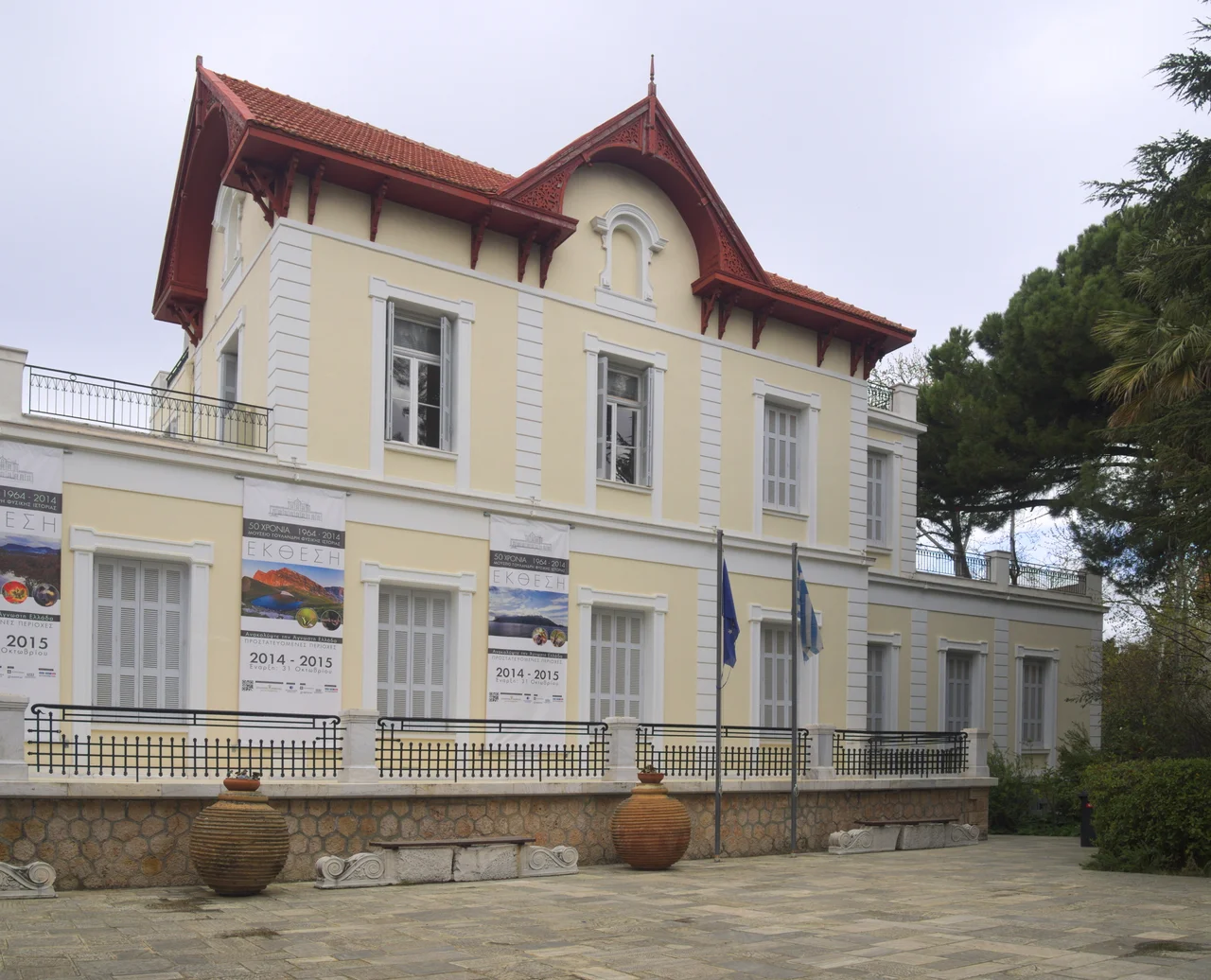

Goulandris Natural History Museum
Before Greece had a serious environmental movement, it had Niki Goulandris and her watercolors. A botanical painter of rare skill, she illustrated the wildflowers of her country with a precision that turned science into art. When she and her husband Angelos opened the Goulandris Natural History Museum in the quiet northern suburb of Kifisia in 1965, they were not just building display cases. They were trying to teach an entire nation to look at its own landscape, and to fear losing it.
A Mission Wrapped in a Museum
The founders were explicit about their purpose. Angelos and Niki Goulandris, of the same shipping family that endowed two of Athens's great art museums, created their natural history museum to promote interest in the natural sciences and, above all, to alert the public to the urgent need to protect Greece's wild habitats and its species threatened with extinction. In 1965, when much of Europe was busy paving over its countryside, this was a remarkably forward-looking idea. The museum was less a cabinet of curiosities than a call to conscience, conservation advocacy dressed in the welcoming form of public exhibits.
The Collections
Behind the displays lies a serious scientific institution. The museum holds vast collections of insects, mammals, birds, reptiles, shells, rocks, minerals, and fossils drawn from the rich variety of Greek wildlife. Its botanical collection is the jewel: more than 200,000 plant specimens, among them 145 species newly discovered through the museum's own research. The seed of that herbarium was the collection of Constantine Goulimis, author of Wild Flowers of Greece, the very book that Niki Goulandris illustrated. In effect, the museum grew partly out of the same passion for Greek flora that first put a paintbrush in its founder's hand.
More Than a Display Case
The museum was never meant to be only a place to wander past stuffed animals. Its laboratories carry out research across ecology, botany, zoology, geology, palaeontology, and biotechnology. Since 1973 it has published a scientific journal, the Annales Musei Goulandris, and it runs further-education programs, seminars, lectures, and traveling exhibitions on the environmental issues facing Greece and the wider world. Among the highlights for visitors are the Zoology Room, the Palaeontology Room, and a striking display of bivalve molluscs gathered from seas around the globe, a reminder that Greek nature is part of a planet-wide web.
A Telling Little Story
One small episode captures both the museum's ambition and the fragility it works to fight. In 2010 the museum funded the botanist Dionysios Mermygkas to study the plants of the Peloponnese mountains, and rhizomes of the rare Iris hellenica were planted in its garden. The iris grew well for a year but never flowered, and the following season it died. Identical rhizomes sent to Copenhagen, however, survived. It is a humbling vignette: even with expertise and care, a wild Greek plant could not be coaxed to thrive in cultivation, while it clung to life far to the north. Conservation, the story whispers, is harder and stranger than it looks.
Kifisia and the Goulandris Legacy
The setting suits the mission. Kifisia, a leafy, well-to-do suburb climbing the lower slopes north of central Athens, has long been the city's green refuge, a place of villas, gardens, and cooler air. It is one of three distinct Goulandris museums scattered across the capital, separate from the Cycladic and Contemporary art collections founded by other branches of the family. Where those museums celebrate what human hands have made, this one celebrates what nature made first, and quietly insists that it is worth saving. Niki Goulandris, painter and philanthropist, carried that conviction until her death in 2019, leaving behind a museum that still asks Greeks to look closely at their own wild inheritance.
From the Air
The museum sits in Kifisia, a northeastern suburb of Athens, at roughly 38.07 degrees N, 23.81 degrees E, on the lower northern slopes of the Attic basin below the bulk of Mount Penteli. From the air the green, villa-dotted suburb stands out against the denser city to the south, with Mount Pentelikon rising to the northeast and the long ridge of Hymettus to the east. Athens International Airport (LGAV) lies about 20 km to the southeast. Best viewed from 3,000 to 5,000 feet on a clear day, when the wooded hills around Kifisia show why Athenians have always escaped here for cooler, greener air.
Nearby Stories
- Great Sand Beach 5 km away
- Battle of Delium 7.7 km away
- Tower of Aliartos 9 km away
- HMHS Britannic 10 km away
- Saronic Gulf 15 km away
- Sousaki Volcano 17 km away
- Sanctuary of Apollo Maleatas 24 km away
- Skyros 66 km away