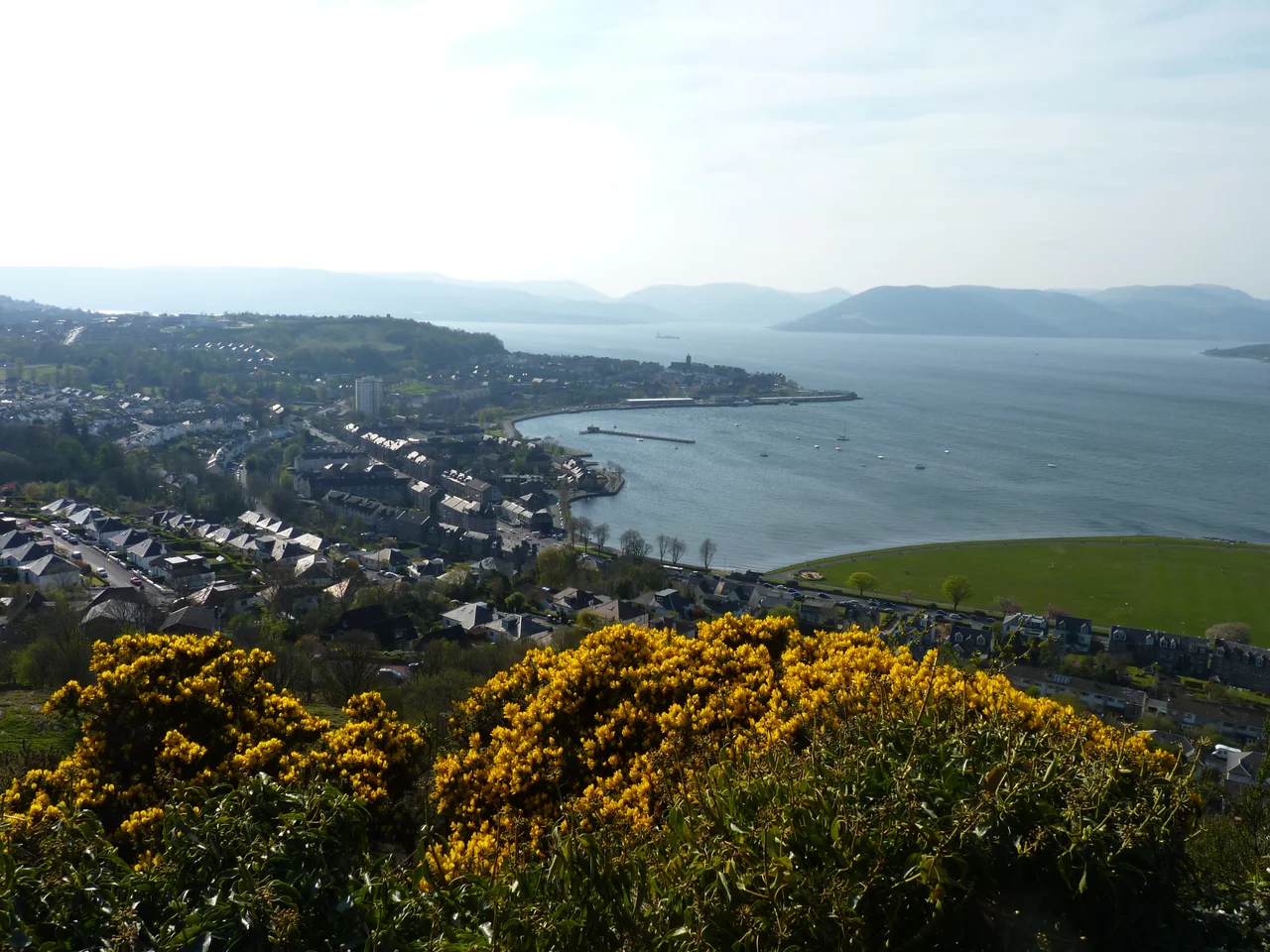

Gourock
Walk up Kempock Street and a statue waits at the north end: a girl on a suitcase with a bucket and spade. She is called Wee Annie. The sculptor was Angela Hunter. The commission came from Riverside Inverclyde in 2011. Annie looks out over the pier where Clyde steamers, in their thousands, once carried Glasgow holidaymakers 'doon the watter' - down the river - to start their summer holidays. The name of this town comes from a Gaelic word for 'pimple,' a reference to the hill that rises above the houses. It has been a fishing village, a seaside resort, a railway terminus, a ferry port, a copper-mining settlement, a ropework, and a yacht-building yard. Most of those past lives still leave traces on the streets.
A King Sails, a Royal Charter Follows
Gourock first appears in the historical record in 1494, when King James IV of Scotland sailed from the shore here to suppress rebellious Highland clans. Two hundred years later, in the late 17th century, William and Mary granted a Charter in favour of Stewart of Castlemilk that raised Gourock to a Burgh of Barony. In 1784 the lands of Gourock were bought by Duncan Darroch, a former merchant who had made his fortune in Jamaica - one of many Scottish fortunes built on Caribbean commerce in that era. Tradition holds that as a boy, before leaving for Jamaica, young Duncan had climbed into the garden of Gourock House to steal apples, and when chased out by the gardener swore he would return one day to buy the estate. The story has the shape of folk memory but the dates support it: he did return, and he did buy it. He built Gourock House near the old castle site. His family later gifted the grounds to the town as Darroch Park, which the council renamed Gourock Park.
From Herring to Railway
Through the 18th and 19th centuries Gourock grew from a fishing village into a working coastal town. The industries shifted: herring curing, copper mining, ropemaking, quarrying, and eventually yacht-building and repair. In the early hours of 21 October 1825, within sight of the town, the steamer Comet II was run into by another steamer, the Ayr. About 62 people lost their lives. The Clyde was a busy and dangerous waterway. When competing railway companies extended their lines to provide fast connections to the Clyde steamers, Gourock Pierhead became a railway terminus - electric trains now run from the same platforms to Glasgow Central. David MacBrayne Ltd's headquarters is still at the pier. CalMac runs a passenger ferry to Dunoon across the firth. Western Ferries runs a car ferry from McInroy's Point, just west of town, to Hunter's Quay on the Cowal peninsula.
An Outdoor Pool Filled with Sea Water
Gourock has one of the three remaining public outdoor swimming pools in Scotland. The Gourock Outdoor Pool was built in 1909, reconstructed in 1969, and was once tidal with a sandy floor. Today it is a modern heated facility, filled with cleaned sea water rather than chlorinated fresh water. It closed at the end of the 2010 summer season for a major rebuild - the old changing accommodation was demolished and replaced with a more modern leisure centre incorporating an enlarged gymnasium and lift access from street level down to the pool. On the rare hot summer day in west Scotland, the pool fills up immediately. On more typical days, the brave swim anyway.
Granny Kempock Stone
Behind Kempock Street, on a cliff, stands the megalithic Kempock Stone - locally known as 'Granny Kempock.' The superstition was that sailors going on a long voyage, and couples about to be married, would walk seven times around the stone to ensure good fortune. A flight of steps winds up from the street, past the stone, to Castle Mansions and St John's Church. The crown steeple of St John's is the town's most recognizable landmark from the water. Kempock Street itself is the main shopping street, holding a small supermarket, art and gift shops, cafes, restaurants and pubs - the working centre of a small town that still serves its surrounding population. The Royal Gourock Yacht Club, founded in 1894 as Gourock Sailing Club and granted Royal status in 1908, sits on Ashton Road.
Castle Levan, the Cloch, and Amazon
Gourock's coastline keeps adding new chapters. Above the medieval Castle Levan, restored and now in use as a bed and breakfast, new estates have spread along the shore. Further along, a short stretch of green belt still separates the town from the Cloch lighthouse, which looks across the firth to Innellan on the Cowal peninsula. The Municipal Buildings on Shore Street, completed in 1924, now house a business centre. Amazon opened a distribution centre at Faulds Park to the south of town in a building that was originally occupied by Mimtec, which manufactured PC products for IBM until its closure in 2023. The town has produced its share of names: the novelist Iain Banks (1954-2013), the three-time America's Cup-winning yachtsman Charlie Barr (1864-1911), the author Neil Munro (1863-1930), the radio broadcaster Fiona Ritchie, the artist George Wyllie (1921-2012), the actress Melissa Stribling (1926-1992), and Sir Ernest Woodroofe (1912-2002), former chairman of Unilever. Wee Annie still watches the pier, in case any of them comes back.
From the Air
Located at 55.95°N, 4.82°W, on the East shore of the upper Firth of Clyde in Inverclyde, immediately west of Greenock. The town's distinctive crown steeple of St John's Church marks the centre. The pier, ferry terminal and Western Ferries' McInroy's Point dock are visible along the waterfront. Glasgow Airport (EGPF) is 28 km east; Glasgow Prestwick (EGPK) is 50 km south. Best viewed at 1,500-3,000 feet AGL on tracks paralleling the firth, with Cowal and Dunoon across the water to the west.
Nearby Stories
- Loch Sloy Hydro-Electric Scheme 1.7 km away
- Lochranza Castle 2.2 km away
- Dalgarven Mill – Museum of Ayrshire Country Life and Costume 5.6 km away
- Loch Fyne 8.9 km away
- Battle of Drumclog 10 km away
- Battle of Kilsyth 12 km away
- Battle of Lagganmore 15 km away
- Comrie 20 km away