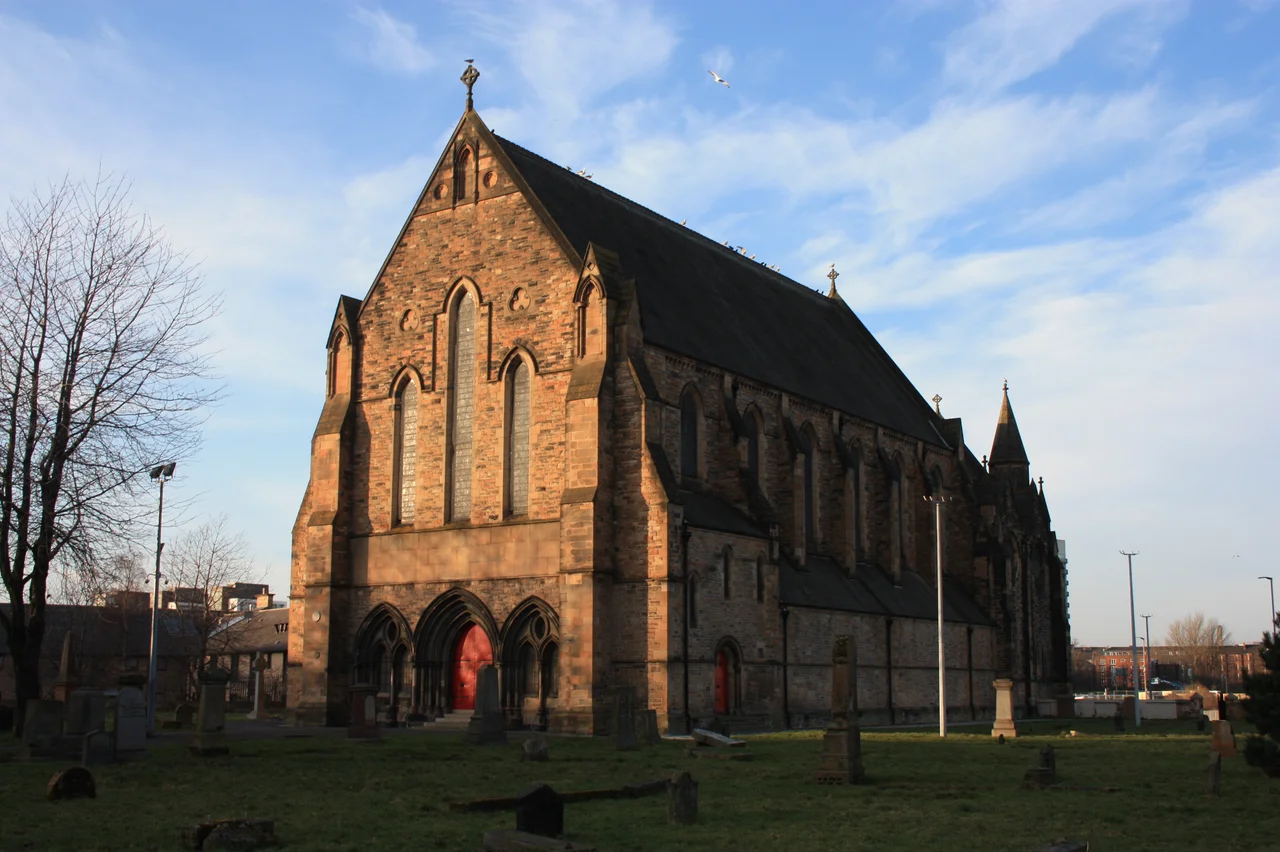

Govan Old Parish Church
When a gravedigger's spade struck stone in December 1855, no one quite understood what had been uncovered. The carved sandstone sarcophagus that emerged from the soil of Govan churchyard would turn out to be one of the most important early medieval finds in Britain - evidence that this quiet stretch of the south bank of the Clyde, soon to be swallowed by Glasgow's shipyards, had once been a centre of royal power in the Kingdom of Strathclyde. The carving style points to the late 9th or early 10th century. The body inside, if any survived, may have been that of Saint Constantine, a Pictish king reportedly killed by Vikings in 877.
When Govan Mattered
The story Govan Old's stones tell is one most Glaswegians have never heard. From the 6th century onward, the rock-fortress of Alt Clut at Dumbarton, fifteen miles downstream, ruled the Brittonic Kingdom of the Clyde. Then in 870, Vikings from Dublin besieged Dumbarton Rock and broke its power. The Annals of Ulster, which had referred to the kings of Alt Clut, suddenly switch in 872 to the kingdom of Ystrad Clud - the Kingdom of Strathclyde. The political centre had moved upstream. Govan, with its existing Christian church and what may have been a Viking-style assembly mound called Doomster Hill rising beside the river, became the spiritual heart of a new kingdom. Royal patronage paid for the stones: a remarkable sarcophagus, four upstanding crosses with intricate interlace and figure carving, five Anglo-Scandinavian hogbacks shaped like Viking longhouses, and over twenty recumbent slabs. All from one churchyard. All from a place no one now thinks of as a capital.
The Earliest Christian Site in the Region
Archaeological excavations between 1994 and 1996 found two early Christian burials beneath the foundations of a later church. Radiocarbon dating put them between the 5th and 6th centuries AD, making Govan the earliest known Christian site in this part of Scotland. The medieval church that succeeded those first burials had a belfry at its west end and a north aisle added in 1651. It was demolished in 1762 and rebuilt, then rebuilt again in 1826 in Georgian Gothic style. The present church, designed by Robert Rowand Anderson and influenced by Pluscarden Abbey near Elgin, was begun in 1884 and dedicated on 19 May 1888. Unusually, Anderson oriented the building north-south rather than the traditional east-west, so the main door could face Govan Road and the heart of the burgh.
The Hogbacks
Of the early medieval stones, the most striking are the five hogbacks. These low, ridge-roofed monuments, carved to resemble Viking longhouses with shingled roofs and end-beasts gripping the ridge, are an Anglo-Scandinavian form - a hybrid of British, Irish, and Norse craft traditions. They were grave markers, presumably for important people in the late 9th or 10th century, and Govan's collection is one of the finest anywhere in Britain. In the 1960s, the antiquarian Ralegh Radford recognised that the Govan stones formed a distinct school of carving, with close cousins at Inchinnan just across the river. Today, thirty monuments are displayed inside the church itself, with one recumbent stone left in the graveyard. For decades, sixteen others were thought to have been destroyed when the adjacent Harland & Wolff plater shed was demolished in 1973. Then in March 2019, community archaeologists working with a schoolboy named Mark McGettigan rediscovered the location of at least three of the lost stones.
Ministers and Memory
Govan Old's parish ministers form a thread through Scottish religious history. Andrew Melville, the great Reformation scholar, served here from 1577 to 1580. Hugh Binning, the so-called child genius, was minister from 1650 to 1653. Matthew Leishman held the post for 53 remarkable years from 1821 to 1874 and became Moderator of the General Assembly of the Church of Scotland in 1858. George MacLeod, later Lord MacLeod of Fuinary, served from 1930 to 1938 before leaving to found the Iona Community - the Christian ecumenical group whose offices remain based in Govan to this day. In 2007, the Presbytery of Glasgow united Govan Old with Linthouse St Kenneth and New Govan, ending regular Sunday services here after fifteen centuries of worship on this site. The future of the building was uncertain until 2016, when the Govan Heritage Trust secured Scottish Government funding to develop it into a community-run cultural and museum complex. The Govan Stones are now open daily from April through October, free to visit, and worth the trip across the river.
From the Air
Govan Old Parish Church stands at 55.8647 N, 4.3130 W on Govan Road, just west of Pearce Institute and beside the Govan War Memorial. The church sits about 200 metres south of the River Clyde and within a few hundred metres of the BAE Systems Surface Ships yard, descendants of the great Govan shipbuilding tradition. Govan Subway station is a short walk to the east. Nearest airports are Glasgow International (EGPF) about 4 nautical miles west and Glasgow Prestwick (EGPK) about 27 nautical miles southwest. From altitude, look for the Clyde's curve past Pacific Quay and the SEC Armadillo, then follow the south bank west to find the distinctive square tower of the church.
Nearby Stories
- Mauchline 3.6 km away
- Shotts 4.2 km away
- HMS Ulysses (1917) 7.7 km away
- Rothesay Castle 8.8 km away
- Inchcailloch 10 km away
- Strachur 14 km away
- Battle of Dollar 16 km away
- Crawford Castle 16 km away