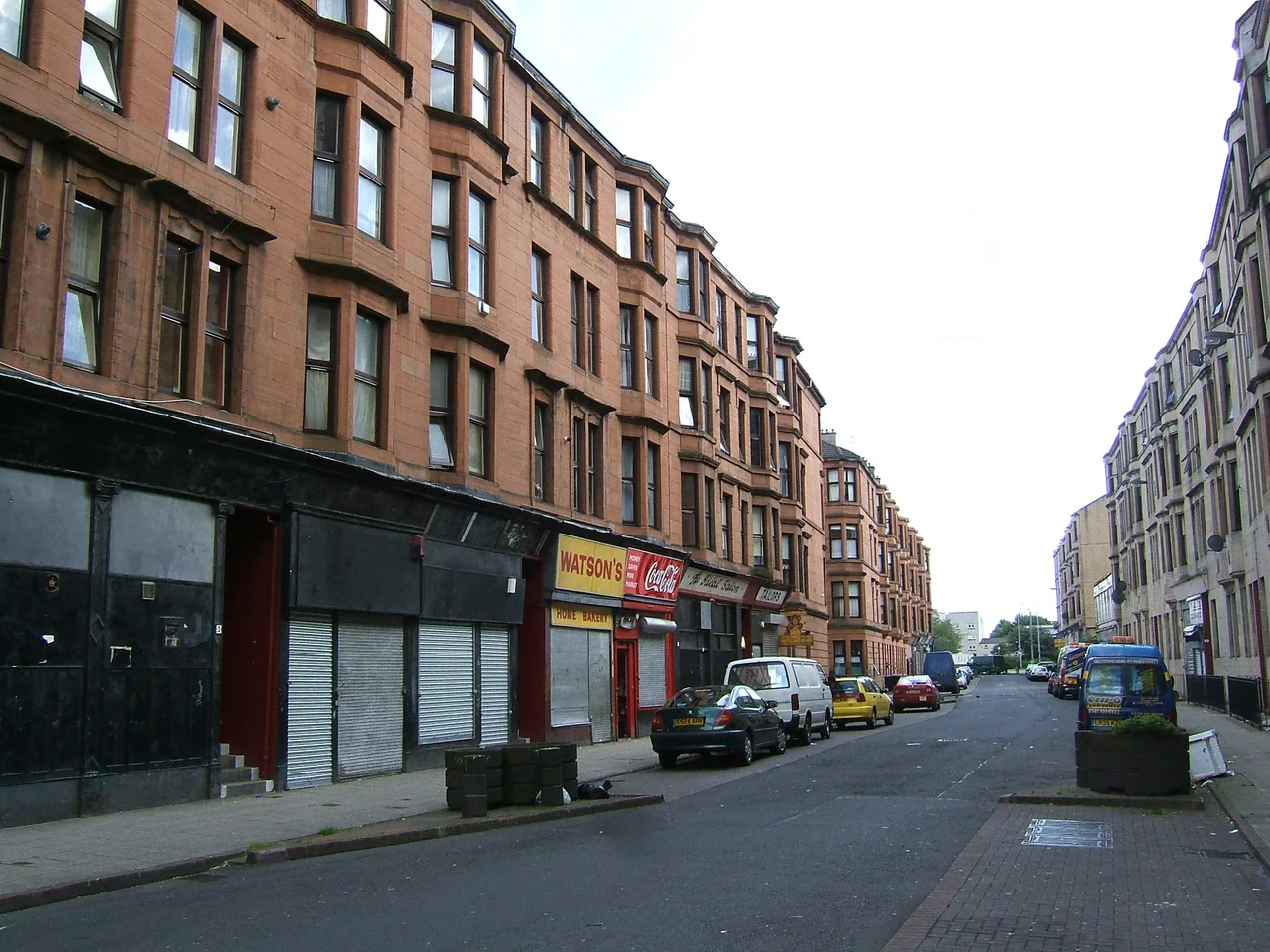

Govan
Baile a' Ghobhainn, the smith's town. That is Govan in Scottish Gaelic, and the name has proved oddly prophetic for a district whose history has been mostly about making things out of metal. In 1843, Robert Napier launched the iron ship Vanguard from his Govan yard. Over the next 130 years, almost 3,000 ships followed - Cunarders, battleships, ferries, freighters - sliding down the slipways into the Clyde and out to every sea on the planet. The yards are mostly gone now, but BAE Systems still builds Royal Navy destroyers at Govan, and the smith's town still answers to its name.
Before the Smiths
Govan was old long before it was industrial. Two Christian burials in the churchyard of Govan Old have been radiocarbon-dated to the 5th or 6th century AD, making this the earliest known Christian site in the region. When the Vikings sacked the fortress of Dumbarton Rock in 870 and the political centre of the Kingdom of Strathclyde shifted upstream, Govan became its spiritual heart. The Govan Stones - a sarcophagus, hogbacks, crosses and recumbent slabs from the 9th to 11th centuries - testify to royal patronage. Beside the church stood Doomster Hill, possibly a Bronze-Age burial mound adapted as a Viking-style assembly site or moot. It was levelled in the early 19th century to make way for Reid's Dyeworks. For centuries afterward, Govan was a quiet ford and ferry crossing, then a village of weavers - the Govan Weavers Society, founded in 1756, still exists as a charity - until the 19th century dragged it into industry.
The Fifth-Largest Burgh
The transformation came fast. In 1759 the Clyde was deepened at Govan, opening the river to seagoing ships. Reid's Dye Works and Pollok's Silk Mill appeared, then in 1841 Robert Napier began iron shipbuilding here. By 1864 Govan had grown large enough to need its own government and became a burgh under the General Police and Improvement (Scotland) Act, the fifth-largest in Scotland at the time. Its boundaries grew to include Plantation, Cessnock, Ibrox, Craigton and Drumoyne, and later Linthouse and West Drumoyne. Between 1864 and 1907 the population exploded more than tenfold, from 9,000 to 95,000. By 1901, Govan was the seventh-largest town in Scotland. Then, in 1912, Glasgow annexed it after years of political battles. Govan became a district of the larger city, and the burgh's independent civic identity quietly ended.
The Yards
What made Govan world-famous was steel. Napier's yard passed to William Beardmore. Randolph, Elder and Company took over Napier's Old Yard at Water Row in 1860, moved to Fairfield estate in 1863, and under John Elder and then William Pearce became the Fairfield Shipbuilding and Engineering Company - a name that survives at Fairfield Heritage today. Across the river at Linthouse, Alexander Stephen and Sons built ships from 1870 until the collapse of Upper Clyde Shipbuilders in 1971. That collapse, more than any single event, defined modern Govan. When the Conservative government refused a six-million-pound loan to the failing consortium in 1971, the workers refused to strike. Instead, under the leadership of Jimmy Reid - born in Govan, raised in Govan - they staged a work-in, completing existing orders to prove the yards remained viable. The work-in saved jobs and changed Scottish politics. Govan went on to be owned by Kvaerner of Norway, then GEC's Marconi Marine, and finally BAE Systems, which still builds warships at the yard. HMS Daring, Dauntless, Diamond, Dragon, Defender and Duncan - the Royal Navy's Type 45 destroyers - all came from Govan slipways in the 2000s and 2010s.
After Industry
The decades after the yards declined were hard. Housing estates built in the 1930s to relieve Gorbals slums became their own version of trap. Moorepark, sometimes called the Wine Alley, was singled out by The Independent in 1994 as one of the worst areas in Britain, with unemployment near 30 percent. The BBC sitcom Rab C. Nesbitt set its grotesque comedy in Govan, though it was rarely filmed there. Yet the area kept producing people who shaped Scotland and beyond. Sir Alex Ferguson, the football manager whose Manchester United won more trophies than any other manager in the English game, grew up here. So did the writer James Kelman, the trade unionist Jimmy Reid, the philanthropist Isabella Elder who gave Elder Park to the people of Govan, the avant-garde performer Ivor Cutler, the actor Iain Robertson, and Lady Elish Angiolini, Lord Advocate of Scotland. Leo Blair senior, father of Prime Minister Tony Blair, was raised on Golspie Street.
A Smith's Town Reinventing Itself
Walk Govan today and you walk through several Govans at once. The medieval Govan of the church and its carved stones. The Victorian Govan of shipyard tenements and the Pearce Institute. The post-industrial Govan of empty lots and regeneration projects. The new Govan of the Govan Old heritage trust, Sunny Govan community radio at 103.5 FM, the planned walkways that Sir Alex Ferguson opened in 2017, and the BAE yard still launching destroyers into the Clyde. Govan Subway station carries thousands every day under the river to Partick. The smith's town is still figuring out what it makes next.
From the Air
Govan sits at approximately 55.8615 N, 4.3083 W on the south bank of the River Clyde, directly opposite the mouth of the River Kelvin and the district of Partick. Govan Old Parish Church, the BAE Systems Surface Ships yard, and Govan Subway station cluster within walking distance of each other. From the air, the BAE shipyard's covered halls and remaining slipways are distinctive features, as is the elegant Govan Old Parish Church near the riverside. Glasgow International Airport (EGPF) is about 3 nautical miles west; Glasgow Prestwick (EGPK) is 27 nautical miles southwest. The Clyde Tunnel passes beneath Govan, carrying the A739 between the north and south banks.
Nearby Stories
- Mauchline 3.6 km away
- Shotts 4.2 km away
- HMS Ulysses (1917) 7.7 km away
- Rothesay Castle 8.8 km away
- Inchcailloch 10 km away
- Strachur 14 km away
- Battle of Dollar 16 km away
- Crawford Castle 16 km away