
Grafton Bridge (New South Wales)
Cars cross on top; trains run underneath. For more than ninety years the old Grafton Bridge has carried two kinds of traffic on two separate decks across the wide Clarence River, a steel double-decker unlike anything else in New South Wales. When it opened in 1932 it did more than link Grafton to South Grafton - it closed the last gap in the railway between Sydney and Brisbane. And in its early years it could do something most bridges cannot: lift open to let ships pass through.
Two Cities, One River
A bridge here had been dreamed of since 1915, but the dream kept changing shape. The first plan was for a railway bridge with a footway; by 1922 the design had grown to carry road vehicles as well. Serious planning was under way by 1921, and construction itself ran from 1927 to 1932. When private contractors quoted prices it considered too high, the New South Wales Public Works Department made an unusual decision: it would build the thing itself, using steelwork supplied by Clyde Engineering. On 19 July 1932 the Governor-General, Sir Isaac Isaacs, formally opened it with a grand celebration - just months after the far more famous Sydney Harbour Bridge had opened down the coast. For Grafton, long separated from its southern half by a wide and sometimes treacherous river, the link was transformational, ending generations of reliance on punts and ferries.
The Bridge That Opened
The cleverest part of the design was the bascule - a counterweighted section that could tilt upward like a drawbridge to let river shipping through. From 1932 the span lifted on demand, raising road and rail together so vessels could pass up and down the Clarence, which in those days still carried real commercial traffic to and from the coast. But river trade faded as road and rail took over, and the mechanism was eventually defeated by something entirely mundane: a water main added across the bridge that blocked the lift. The bascule last operated in 1969, after which the opening span was sealed shut, frozen permanently in the closed position. The capacity to lift is gone, but the distinctive bascule structure still reads clearly in the bridge's silhouette - a piece of working machinery turned into a monument to a busier river age.
Stacked for the Clarence
The engineering answer to crossing a wide, navigable river in a flood-prone valley was to stack everything vertically. The upper deck carries a two-way road along Bent Street, once part of the Summerland Way. The lower deck carries the North Coast railway line, a water main and footways on either side. There is even provision for a second rail track, though that space now serves the water main instead. By completing the standard-gauge line between Sydney and Brisbane, the bridge let trains run straight up the coast and abandon the slow, winding inland detour via Tenterfield - a quiet revolution in how goods and people moved through eastern Australia.
A New Bridge, an Old Landmark
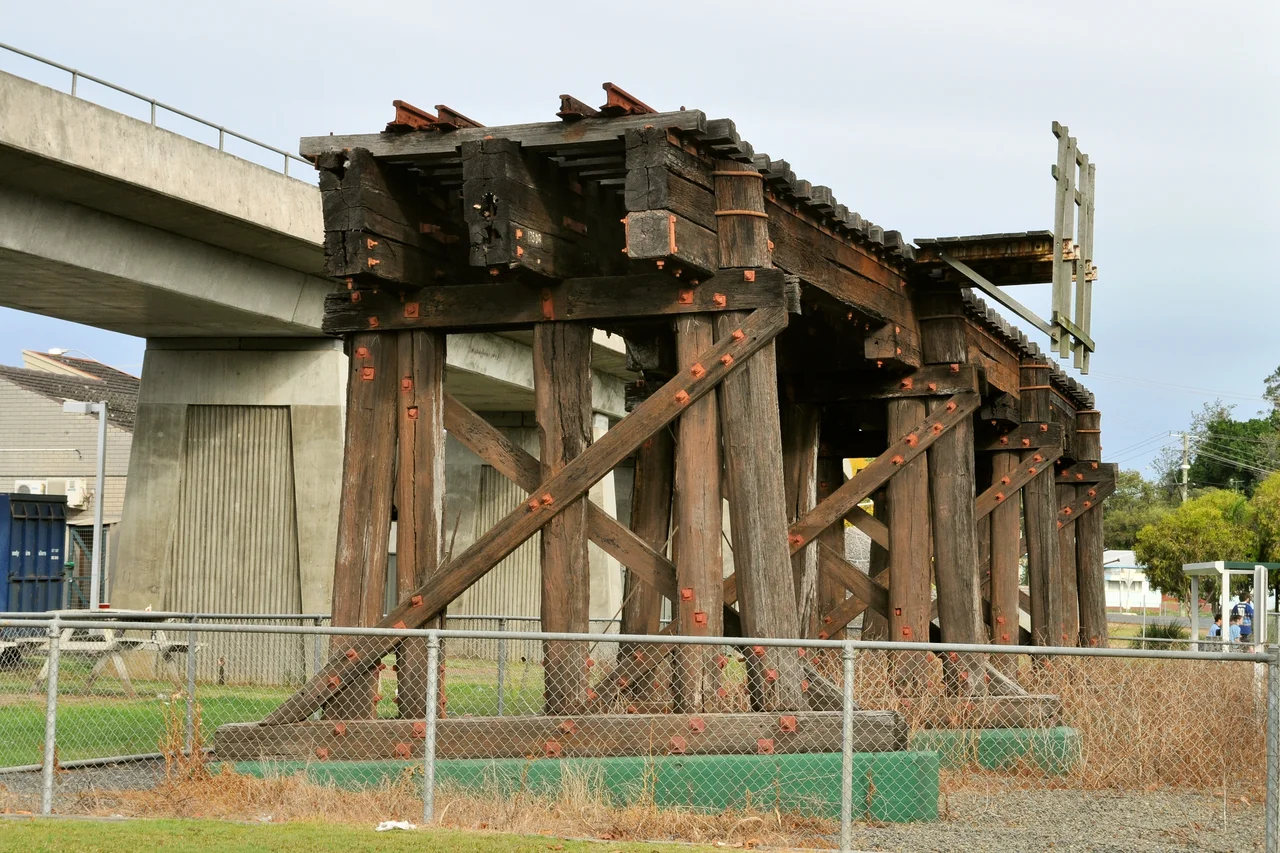
By the twenty-first century one ageing bridge could no longer carry the load, and in December 2019 a parallel crossing, the Balun Bindarray Bridge, opened 70 metres to the east to take much of the road traffic. The 1932 structure endures, heritage-listed since 1999 and still a commanding presence over the river - a reminder, as the listing puts it, of road and rail to the people of Grafton. Nearby, the three surviving timber spans of an even older 1915 viaduct still stand in parkland south of the railway station. Best of all, the bridge frames a city famous for its jacarandas, the purple trees that line Grafton's streets and have crowned it Australia's jacaranda capital since the 1880s.
From the Air
The Grafton Bridge spans the Clarence River between Grafton and South Grafton, near 29.70 degrees south, 152.94 degrees east. From the air, look for two near-parallel river crossings: the historic dark steel double-deck truss bridge and, 70 metres to its east, the newer Balun Bindarray road bridge. The wooded length of Susan Island lies just upstream, and Grafton's broad jacaranda-lined grid sits on the north bank. The nearest field is Grafton Airport (ICAO YGFN); Coffs Harbour Airport (ICAO YCFS) lies to the southeast. Best viewed at low altitude in clear conditions - in late spring the surrounding jacarandas add a distinctive purple cast to the city.
Nearby Stories
- Gibraltar Range National Park 26 km away
- Woolgoolga, New South Wales 27 km away
- History of New Italy, New South Wales 29 km away
- Guy Fawkes River National Park 31 km away
- Tenterfield School of Arts 64 km away
- Cape Byron Marine Park 75 km away
- Cape Byron Light 109 km away
- SS Elingamite: Gold, Fog, and a Captain Wrongly Blamed 1796 km away