
Grand Indonesia
There was, for a while, a replica of the Prometheus statue from Rockefeller Center inside a shopping mall six degrees south of the equator. It stood in a darkened atrium designed to evoke a New York streetscape, surrounded by ceiling murals of Manhattan buildings and a projector that cycled images of Times Square. The fountain at its feet danced to "Theme From New York, New York." This was Grand Indonesia, opened in 2007 on Jalan M.H. Thamrin in the heart of Central Jakarta, a complex that did not merely offer retail -- it offered the theatrical suggestion that you had left the tropics entirely. The Prometheus statue is gone now, replaced in 2019 by a larger LED screen. The New York ambiance has been eroding for over a decade. But the fountain still dances.
Two Malls, One Bridge
Grand Indonesia is not a single building but two -- the West Mall and the East Mall -- connected by a multi-level bridge. Together they sprawl across 140,000 square meters of retail space within a total complex footprint of 630,000 square meters, making it the fourth largest mall in Indonesia. The complex sits beside the Selamat Datang Monument at the Hotel Indonesia Roundabout, flanked by the towers of Menara BCA and the Kempinski Residences. Eight levels of shopping are divided into three zones: the Specialty Zone for premium retail, the Main Zone for general shopping, and what was once called Crossroads of the World. That last zone deserves its own story, because it is a case study in how themed retail ages.
The Crossroads That Closed
Crossroads of the World was designed by Legacy Entertainment as Grand Indonesia's signature attraction -- four themed districts modeled on an Entertainment District, a Fashion District, a Garden District, and a Market District. The idea was immersive retail, shopping as theater. It lasted roughly a decade. In 2011, portions of the Market and Garden Districts were replaced by a Toys Kingdom outlet and an Ace Hardware store. By 2013, decorative elements were being stripped to accommodate new tenants who needed plain walls. In 2017, Crossroads of the World was fully removed from the mall's branding. Only fragments of the Entertainment and Fashion Districts survived, embedded in a floor plan that no longer acknowledged them. The arc is familiar to anyone who follows themed retail: the spectacle attracts crowds, but the economics of leasing floor space eventually demand something simpler.
Waltzing Waters at the Equator
The Dancing Fountain remains Grand Indonesia's most enduring attraction. Built by Waltzing Waters, a fountain company based in Florida, the installation is the only one of its kind in Indonesia -- a nine-section model housed in the Fountain Atrium of the West Mall, spanning levels 3A and 5. Shows run every three hours on weekends and public holidays, choreographed to a rotating playlist: Gershwin's "Rhapsody in Blue," an Andrew Lloyd Webber medley, and the signature "Theme From New York, New York." Seasonal programming adds Trans-Siberian Orchestra and "Sleigh Ride" from November through January. A Chinese New Year selection was part of the rotation until 2011, when it was quietly discontinued. The atrium around the fountain was originally kept dark to enhance the water and light effects, but the construction of a food court called Foodprint on the second floor in 2017 introduced permanent ambient light that diluted the theatrical darkness.
A Gallery Above the Shops
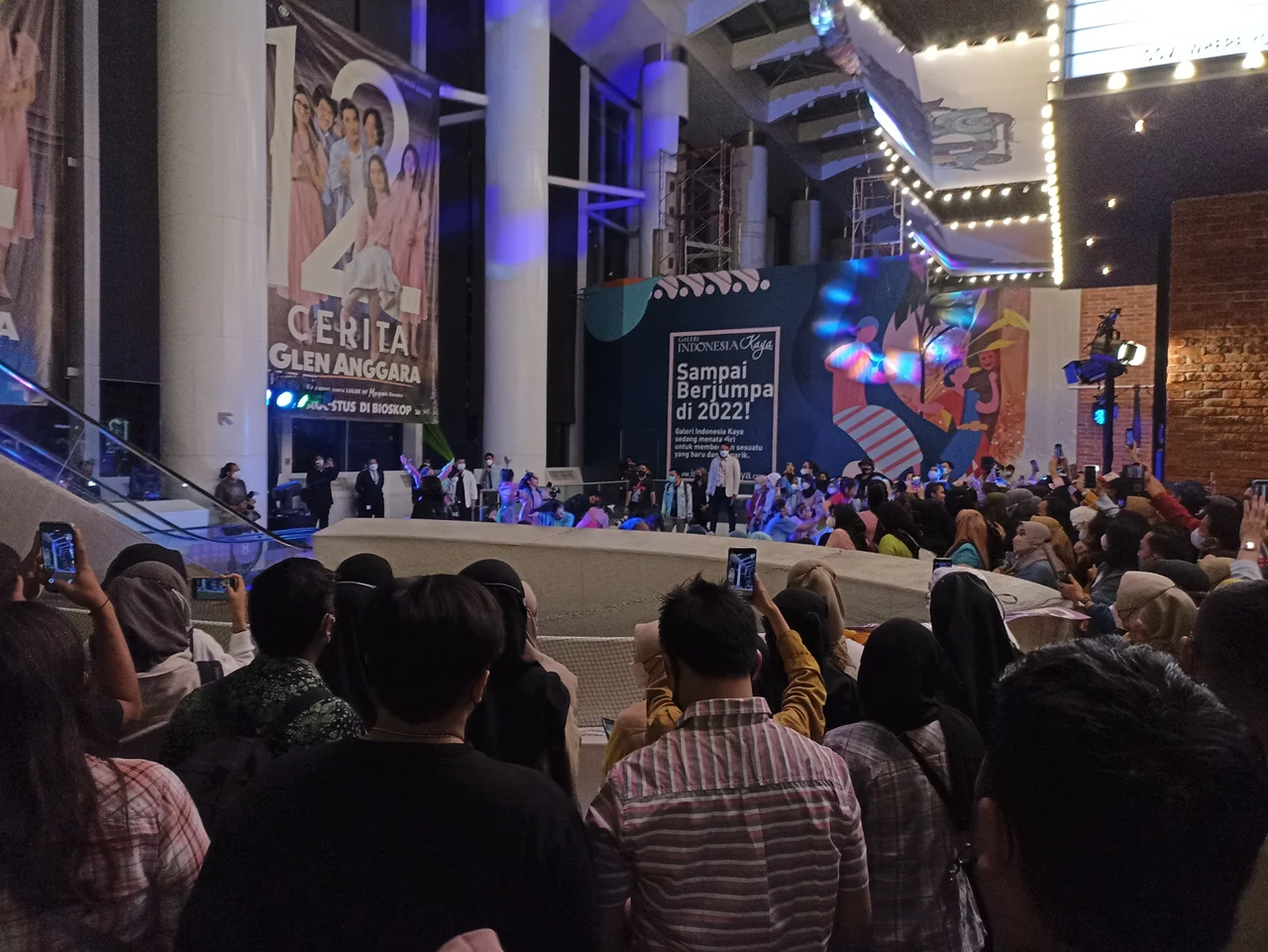
On the eighth floor of the West Mall, above the cinema complex with its basketball-court-sized ScreenX screen -- at 26 by 14 meters, the second largest in the world -- sits the Galeri Indonesia Kaya. The name translates roughly as "Gallery of the Rich Indonesia," and it functions as a free cultural space showcasing Indonesian heritage. A 2022 renovation transformed it into a digital gallery with augmented-reality installations: visitors can virtually cook traditional Indonesian dishes, fly over the archipelago's landscapes, or encounter endemic wildlife through interactive screens. A 150-seat auditorium hosts drama performances and cultural programming. It is a curious thing to find at the top of a shopping mall -- a space devoted not to selling but to a kind of national self-portrait, tucked above the commerce, reachable only by those willing to ride the escalator past every retail floor to get there.
Spectacle in the Tropics
Grand Indonesia's story is one of constant reinvention, though the reinventions tend to subtract rather than add. The New York theming gave way to LED screens. The themed districts gave way to conventional retail. The Prometheus statue gave way to a video display. What persists is the scale itself -- the sheer volume of climate-controlled space at the center of Jakarta's busiest roundabout, the bridge linking two buildings like a commercial isthmus, the fountain still performing Gershwin to weekend crowds. The mall sits where Hotel Indonesia's original Olympic-size swimming pool once was, built when Sukarno was reshaping the capital for the 1962 Asian Games. That pool gave way to this complex in 2007. In Jakarta, even landmarks are provisional. What matters is not what stands but what happens in the space -- and at Grand Indonesia, something is always happening.
From the Air
Located at 6.195S, 106.820E in Central Jakarta, immediately adjacent to the Hotel Indonesia Roundabout (Bundaran HI) and the Selamat Datang Monument. The complex is identifiable from the air by its two main structures flanking Menara BCA tower and the Kempinski Residences tower. Jalan M.H. Thamrin runs north-south past the site, with the green expanse of Merdeka Square and the National Monument (Monas) approximately 1 km to the north. Nearest major airport is Soekarno-Hatta International (WIII), about 25 km northwest. Halim Perdanakusuma Airport (WIHH) is approximately 12 km southeast. Best viewed at low altitude in clear weather.
Nearby Stories
- The King's Footprints in the River 2.8 km away
- Rawagede Massacre 6.4 km away
- The Cruiser That Wouldn't Stop Fighting 14 km away
- Four Minutes Over the Java Sea 14 km away
- The Scholar's Mosque 21 km away
- Through the Cidepong Hills 37 km away
- Ujung Kulon National Park 97 km away
- The Islands That Vanished from Sight 352 km away