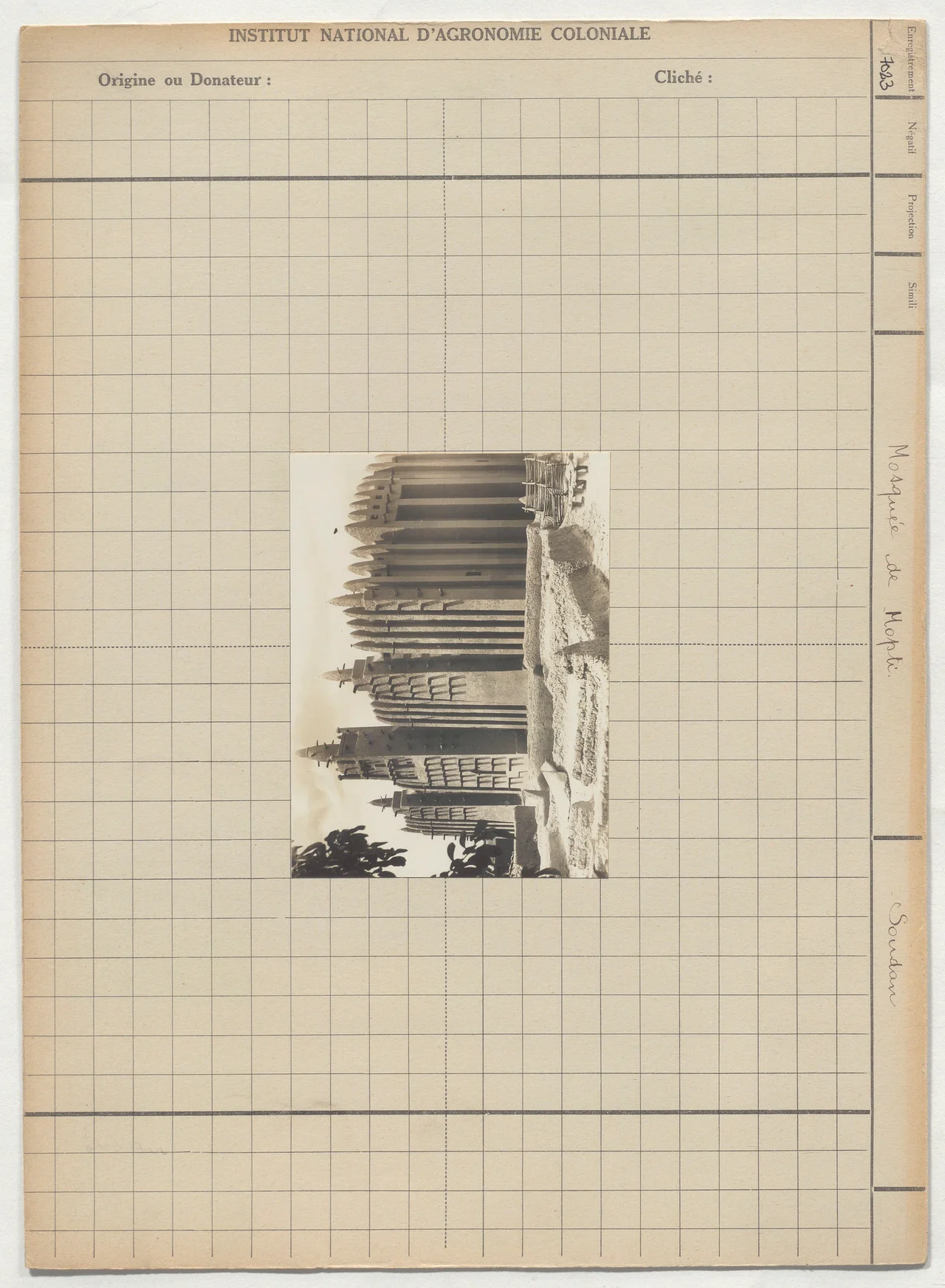

Grand Mosque of Mopti
Run your eye up the mihrab tower and you'll see them: bristling rows of timber stubs, called toron, jutting from the smooth mud walls like the spines of some great sleeping animal. They are not decoration alone. Each year, when the rains have passed, the people of Mopti climb those very beams to replaster the mosque by hand - a building that must be remade, again and again, to survive. The Grand Mosque of Mopti is architecture you cannot freeze in time. It is alive, and it demands tending.
City at the Confluence
Mopti grew up where two rivers meet - the Niger and the Bani - on what was once a small Bozo fishing settlement. By the early 20th century it had become a thriving commercial port under French colonial administration, a hub linked downriver to Bamako and the wider trade of the Western Sudan. It was into this rising river town, in the Komoguel district, that the city built its Friday mosque between 1933 and 1935. The structure belongs to a tradition known as the mosques of the Niger valleys - earthen buildings raised by experienced masons and the collective labor of the community, a style born of trans-Saharan trade and the spread of Islam along its routes.
Built of Earth and Timber
The mosque is a marvel of mud. Its symmetrical facades rise to a mihrab tower of 17 meters and lateral towers of 13.5, the whole structure covering some 530 square meters. There is no open courtyard - the prayer hall is enclosed, its roof carried on four bays of pillars set parallel to the qibla. Corner pillars and buttresses taper to elongated points; the northern and southern entrances open through Djennian portals. The towers climb to trapezoidal spires capped with ceramic crowns, and atop each, a pair of ostrich eggs - a recurring motif in Sahelian sacred architecture, symbols of fertility and purity. The toron that stud the walls double as a permanent scaffold for the annual replastering that keeps the earth intact.
The Cement Years
Mud architecture is fragile, and good intentions can wound it. A restoration in 1980 introduced cement - baked brick added to the towers and corner pillars, a cement skin applied to the upper facades. It looked, perhaps, like progress. It was the opposite. Cement traps moisture against the earthen core and cannot breathe with the building as mud plaster does; the additions damaged the very structure they were meant to protect. The mosque that had stood for four decades, faithfully replastered by hand, now bore a hard shell that was slowly killing it from within.
Restored to Mud
Between 2004 and 2006, the Aga Khan Trust for Culture set out to undo the harm. Local masons - the inheritors of the very tradition that built the mosque - stripped away the cement layer and stabilized the upper structure, replacing damaged areas with traditional mortar and brick made by mixing earth with rice chaff. Completed in June 2006, the restoration returned the building to the materials it was meant to be made of: earth, water, timber, and the recurring care of the hands that maintain it. In 2009, Mali placed the mosque on UNESCO's World Heritage Tentative List, formal recognition of a building that had nearly been lost to the wrong kind of repair.
From the Air
The Grand Mosque of Mopti (Komoguel Mosque) stands at 14.49°N, 4.20°W in the old quarter of Mopti, near the junction of the Niger and Bani rivers. Nearest airport is Mopti-Ambodédjo (GAMB / MZI), a few kilometers east. From the air the mosque's twin-river setting and the surrounding mud-built port quarter are the key landmarks; the ochre towers stand out against the riverbank. Clearest viewing in the dry season (November-February). Recommended low-level viewing altitude 2,000-4,000 ft AGL to pick out the towers and the confluence.
Nearby Stories
- Tireli, Mali 22 km away
- Battle of Konna 27 km away
- Dia, Mali 45 km away
- Battle of Jenné 66 km away
- Tominian 106 km away
- Ouahigouya 139 km away
- Hand of Fatima (rock formation) 192 km away
- Néma 354 km away