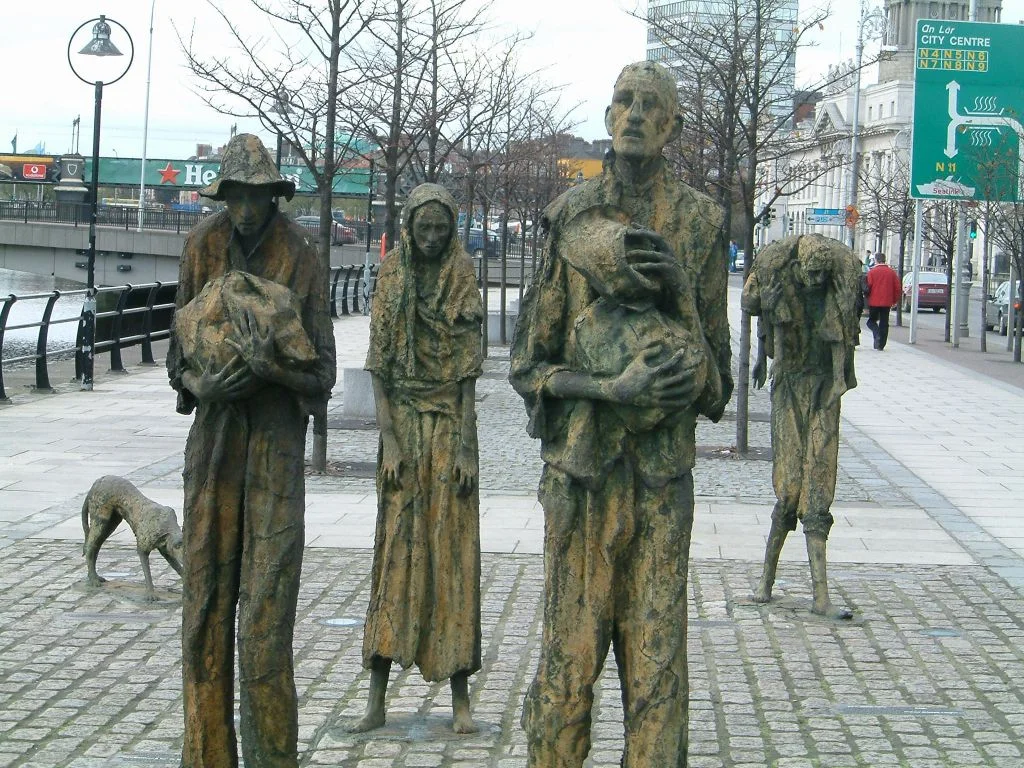

Great Famine (Ireland)
An Drochshaol, the people called it - the bad life, the hard times. The Irish words carry what English cannot: that this was not weather, not accident, not simply hunger. It was a way of living and dying that wore down a country until the country was unrecognizable. In 1841, the census counted 8,175,124 people on the island of Ireland. By 1901, the population had fallen to 4.4 million. One million died. Two million fled. And the green hills that travelers still cross today are quieter than they should be, because the people who once filled them never came back.
Black '47
The blight arrived from America - probably on a ship's load of potatoes, carried by ocean to feed passengers and crew. By August 1845, it had reached the Isle of Wight. By September, The Gardeners' Chronicle stopped the press to announce that "the potato Murrain has unequivocally declared itself in Ireland." The disease was Phytophthora infestans, an oomycete that turned plants to rot in the ground. One-third of the 1845 crop was lost. In 1846, three-quarters. By 1847 - which became known as Black '47 - the seed potatoes were gone. Hunger arrived in autumn 1846. The first deaths from starvation followed within weeks. Three million Irish people had depended entirely on the potato for food. Now they had nothing.
The Ships at the Quays
While people died on the roads, ships continued to leave Irish ports loaded with grain. Nicholas McEvoy, parish priest of Kells, watched fifty dray-loads of meal roll past one milling establishment in a single night - bound for Drogheda, then to England. He wrote that he could not understand why his country alone, of all the starving in Europe, was "unworthy the sympathies of a paternal gentry or a paternal Government." Other countries had closed their ports during famine. Ireland's were kept open. The Whig government in London, devoted to laissez-faire economics, refused to interfere with the markets. Charles Trevelyan, who administered government relief, wrote privately that if small farmers went and landlords sold their estates, the country might "at last arrive at something like a satisfactory settlement." John Mitchel later wrote the sentence that lodged in Irish memory: "The Almighty, indeed, sent the potato blight, but the English created the Famine."
The Workhouse and the Road
Relief came as workhouses, public-works schemes, soup kitchens. None were enough. The Poor Relief Act of 1847 included the Gregory clause: anyone holding more than a quarter-acre of land could receive no aid. To eat, you first had to give up the land - which meant giving up the only thing that might let you live afterward. Tens of thousands of families surrendered their holdings. Landlords cleared the rest. Captain Kennedy estimated that in West Clare alone, a thousand cabins had been levelled in six months. The Mahon family of Strokestown evicted 3,000 people in 1847 and continued to dine on lobster soup. The 3rd Earl of Lucan, who owned more than 60,000 acres, said he "would not breed paupers to pay priests." Between 1849 and 1854, police recorded almost 250,000 evictions - and the historian James Donnelly believes the true figure, including "voluntary" surrenders, exceeded half a million.
Coffin Ships
Those who could leave, left. Between 1845 and 1855, at least 2.1 million people fled Ireland - one of the greatest exoduses from any single island in history. They sailed from small western harbors on vessels so overcrowded and disease-ridden they were called coffin ships. Of the 100,000 Irish who reached Canada in 1847, one in five died on the voyage or in quarantine. More than 5,000 are buried on Grosse Isle in the St. Lawrence. The 1851 Toronto census found that more than half its residents were Irish; 38,000 had landed in a city of fewer than 20,000 just four years earlier. By 1850, the Irish made up a quarter of the population in Boston, New York, Philadelphia, and Baltimore. Unlike most historical emigrations, women left in equal numbers, equally young. Once across, they sent money home - £1.4 million by 1851 - so the next sibling could go.
Kindness from Strangers
In 1847, sixteen years after their own forced march along the Trail of Tears, the Choctaw Nation of Oklahoma collected $170 and sent it to Ireland. They had known starvation themselves. Pope Pius IX issued an encyclical calling the whole Catholic world to give. Queen Victoria contributed £2,000. Sultan Abdulmecid I of the Ottoman Empire reportedly offered £10,000 and was asked to reduce it to £1,000 so as not to embarrass the Queen. From Calcutta, Irish soldiers and East India Company employees raised £14,000. James K. Polk donated $50. A young Illinois congressman named Abraham Lincoln sent $10. Total relief from outside Ireland came to about £856,500. It was not enough. Nothing was ever going to be enough.
What Was Lost
The Famine fell hardest on the west and south, where the Irish language was still the daily tongue. Drumbaragh in County Meath lost 67% of its people. In Springville, fifty houses became eleven. Folk memory carries what no statistic can: the empty cabins on the hillsides, the lazybeds of ridged potato earth that still pattern the green grass of Connemara like the bones of an old skeleton. The famine reshaped the marriage age, the age of inheritance, the structure of the family. It made Liverpool "Ireland's second capital" and it built South Boston. It convinced generations of Irish people, at home and across the diaspora, that the British Crown could not be trusted with Irish lives. The Land War of 1879 came out of it. So, eventually, did independence. The National Famine Memorial at Murrisk in County Mayo - a bronze coffin ship with skeletons threaded through the rigging - faces out toward the Atlantic, toward where so many went and never returned.
From the Air
The Great Famine's geographic center of memory falls roughly at 53.351N, 7.921W - the rural midlands of Ireland. From cruising altitude over central Ireland, the patchwork of small fields and the abandoned cabin sites still visible in the west tell the demographic story. Dublin (EIDW) lies to the east; Shannon (EINN) to the west; Knock (EIKN) to the northwest, in the heart of the worst-affected counties of Mayo and Roscommon. Look for the small stone walls dividing land into impossibly small holdings - the very subdivision that helped the blight cut so deep.
Nearby Stories
- Saighir 7.8 km away
- Portlaoise 8.2 km away
- Castlepollard Mother & Baby Home 8.9 km away
- Mountbellew 14 km away
- St Mel's Cathedral 15 km away
- Castlerea 18 km away
- Mullingar 19 km away
- Gort 25 km away