
Great Malvern
Edward Elgar liked to compose while walking. He would set off from his house on the eastern slope of the Malverns with a notebook in his pocket, climb until the Worcestershire plain spread out below him, and let melodies arrive on the wind. The Enigma Variations, the *Cello Concerto*, the *Dream of Gerontius* - they were assembled, in part, from notes scrawled on these hillsides. A century later you can still walk the Elgar Route through Great Malvern and find his statue on Belle Vue Terrace, leaning on his bicycle, gazing up at the hills that taught him how to listen. The town below him is Victorian in a way few English places still are: a steep tangle of red brick and stone climbing the slope, threaded with springs, watched over by an 11th-century priory church.
Bare Hill, Healing Water
The name reaches back to before England existed. *Malvern* derives from the Common Brittonic words that survive in modern Welsh as *moel* and *bryn* - bare hill - and probably referred at first to the Worcestershire Beacon, the tallest summit of the range. By the time it appears in Domesday Book in 1086 as *Malferna*, the settlement at its foot was already gathering around a Benedictine priory founded in the 1080s. The growth that turned a hill-village into a town came later, and it came from the water. Springs rise all over these hills, and Malvern water - so clean it was said to contain almost nothing - became a 19th-century obsession. By 1842 two doctors, James Wilson and James Manby Gully, had set up rival hydrotherapy clinics, and the town exploded outward. Queen Adelaide visited in September that year. Charles Dickens, Florence Nightingale, Tennyson, Carlyle, and the future Franklin D. Roosevelt (at age seven, convalescing) all came to take the cure.
Priory of Glass
The Priory Church survives because the townspeople bought it. When Henry VIII's commissioners came to dissolve the monastery in 1539, the parish was given the option to purchase the building, and a man named William Pinnocke did so on the town's behalf. They acquired with it one of the most extraordinary collections of medieval stained glass in England - 15th-century windows that escaped the iconoclasts because they were nominally parish property rather than monastic. The priory's medieval floor tiles are similarly the finest set in any English parish church. Henry VII and his queen Elizabeth of York made substantial endowments to the priory in their lifetime; their elder son Prince Arthur, who would die before he could become Henry VIII's brother-on-the-throne, knew this church. So did William Langland, who may have been educated here and who set his great vision-poem *Piers Plowman* (1362) on "a Maye mornynge on Malverne hylles."
Lewis, Tolkien, and the Lamp Post
C.S. Lewis and J.R.R. Tolkien were friends and walking companions, and one of their favourite destinations was Malvern, where Lewis's former pupil George Sayer had become Head of English at Malvern College. The story goes that Lewis, Tolkien, and Sayer were leaving a Malvern pub one winter evening when it began to snow. A gas lamp glowed at the end of the lane, throwing yellow light onto the falling flakes, and Lewis remarked that it would make a very nice opening for a book. The image became the lamp post in *The Lion, the Witch and the Wardrobe*. Tolkien, walking the high ridges with Sayer, would compare the Malverns to the White Mountains of Gondor; in 1952 he recorded himself reading from *The Hobbit* and *The Lord of the Rings* at Sayer's Malvern home, recordings that were later pressed onto gramophone records. The town hands these stories around freely. There is a blue plaque on the Unicorn Inn marking Lewis's visits.
Spa Town Twilight
The hydrotherapy boom did not last. By the early 20th century medicine had moved on, the spa hotels emptied, and Malvern's enormous Victorian buildings stood looking for purpose. They found it in education. Malvern College, founded in 1865, expanded to fill several former hotels; the Imperial Hotel, built in 1860 by E.W. Elmslie (who also designed the magnificent Great Malvern railway station you can still see), became Malvern Girls' College and then Malvern St James. The same architect's Victorian station - all decorative ironwork and painted floral capitals - turns up in television: it played a commuter-belt halt in the 1975 post-apocalyptic series *Survivors*. Two Nobel laureates and an Olympic gold medallist passed through Malvern College's gates, as did the emperor Haile Selassie, who stayed at the Abbey Hotel during his 1936-41 exile from Italian-occupied Ethiopia.
The Hills Still Belong to Everyone
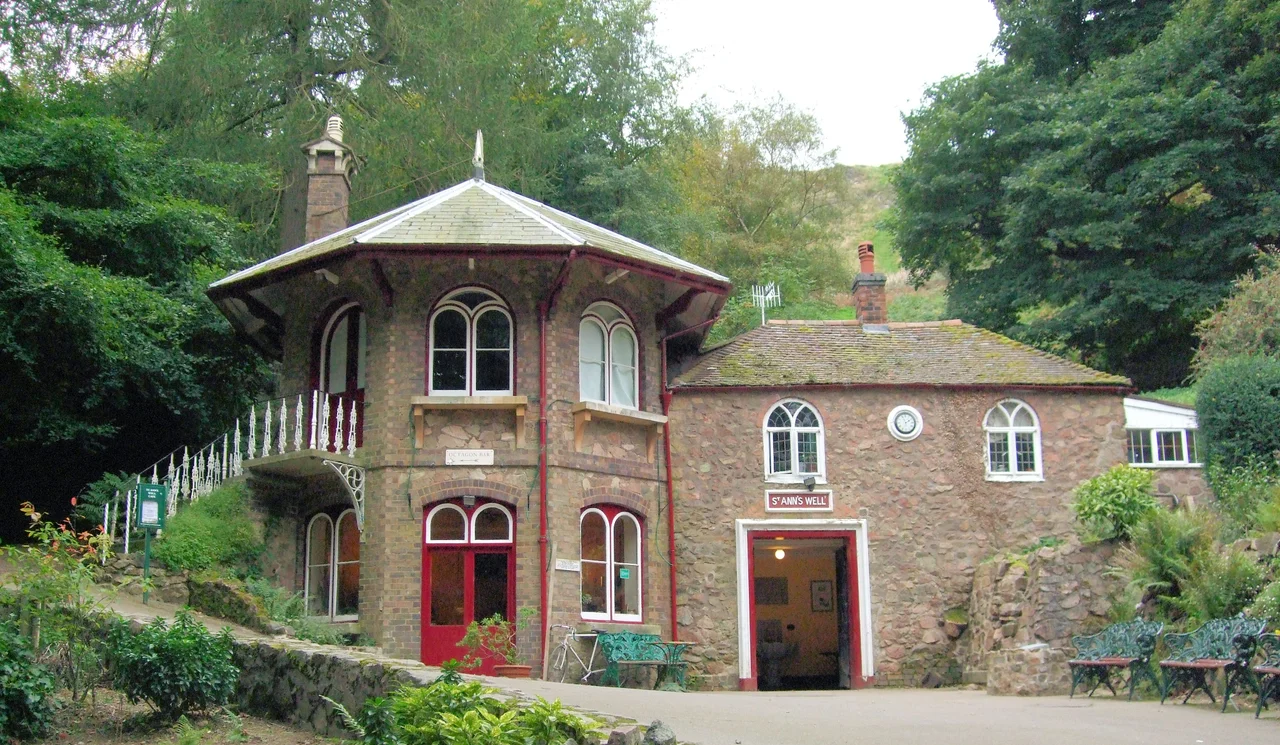
There is one more reason the Malvern Hills look the way they do. By the 1880s the spa boom threatened to swallow the open ridges in villa development, and the Malvern Hills Act of 1884 created a body - the Conservators - empowered to buy up the manorial wastelands and keep them open. By 1925 they had acquired most of it. The result is one of the longest continuously protected upland landscapes in England, a nine-mile spine of ancient Precambrian rock open to walkers from any direction. Climb to the Worcestershire Beacon at 1,394 feet on a clear day and you can see thirteen counties; turn south and the ridge runs all the way to British Camp, the great Iron Age hillfort that crowns Herefordshire Beacon. The springs that built the town still flow at St Ann's Well in its 1813 building. The Elgar statue still leans on its bicycle. Below it, on Belle Vue Terrace, the Enigma Fountain plays.
From the Air
Located at 52.11°N, 2.33°W at the eastern foot of the Malvern Hills (which rise to 1,394 ft at Worcestershire Beacon). The town drapes the hillside from 164 ft to about 656 ft elevation. Best viewed at 2,500-4,000 ft AGL with the unmistakable Malvern ridge running north-south. The Severn winds about 4 miles to the east. Nearest airfields: Gloucestershire (EGBJ) 20 nm south, Wolverhampton (EGBO) 25 nm north-east, Birmingham (EGBB) 35 nm north-east. Watch for the prominent Great Malvern railway station near town centre.
Nearby Stories
- Kidderminster 2.5 km away
- Stokesay Castle 5.4 km away
- White Castle, Monmouthshire 6.2 km away
- National Motorcycle Museum (UK) 7.7 km away
- Church of the Holy Trinity, Stratford-upon-Avon 8.2 km away
- Prinknash Abbey 8.3 km away
- Dore Abbey 18 km away
- Woodstock Palace 27 km away