.JPG)
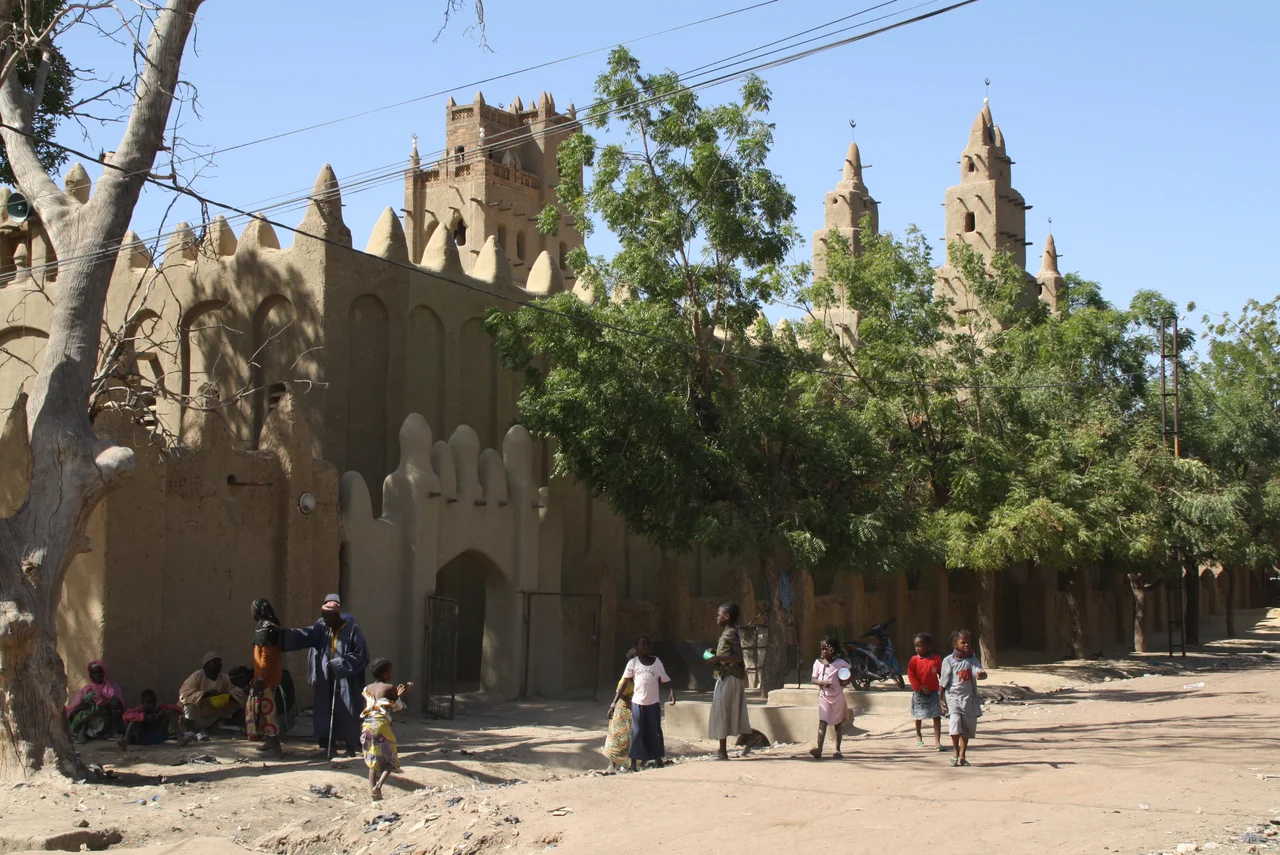
Great Mosque of Niono
There is no steel here, no poured concrete, no imported glass - only earth, palm wood, and clay mortar, shaped by hands that learned their craft the way their grandfathers had. And yet in 1983 the Great Mosque of Niono received the Aga Khan Award for Architecture, one of the most prestigious honors in the Islamic world, beating out steel-and-glass projects from across three continents. The jury's point was deliberate: this mud-brick mosque in central Mali proved that a building made entirely of local materials, by local workmen, could be a masterpiece.
Built From the Ground It Stands On
The mosque's first version rose in 1948, raised by a team of bricklayers from Djenné - the celebrated mud-architecture town downriver - led by the mason Lassiné Minta. As Niono's population swelled, the building grew with it, expanded in stages until the last major enlargement was completed in 1973. The techniques never changed, because they did not need to. Load-bearing walls and arches of sun-dried mud brick, floors and roofs of palm wood, matting, and packed earth: these are methods that have shaped the Sahel for centuries. What the Aga Khan jury celebrated was not novelty but continuity - the survival of a sophisticated tradition in a century racing toward concrete. The mosque, they wrote, showed that traditional forms remain one of architecture's strongest allies in keeping cultural identity alive.
A Sculpture You Can Pray In
Step inside and the scale reveals itself. The mosque covers 1,800 square meters; its main prayer hall alone spans 658, and a women's prayer hall rises across two floors. The interior is a hypostyle forest - sixty-eight pillars carrying the weight of those heavy earthen roofs, dividing the dim cool space into bay after shadowed bay. Outside, four minarets punctuate the form: a principal tower over the western entrance and three more clustered at the eastern end along the qibla wall, the side that faces Mecca. The whole structure has the hand-modeled, slightly organic quality of earthen architecture, as though it had grown from the plain rather than been set down upon it. In the flat light of the Sahel, its bristling silhouette is unmistakable.
A Living Monument
Mud architecture is never finished. Rain erodes it, sun cracks it, and each year the community must replaster the walls - so the mosque is, in a real sense, remade by hand again and again by the people who use it. That ongoing act of care is part of what makes it remarkable, and part of why UNESCO added it to its World Heritage Tentative List in 2009 under the cultural category. The Great Mosque of Niono is not a relic preserved behind glass. It is a working house of prayer, sustained by the same skills that built it, standing as proof that the oldest way of building in the Sahel is also, still, a living one.
From the Air
The Great Mosque of Niono stands at 14.25°N, 6.00°W in the town of Niono, Ségou Region, central Mali, at the northern reach of the Office du Niger irrigation zone. Bamako-Sénou International (GABS) is the nearest major airport, well to the southwest; Ségou's airfield lies closer to the south. From the air, Niono appears as a town set amid a geometric grid of irrigation canals and rice paddies - a startling patch of green order in dry country - with the mosque's bristling minarets and earthen mass marking the urban core. Skies are generally clear and dust-hazed; the low, raking light of early morning or late afternoon best reveals the mosque's sculpted, hand-built surfaces.
Nearby Stories
- Sansanding 41 km away
- Dia, Mali 72 km away
- Nyamina 90 km away
- San, Mali 115 km away
- Inner Niger Delta 121 km away
- Ghana Empire 186 km away
- Koulikoro 189 km away
- Lake Débo 226 km away