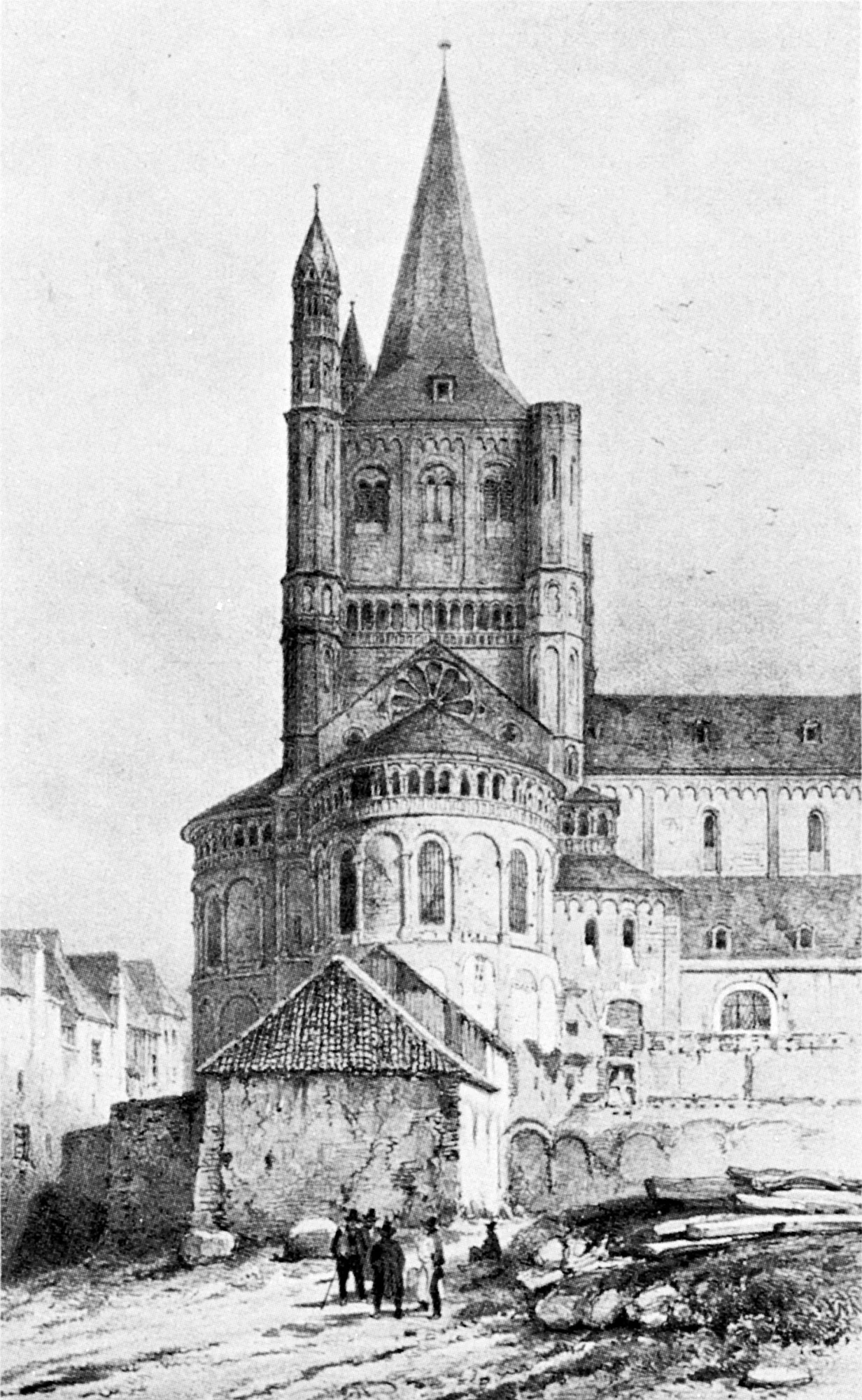

Great St. Martin Church, Cologne
On the night of May 30, 1942, the RAF dropped enough incendiaries on Cologne to burn the tower and nave of Great St. Martin to the ground. By the war's end, the bombs had taken the sacristy, the north apse, the chapel of St. Benedict, the triforiums of all three apses, and a direct hit on the central tower's foundation. Almost ninety-five percent of the old city around it lay in ruin. The trefoil-shaped east end, with its three round apses meeting at the crossing, was a thousand years old when the war began. The decision to rebuild it took until 1948. The decision to finish it took until 1985.
An Island in the Rhine
Long before there was a church here, this was an island. The Rhine split around a low rise of land east of the Roman Praetorium, and the Romans built something large on that island in the first century. Excavations in 1965 turned up a building 76 meters long and 71.5 meters wide, with a strange shallow pool in its inner room measuring 34 by 17.2 meters. No comparable structure has been found anywhere else north of the Alps. Was it a recreation hall with a swimming pool? A live-fish storage tank for the river markets? A sacred Roman precinct? The archaeologists could only guess. By the second century the pool had been filled in and warehouses surrounded it, storing goods bound up and down the Rhine. The island eventually fused to the bank. The river kept moving. The mystery did not.
Bruno the Great's Choir House
The trustworthy founding comes from the Lorsch Codex: Archbishop Bruno the Great, brother of Emperor Otto I, established a men's choir house here between 953 and 965, dedicated to Martin of Tours. In 989 it became a Benedictine monastery, staffed for the next century by Irish monks, part of the great Hiberno-Scottish missionary current that crossed the continent. Their names survive even if their voices do not: Kilian, Helias, Aaron Scotus, Molanus. Archbishop Pilgrim of Cologne disliked the Irish presence and worked to replace them; the last Irish abbot, Arnold of St. Martin's, died in 1103. Then in 1150 a fire swept Cologne and the abbey burned with it. What rose from those ashes is what survives, in essence, today.
The Trefoil Crown
Archbishop Philipp I. von Heinsberg consecrated the new church in 1172. The genius of the design lives in the east end: three round apses meeting in a cloverleaf around the central crossing, with the soaring tower lifting above them. This triconch shape, echoed at nearby St. Maria im Kapitol, gives Great St. Martin its silhouette and its name in any postcard of the Cologne skyline. By the mid-thirteenth century the apses got larger windows, the nave grew five meters longer, and a western atrium completed the plan. Storms and fires kept finding the towers. A 1434 gale toppled three of the four gables; one struck a fish market, two fell through the vault above the main altar. Each blow was answered. The roofs were repaired, a commemorative bell hung in 1436, the altars rebuilt.
Forty Years of Silence
The 1942 firestorm gutted the church, and the bombs of 1944 and 1945 took the rest. After the war, Cologne had to decide whether its medieval churches were worth restoring at all. A series of public lectures in 1946 and 1947 asked the question directly: 'What happens to the Cologne Churches?' Artists, architects, politicians and restorers argued it out in front of an exhausted public. Some thought the ruins should remain as memorials. The decision went the other way. Work began in 1948. The apse walls and dwarf galleries went back up by 1954. The nave got its roof in 1971. The full exterior, four towers and all, was restored in 1965. The interior took until 1985, when Archbishop Joseph Höffner reconsecrated the altar and installed relics of Bridget of Sweden, Sebastianus, and Engelbert of Cologne. The first worshippers in forty years walked back through the doors.
Living Stone
Since 2009 a branch of the Monastic Fraternities of Jerusalem has prayed the hours here. The triconch east end frames the skyline along the Rhine waterfront, and from across the river you can pick out the soaring crossing tower above the red-roofed Old Town, with the twin spires of Cologne Cathedral just behind it. J.M.W. Turner painted Great St. Martin in 1826, the church visible on the right side of his view of a packet boat arriving at evening. The painting hangs in the Frick Collection in New York. The building Turner painted was not the building destroyed in 1942, and the building you can visit today is not exactly the one Turner painted. It is, however, where Bruno the Great asked monks to sing for the soul of Martin of Tours, on top of a Roman mystery, on what used to be an island. Some places insist on continuing.
From the Air
Coordinates 50.9385 N, 6.9618 E, in Cologne's Innenstadt district on the west bank of the Rhine, immediately south of the Hohenzollern Bridge. The trefoil east end and tall crossing tower stand a few hundred meters south of Cologne Cathedral. Recommended viewing altitude 1,500-3,000 ft AGL for the river-and-skyline composition. Nearest major airport: Cologne Bonn (EDDK / CGN), 8 nm southeast. Düsseldorf (EDDL / DUS) lies 22 nm north. Cologne's Class C airspace surrounds the field; cathedral-and-church corridor is a popular sightseeing route, expect traffic.
Nearby Stories
- Diamond Interchange: How a Simple Idea Reshapes Towns Like Julich 2.8 km away
- Dusseldorf-Unterbach 6.1 km away
- Baumwollspinnerei Ermen & Engels 11 km away
- RAF Bruggen 15 km away
- Hagen Open-air Museum 21 km away
- Belgium 130 km away
- Marcinelle Mining Disaster 173 km away
- Zwingenberg Castle 178 km away