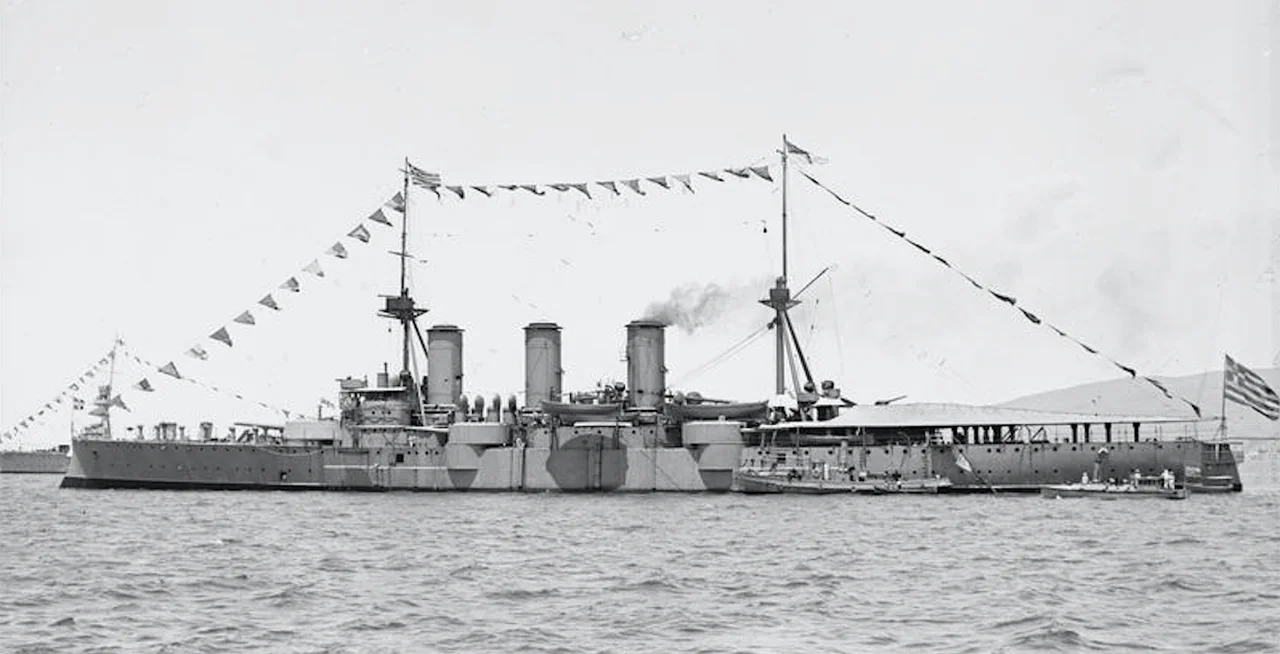

Greek Cruiser Georgios Averof
Admiral Kountouriotis had had enough. The three old Greek battleships were too slow, the Ottoman fleet was escaping, and the battle at Elli was slipping toward indecision. On 3 December 1912, he hoisted the flag signal for the letter Z — Independent Action — and the Averof turned alone toward the enemy at 20 knots. She cut across the front of the Ottoman line, concentrated fire on the Ottoman flagship, and forced the entire fleet to turn and run. The crew had fired their guns in battle for the first time that morning. They would not be the last time.
Bought With a Dead Man's Money
The Averof exists because a wealthy Greek philanthropist named Georgios Averof died and left his fortune to his country. Italy's Orlando Shipyards in Livorno had been building an armoured cruiser for the Italian Regia Marina, but the Italian government cancelled its order for budgetary reasons. Greece stepped in with a one-third down payment of approximately 300,000 gold pounds sterling — funded by the Averof bequest — and acquired the ship in 1909. She was launched on 12 March 1910, the last armoured cruiser to be commissioned in the world; the class had already been rendered obsolete by the battlecruiser, but Greece needed what she could get. The ship arrived at Faliro Bay near Athens on 1 September 1911, the most modern warship in the Aegean, fitted with Italian engines, French boilers, British guns, German armour, and a small Orthodox chapel dedicated to Saint Nicholas inside her hull — converted from what had originally been designed as an ammunition store.
The Devil's Ship
The First Balkan War began in October 1912. The Averof, under Captain Sofoklis Dousmanis and commanded at fleet level by Admiral Pavlos Kountouriotis, became its naval centrepiece. At the Battle of Elli on 3 December 1912, Kountouriotis's independent action — leaving the battle line and attacking the Ottoman fleet alone — succeeded beyond expectation. The Averof crossed the T of the Ottoman formation, concentrated fire on the enemy flagship, and forced a retreat. At the Battle of Lemnos on 5 January 1913, she did it again. In both engagements the ship suffered only slight damage while inflicting severe damage on multiple Ottoman vessels. The Ottomans called her *Şeytan papor* — The Devil's Ship. Her own crew called her Lucky Uncle George. By closing the Aegean to Ottoman supply ships, she shaped the land campaign as well; the Ottoman forces facing Greek troops on the peninsula could not be reinforced, and they lost. It was, in a real sense, a cruiser that determined the borders of modern Greece.
A Long Life in a Long War
The Averof continued serving through the First World War, the Greco-Turkish War of 1919–1922, and the interwar years. She underwent a major refit in France from 1925 to 1927, receiving new anti-aircraft armament and an overhaul of her engines. In 1935 she evacuated the former Prime Minister Eleftherios Venizelos after his failed coup attempt. On 20 May 1937 she attended the Coronation Naval Review at Spithead for King George VI — the only vessel present that had also attended the review in 1911, for King George V. King George VI was told the fact and made a point of welcoming her captain. The ship carried her history lightly, still in service, still flying the Greek flag, still the largest and most recognizable vessel in the Hellenic Navy.
Axes and Handsaws
On the morning of 18 April 1941, the Greco-German front had collapsed and German forces were entering Greece. The Averof received orders to be scuttled to prevent her capture. The crew refused. They cut through the closed harbour boom — a steel cable barrier — with axes and handsaws, and the ship slipped out of the harbour as her commander, Captain Ioannis Vlachopoulos, climbed up a rope ladder to join them while the vessel was already underway. Under constant threat of Luftwaffe air attack that had already sunk Greek and British warships in the evacuation, she sailed to Souda Bay in Crete and then to Alexandria, arriving in Egypt on 23 April 1941. Too slow for Mediterranean convoy work and lacking adequate anti-aircraft armament, she was assigned to Indian Ocean escort duties, based at Bombay. Mechanical problems plagued her throughout — her boilers had not been overhauled since her 1927 refit — and British sailors, exasperated by her repeated breakdowns, took to calling her 'Georgios Never-off.' She persisted.
The Flag on the Acropolis
On 17 October 1944, with Greece liberated and the German army withdrawing, the Averof sailed from Cairo carrying the Greek government-in-exile back to Athens. Under Captain Theodoros Kountouriotis — the son of the admiral who had commanded her at Elli in 1912 — she entered the port of Piraeus. When she docked, her flag was taken down and carried up to the Acropolis, where Prime Minister Georgios Papandreou raised it over the city. The Averof was decommissioned in 1952 and spent years at Salamis and then Poros before the Greek Navy moved her to Palaio Faliro in 1984, where she has been a floating museum ever since. She is berthed at Trocadero quay in the Naval Tradition Park, still technically in active service, still carrying a rear admiral's flag. Every Hellenic Navy ship passing through Faliro Bay renders her honours. The crew stands to attention. Officers salute. It is a ritual of memory for a vessel that outlived every reason it should have been destroyed.
From the Air
The Georgios Averof is moored at Palaio Faliro at approximately 37.933°N, 23.684°E, on the Saronic Gulf coast about 8 km southwest of central Athens. From the air at 2,000–4,000 feet, look for the Naval Tradition Park at Trocadero quay on the Faliro waterfront — the grey hull of the cruiser is distinguishable against the marina. The ship sits between the Athens seafront promenade and the open water of the Saronic Gulf. Athens International Airport Eleftherios Venizelos (LGAV) is approximately 25 km to the east-southeast. On clear days the Acropolis is visible to the north, closing the visual connection between the ship and the hill from which her flag was flown in 1944.
Nearby Stories
- Parnitha 3.4 km away
- Kea (island) 7.3 km away
- Sanctuary of Apollo Maleatas 11 km away
- Sousaki Volcano 12 km away
- Battle of Leuctra 14 km away
- Great Sand Beach 18 km away
- Agios Georgios (island) 23 km away
- Skyros 84 km away