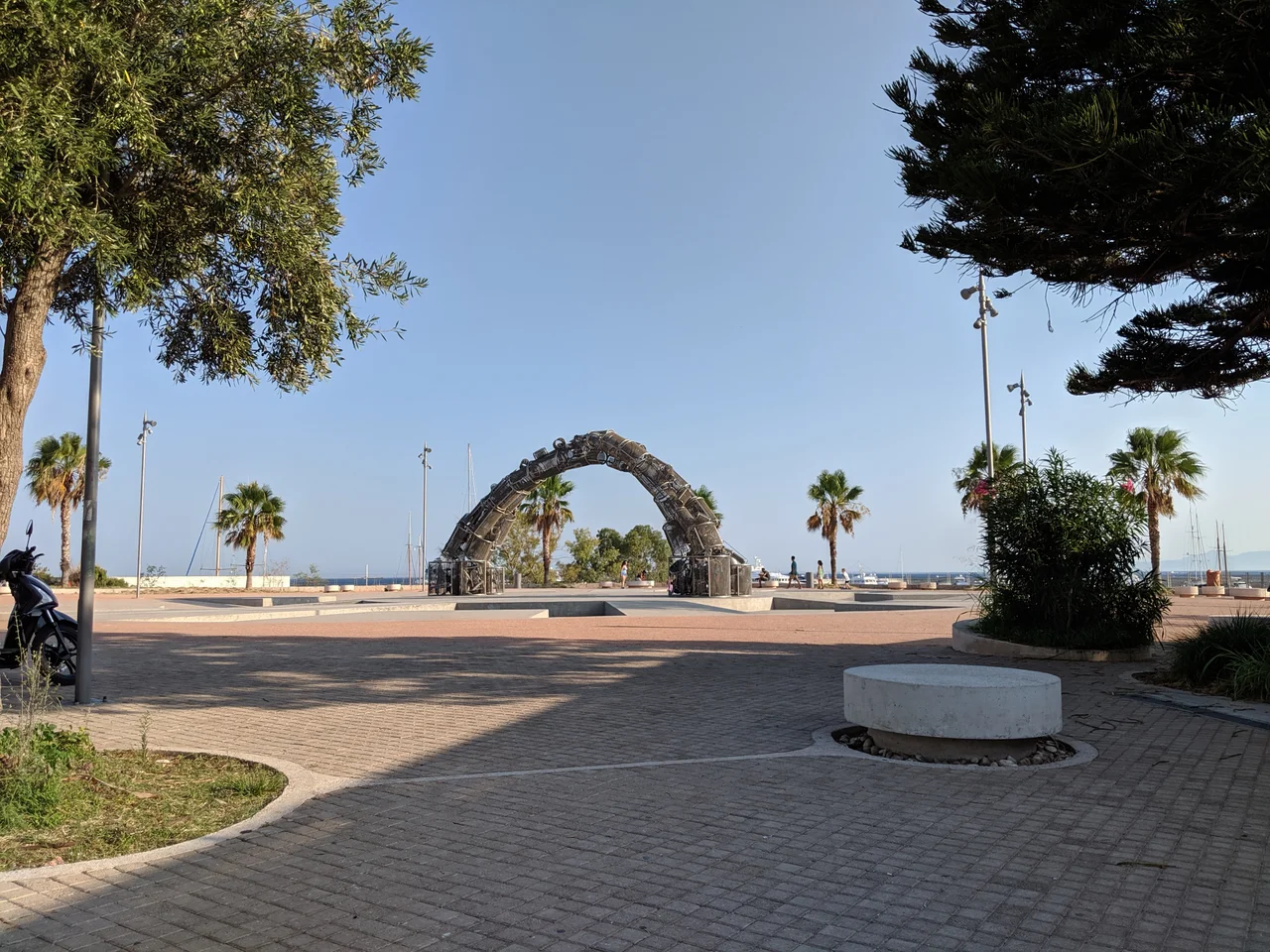

Greek Genocide Memorial in Piraeus
In the early 1920s, hundreds of thousands of Greeks poured into Piraeus with almost nothing. They came from Pontus on the Black Sea coast, from Smyrna and the Aegean littoral, from villages their families had inhabited for generations — driven out by deportations, death marches, and massacres that Greek and international scholars recognize as genocide. They arrived to a Greece that was itself exhausted and ill-equipped to receive them. That displacement, and the mass death that preceded it, is what the memorial in Alexandra Square was built to remember. Unveiled on May 21, 2017, the sculpture named "Pyrrhic Flight" stands in Piraeus as the first permanent memorial in the city to the genocide of the Greeks of Pontus and Anatolia — a deliberate anchor of grief and memory in one of the ports where survivors once disembarked.
A People Erased
The Greeks of Pontus had lived along the southern shore of the Black Sea since roughly 700 BC — a community with its own dialect, its own saints, its own music rooted in the kemençe and the lyra. The Ottoman Empire had long governed them as a Christian minority, unequal before the law but tolerated. That tolerance collapsed during and after the First World War. Beginning in earnest around 1914 and continuing through the early 1920s, the Ottoman government subjected the Greek populations of Pontus and Anatolia to organized violence: mass deportations into the Anatolian interior, forced labor battalions in which tens of thousands died, and outright massacres. By the time the Asia Minor Catastrophe of 1922 brought Greek military defeat and the burning of Smyrna, the communities that had existed for millennia along the Aegean and Black Sea coasts had been destroyed. Historians put the death toll among Pontic Greeks at somewhere between 300,000 and 360,000. Those who survived became refugees almost overnight.
The Wave That Washed Ashore
Piraeus was among the first ports to receive them. Through 1922 and into 1923, ships carrying survivors arrived in Greek harbors — people who had watched their homes burn, walked hundreds of miles under guard, or hidden in the mountains until the violence subsided. The population exchange treaty of 1923 formalized what violence had already largely accomplished: the removal of nearly all Greeks from Anatolia, and of Muslims from Greece. More than a million people were relocated. Piraeus, already a working port city, absorbed enormous numbers of refugees who had no resources and no familiar landscape. Many settled in neighborhoods that remain identified with the Asia Minor Greek community to this day. Their presence transformed the city — culturally, musically, demographically — even as their losses remained largely uncommemoralized for decades.
Pyrrhic Flight: The Sculpture
The memorial that now stands in Alexandra Square was funded by the shipping businessman Evangelos Marinakis and created by artist Panagiotis Tanimanidis. Tanimanidis named it "Pyrrhic Flight" — a title that holds together the ancient war dance of the Pontians and the forced exodus that undid their world. The sculpture is 15.50 metres long and 7.10 metres high, constructed from stainless steel with brass details. Its form rises like a wave — an arc of barrel-like steel segments that reads, from a distance, as a mass in motion. Inside, seventeen sculptural compositions are embedded: successive relief icons depicting the journey from Pontus toward a homeland the refugees had never lived in. The shape deliberately departs from the heroic realism common to Greek public monuments. Nothing here is triumphant. The wave lifts, but it does not arrive safely.
Recognition and Remembrance
Greece officially recognized the Pontic Greek genocide in 1994 and extended that recognition to Anatolian Greeks in 1998. May 19 is observed as a national day of remembrance. Yet for decades, Piraeus — the city that received so many survivors — had no permanent monument to what had been lost. The 2017 unveiling ceremony was notable precisely because it was the first time official memorial events for the genocide had taken place in Piraeus itself. The genocide is recognized by a number of countries and international bodies, and remains a subject of historical and diplomatic dispute between Greece and Turkey. The memorial in Alexandra Square takes no political position. It is about the people who died and those who did not — about the specific texture of exile, the weight of 17 carved images lining the inside of a steel wave, and the fact that someone thought to build this here, in the port where the ships came in.
A Square, a City, a Memory
Alexandra Square today is an urban plaza in a dense, lived-in part of Piraeus. The monument shares the space with the ordinary traffic of city life: people passing through, children nearby, the sounds of the harbor not far off. That ordinariness is not a diminishment. Memorials that stand in the middle of things — not sequestered in museum gardens, but embedded in streets that people use every day — make a different kind of claim. They insist on being seen by people who were not looking for them. The descendants of the Pontian and Anatolian Greek refugees still live throughout the greater Athens and Piraeus area. For them, this is not abstract history. The kemençe still plays. The dialect is still spoken in some households. And now, in the square, there is a wave made of steel to mark what was taken and what survived.
From the Air
The Greek Genocide Memorial stands in Alexandra Square in Piraeus, at approximately 37.934°N, 23.650°E. Piraeus lies directly west-southwest of central Athens, immediately identifiable from the air by its dense harbor geometry — multiple basins, the commercial port, and the protected marina at Zeas. At low altitude (1,500–3,000 feet), the urban grid of Piraeus resolves clearly and Alexandra Square can be found inland from the main waterfront. The nearest major airport is Athens International Eleftherios Venizelos (LGAV), approximately 25 km to the east-northeast. Visibility is typically good in summer; afternoon haze can soften the view in warmer months.
Nearby Stories
- Parnitha 3.4 km away
- Kea (island) 7.3 km away
- Sanctuary of Apollo Maleatas 11 km away
- Sousaki Volcano 12 km away
- Battle of Leuctra 14 km away
- Great Sand Beach 18 km away
- Agios Georgios (island) 23 km away
- Skyros 84 km away