.JPG)
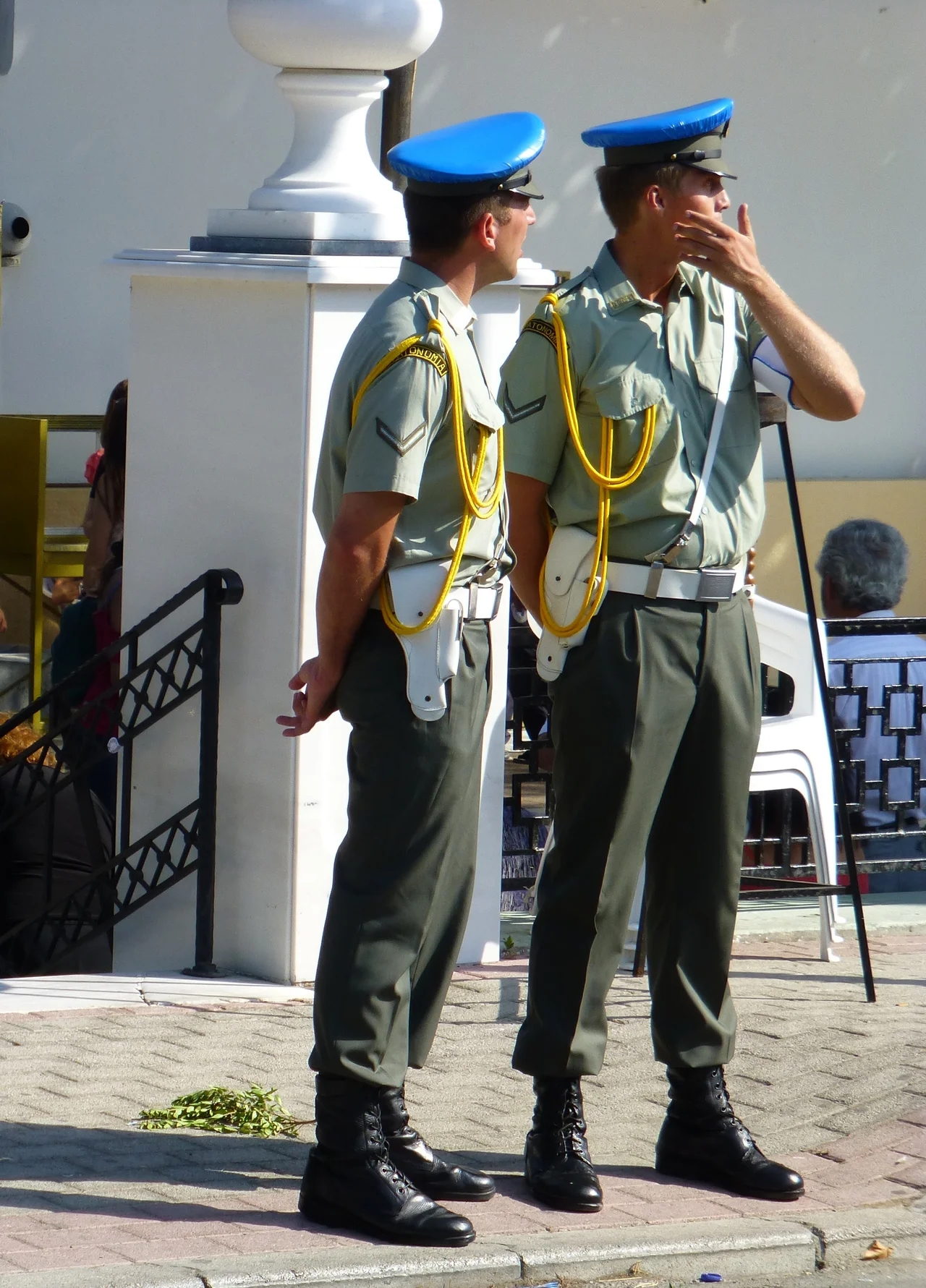
Greek Military Police
The park is called Eleftherias - Freedom. Its name is not an accident, and it is not a comfort. The handsome late-nineteenth-century buildings standing among its trees, just off the broad sweep of Vassilissis Sofias Avenue, once held the interrogation cells of the Greek Military Police. Between 1967 and 1974, men were brought here and broken. Athens kept the buildings, kept the name, and turned the place into a memorial - a deliberate refusal to let the suffering disappear quietly into the landscape.
A Force Chosen for Its Hatred
The Greek Military Police, known by the acronym ESA, was founded in 1951 as Greece prepared to join NATO. For its first years it was an ordinary, if powerful, branch of the army. What set it apart was selection: officers and conscripts alike were chosen for an extreme, near-paranoid anti-communism, which gradually concentrated the most conservative and anti-democratic men of the officer corps in one institution. A posting to ESA was prized for the authority it carried. That same authority is what made it so dangerous when, in April 1967, a colonels' coup seized the Greek state and began ruling by martial law.
The Cells at EAT-ESA
Under chief Dimitrios Ioannides, ESA swelled past 20,000 men and became the junta's chief instrument of repression. Thousands of political opponents were arrested and exiled to desolate Aegean prison islands. The worst of the abuse centered on the Special Interrogation Section - EAT-ESA - and the men held there were real people whose lives were permanently altered. Army Major Spyros Moustaklis, arrested for his part in a 1973 navy mutiny, endured forty-seven days of torture without betraying his colleagues; a blow to his neck left him brain-damaged and unable to speak for the rest of his life. Alexandros Panagoulis, who had tried to assassinate junta leader Georgios Papadopoulos in 1968, was beaten and tortured in these same cells. Witnesses later testified to the unit's chilling motto: those who entered left either as friends or as cripples.
A Reckoning, Incomplete
Democracy returned in 1974, and Constantine Karamanlis disbanded ESA. The reckoning came quickly but imperfectly. The first torturers' trial opened at the Athens court-martial in August 1975, and its verdict was read that December: thirty-seven people were condemned, including three senior military-police officers sentenced to twenty-three, twenty, and twenty years. Yet most served only token terms. Torture had not been a defined crime in the Greek penal code at the time it was committed, so the torturers could be prosecuted only for grievous bodily harm. The survivors had to watch the law stretch to reach men who had spent years perfecting cruelty - and only partly succeed.
What the Park Remembers
Today the building that held the interrogation sections houses the Eleftherios Venizelos Museum, and nearby stands the Museum of the Anti-Dictatorial and Democratic Resistance, where photographs, documents, and the personal belongings of the imprisoned and exiled are kept by the people who lived it. ESA itself was renamed simply Stratonomia, the Military Police, reformed into a conventional force staffed mostly by ordinary conscripts. The story is told here not as spectacle but as testimony. Walk the quiet paths of Eleftherias Park and the green of the trees does its gentle work - until you remember why the place is named for freedom, and at what cost the name was earned.
From the Air
Located in central Athens at 37.981°N, 23.752°E, along Vassilissis Sofias Avenue near the National Gallery and the US Embassy. Athens International Airport (LGAV) lies roughly 30 km east-southeast. Best appreciated on the ground as a memorial site; from the air, the green of Eleftherias Park stands out against the dense urban fabric east of the Acropolis. Clear Attic skies offer broad visibility over the basin.
Nearby Stories
- Great Sand Beach 5 km away
- Battle of Delium 7.7 km away
- Tower of Aliartos 9 km away
- HMHS Britannic 10 km away
- Saronic Gulf 15 km away
- Sousaki Volcano 17 km away
- Sanctuary of Apollo Maleatas 24 km away
- Skyros 66 km away