
Greek Public Tobacco Factory
Three thousand people once worked inside this building, and on the busiest days the air would have carried the dry, sweet smell of cut tobacco from every floor. The Greek Public Tobacco Factory rises in a full city block in the Kolonos district of west Athens, an enormous square of reinforced concrete wrapped around a glass-roofed courtyard. It was built for an unglamorous reason - to control and tax the cigarettes that had become Greece's most valuable export - and it ended up living through nearly everything the twentieth century threw at the city.
A Building to Tax the Smoke
Tobacco made the modern Greek economy. The eastern leaf thrived on the poor, sloping soils of Thessaly and Macedonia, lands annexed to Greece in the late nineteenth century, and by the early twentieth it had overtaken raisins as the country's leading export. The state wanted its share. In 1883 it levied a tax amounting to forty percent of a cigarette's price, and it required cutting and packing to happen in public facilities where every gram could be watched. When fire destroyed the first such factory on Aristotelous Street in 1928, a replacement became urgent. The Greek State had already bought a 9,118-square-meter plot off Lenormann Street; civil engineer Nikolaos Gavalas took charge, and the new factory was completed in 1930 for just under three million drachmas.
Light, Air, and the Fear of Damp
The result was a confident piece of modernism: four wings on a square plan, two storeys over a semi-basement, measuring roughly 84 by 87 meters around a central atrium of 1,100 square meters roofed in a glass-and-metal canopy. Huge windows pierced every face of the building - not for beauty alone, but because dampness was the enemy of tobacco, and the leaf needed constant air and light to stay sound. The atrium, a bold engineering feat for its day, was where deliveries were unloaded. Yet the same heavy taxation that justified the building also invited smuggling, so the state covered the warehouse windows with metal screens and ran a customs office on site. Across sixty-five years, twenty-five cigarette firms passed through these halls; SANTE, the last, departed only in 1997.
A Shelter and a Prison
The factory's history darkens in the 1940s. During the German occupation the building was pressed into service as a detention center and camp, part of the machinery of an occupation that brought hunger and terror to Athens. After the Germans withdrew it was looted by furious civilians, then bombed during the street fighting of December 1944. In the years that followed it opened its doors to people who had lost everything - refugees from the surrounding Kolokynthos district and needy families among them - before the state reclaimed it for a long succession of bureaucratic uses: a prison, the Court of Audit, the press directorate, the statistical service, the tax administration. A working factory had become a building that absorbed whatever the country needed of it.
Where the Cut Leaf Gave Way to Books
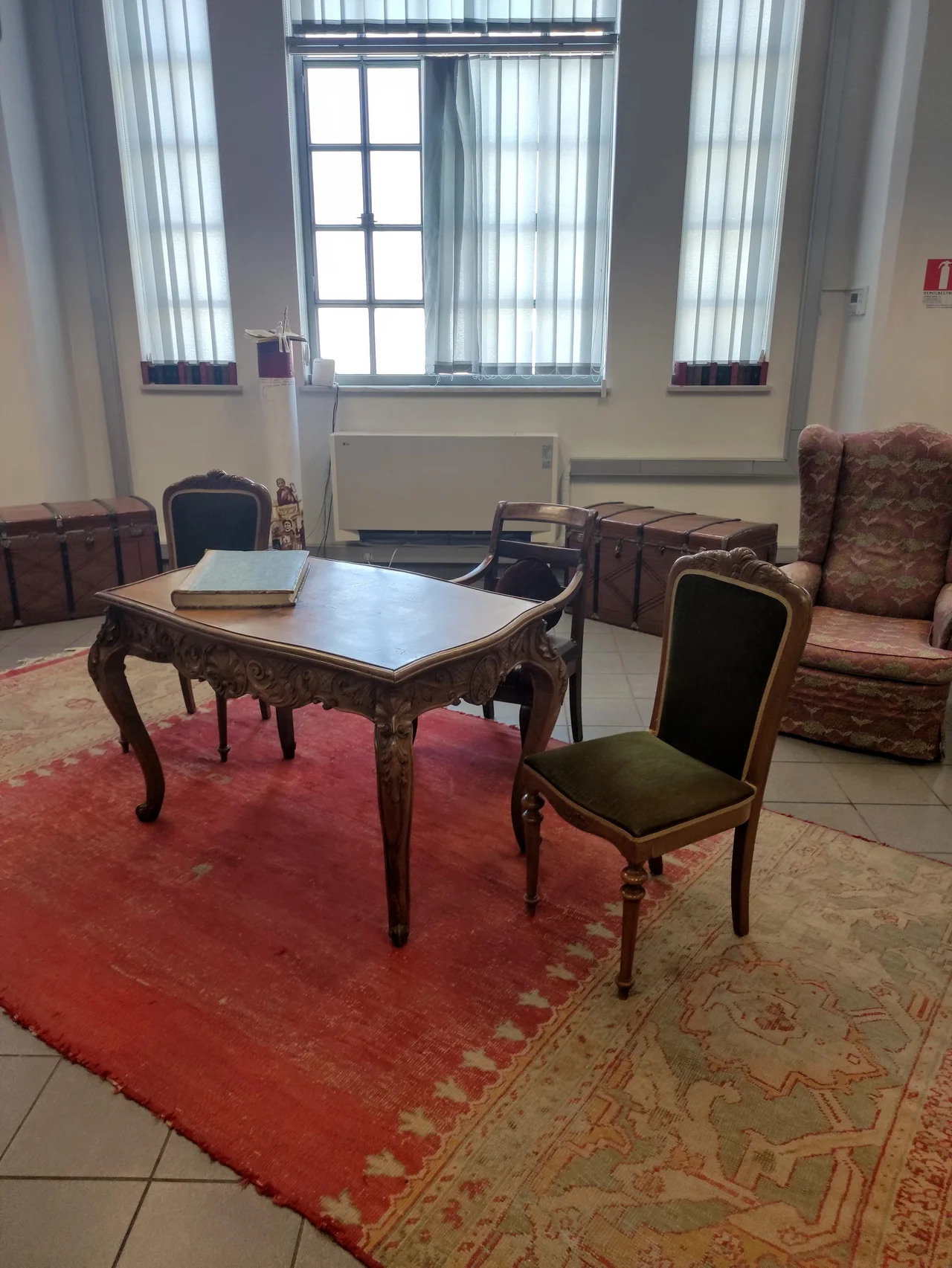
Its final reinvention is the gentlest. The old tobacco works now holds the Library of the Hellenic Parliament, whose collections run to some 650,000 volumes - books on law and history and the sciences, newspapers reaching back to 1789, manuscripts, maps, and rare editions, including the Benakeios Library donated in part by Emmanuel Benakis. The halls where workers once blended and packed cigarettes have become reading rooms and conservation studios, and the building hosts exhibitions that bring crowds back into the great glazed courtyard. The smell of tobacco is gone. In its place is the quieter smell of paper - and a labor history, written into the concrete, that the new tenants have chosen not to erase.
From the Air
Located in the Kolonos district of west-central Athens at 37.998°N, 23.711°E, on the block bounded by Lenormann, Amfiaraou, Leandrou, and Creontos streets, about 2 km northwest of the Acropolis. Athens International Airport (LGAV) is roughly 33 km east-southeast. The large square footprint with its glazed central atrium is identifiable from the air against the surrounding dense low-rise blocks. Best viewed in clear daytime conditions common over the Attic basin.
Nearby Stories
- Great Sand Beach 5 km away
- Battle of Delium 7.7 km away
- Tower of Aliartos 9 km away
- HMHS Britannic 10 km away
- Saronic Gulf 15 km away
- Sousaki Volcano 17 km away
- Sanctuary of Apollo Maleatas 24 km away
- Skyros 66 km away