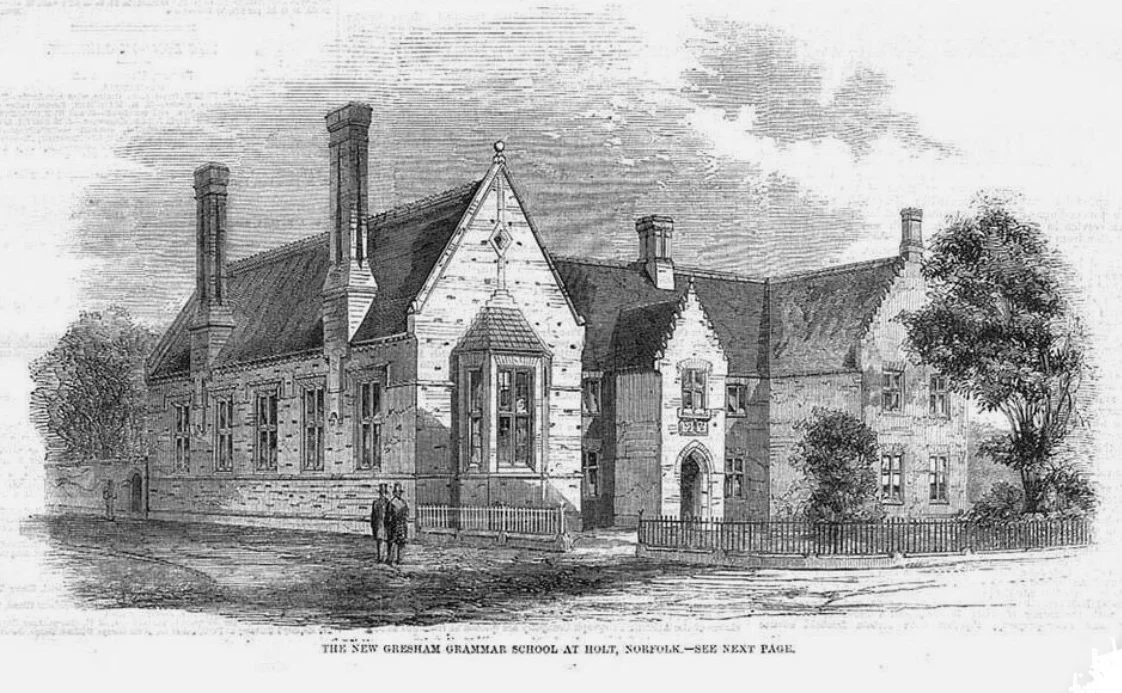

Gresham's School
Benjamin Britten did much of his early composing in the sanatorium. W. H. Auden wrote an essay about the school that still circulates among his admirers. Donald Maclean passed through its corridors before heading to Cambridge and then to Moscow as a KGB spy. James Dyson attended, and later donated a STEAM building that bears his name. This roll call of the remarkable, the infamous and the brilliant comes not from Eton or Harrow but from a boarding school in the small Norfolk market town of Holt — a school funded by a medieval fishmonger's charity and run for nearly five centuries by the Worshipful Company of Fishmongers.
A Grammar School Born from Dissolution
Sir John Gresham founded the school in 1555, during the reign of Queen Mary I, on the site of his family's manor house in Holt. The founding was connected to an absence: Henry VIII had suppressed the Priory of Augustinian canons at Beeston Regis in 1539, ending a priory school that the Gresham brothers had probably attended. With no school left for the neighbourhood of Holt, John Gresham stepped in.
He endowed the school and placed it in the hands of the Worshipful Company of Fishmongers of the City of London, where it has remained ever since. For three and a half centuries the school occupied the Old School House — the original manor house overlooking Holt's market square. In 1708, a fire destroyed most of the medieval town around it. The school survived; most of Holt's surviving historic buildings belong to the 18th century as a result. By the early 1900s, under headmaster George Howson, the school expanded onto a new 200-acre campus at the eastern edge of town, building the chapel, teaching buildings and boarding houses that define its present character.
The People Who Passed Through
Auden arrived in the 1920s, already writing. He later described the school's honour system — in which boys were required to report their own moral lapses to a housemaster — as peculiarly formative. Britten was a sickly pupil who spent time in the school sanatorium, composing there; his early work A Hymn to the Virgin was among the pieces written during that period. Stephen Spender was also at Gresham's, making the school briefly the hub of a remarkable literary generation.
Dyson attended in the 1960s, less celebrated then. He went on to build the vacuum cleaner empire and in 2021 completed the gift of the Dyson STEAM Building — a new centre for Science, Technology, Engineering, Arts and Mathematics on the school campus. Olivia Colman attended in the 1990s before her career in film and television. Lord Reith, who founded the BBC, was an Old Greshamian. So was Alan Hodgkin, who won a Nobel Prize for his work on nerve impulse transmission. The school produced the fourth President of Ireland, Erskine Hamilton Childers, and, under rather different circumstances, Maclean, who defected to the Soviet Union in 1951.
Holt Today
The school now teaches around 800 children across three schools — senior, preparatory, and a pre-prep nursery occupying the historic Old School House itself. It went fully co-educational in 1971 and has been an International Baccalaureate World School since 2007, placing consistently among England's top twenty IB institutions. In 2025, Tatler named it Best Public School in Britain alongside nominees including Eton.
The chapel, completed in 1916 during the First World War in which 106 Old Greshamians were killed, remains a listed building at the heart of the campus. Its bell was cast in Whitechapel in 1915. The school motto appears on the chapel door: Fiat voluntas tua — Thy will be done, a phrase from the Lord's Prayer that would have been familiar to every pupil who ever sat in that building, from Auden's generation to the present.
From the Air
Located at 52.91°N, 1.10°E in Holt, North Norfolk, approximately 35 km northwest of Norwich. The school campus occupies a substantial area at the eastern edge of Holt town, identifiable from the air by its playing fields, chapel tower and woodland. The nearest airport is Norwich International (EGSH), approximately 33 km to the southeast. The approach over the rolling North Norfolk farmland offers clear views at 2,000–3,000 ft in good visibility.
Nearby Stories
- Houghton Hall 3.1 km away
- Norfolk Tank Museum 7.5 km away
- Weeting Castle 11 km away
- Skegness Lifeboat Station 25 km away
- HMS Cobra 40 km away
- Battle of Lowestoft 79 km away
- SM U-97 101 km away
- Southern Bight 112 km away