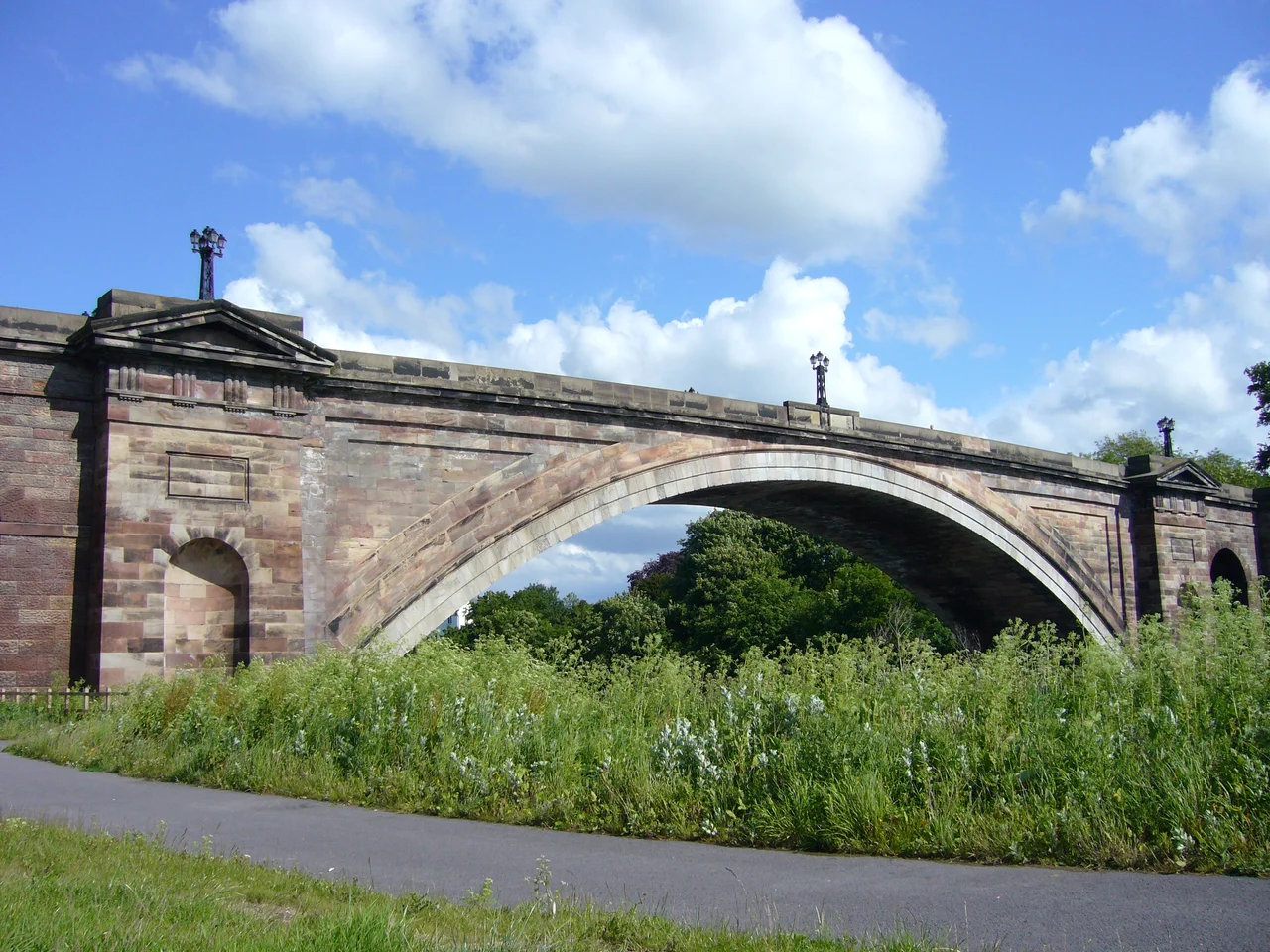

Grosvenor Bridge (Chester)
A thirteen-year-old girl in a carriage, accompanied by her mother, was driven through a triumphal arch staged on the unfinished roadway. A twenty-one-gun salute thundered across the Dee. The girl was Princess Alexandrina Victoria of Kent; in five years she would be Queen Victoria. The bridge under her wheels on 17 October 1832 was the longest single-span stone arch bridge in the world, and it would hold that title for the next three decades.
One Bridge, One Problem
At the start of the nineteenth century, Chester had a single river crossing: the Old Dee Bridge at Handbridge, a narrow medieval structure that had been overwhelmed for generations. Carts queued. Coaches lost their patience. And then Thomas Telford, the great Scottish engineer, proposed a new road from Shrewsbury to the Irish ferries at Holyhead, a route that would have bypassed Chester entirely. The threat was financial. Chester's prosperity rested partly on Irish trade, and if Telford's road took that trade west of the city, Chester would lose. A committee formed. A new bridge was the answer. It had to be tall enough for the city's shipbuilding traffic to pass beneath, and it had to be impressive enough to keep Chester on the map.
Thomas Harrison's Single Arch
The Chester architect Thomas Harrison designed an arch sixty feet high and two hundred feet wide. James Trubshaw, the chief builder, called it "a lasting monument to the glory and superiority of Great Britain". The numbers were not idle boasting. When the bridge was completed, it was the longest stone arch in the world. Its span remains the longest masonry arch in Britain to this day. The original alignment had run between Chester Castle and the junction of what is now Old Wrexham Road, but surveys showed soft, wet ground there, and Harrison worried the piers would never hold. Thomas Telford himself found a drier site downstream, and construction shifted. The old Wrexham Road became a dead end. A new highway was cut to meet the new bridge. The first stone was laid by Robert, 2nd Earl Grosvenor, on 1 October 1827.
Six Years of Building
Harrison did not live to see his arch close. He died in 1829, two years into construction, and his pupil William Cole carried the work to completion. The opening on 17 October 1832 was theatrical; the bridge was not actually finished, and the Princess's carriage passed over a roadway that was still being worked on. The first regular traffic crossed in November 1833. The total cost came to fifty thousand pounds, an enormous sum for the time, and a toll was imposed to recover it. The toll lasted more than half a century, longer than the original estimate. It was abolished in 1885, by which point the city had decided that charging for the crossing was hurting trade more than it was helping the books. Chester Corporation took over the maintenance, and the corporation's successors have maintained it ever since.
Views from the Sandstone
From the parapet, the views run in both directions along the tidal Dee. Upriver lies Chester Castle, the spire of St Mary's Without-the-Walls, and the medieval rooftops of Handbridge across the water. Downriver, the river widens past the impressive mansions of Curzon Park and the long flat sweep of the Roodee, which has been used as a racecourse since 1539. The river's water levels swing dramatically through the day. At low tide, sandbanks show through near the bridge piers; at high tide, the water nearly reaches the underside of the arch. The bridge is a Grade I listed building, the rarest category in the National Heritage List for England, which protects roughly two and a half percent of England's listed buildings.
The Princess and the Arch
Princess Victoria's role in the opening was carefully arranged by her mother, the Duchess of Kent, who was working hard at the time to keep the future queen visible in public life. The court at Kensington Palace was not always friendly, and the Duchess pushed for these provincial appearances. A few years later, Victoria would write in her diaries about the Welsh tour that had brought her north, including the morning at Chester when the cannons fired and she crossed under the triumphal arch. The bridge that carried her wheels then is the same bridge that carries the A483 today. The engraved commemorative inscription is still visible on the masonry, recording the names of the men who built what was briefly the largest arch on earth.
From the Air
Located at 53.184N, 2.896W, the Grosvenor Bridge crosses the River Dee just south of Chester's walled city. From altitude its single high arch is recognisable spanning the river between Chester Castle (immediately upstream) and the Roodee racecourse flat ground. The river itself bends sharply through this stretch, giving good orientation. Nearest airports: Hawarden (EGNR, 3nm west) and Liverpool John Lennon (EGGP, 19nm north). The A483 Grosvenor Road approaches the bridge from the south through the Handbridge district.
Nearby Stories
- Goodison Park 1.5 km away
- First Battle of Middlewich 2.4 km away
- Whittington Castle 4.2 km away
- Worsley 9.5 km away
- Gwrych Castle 14 km away
- Lilleshall Abbey 22 km away
- Cymer Abbey 31 km away
- Celtic Array 70 km away