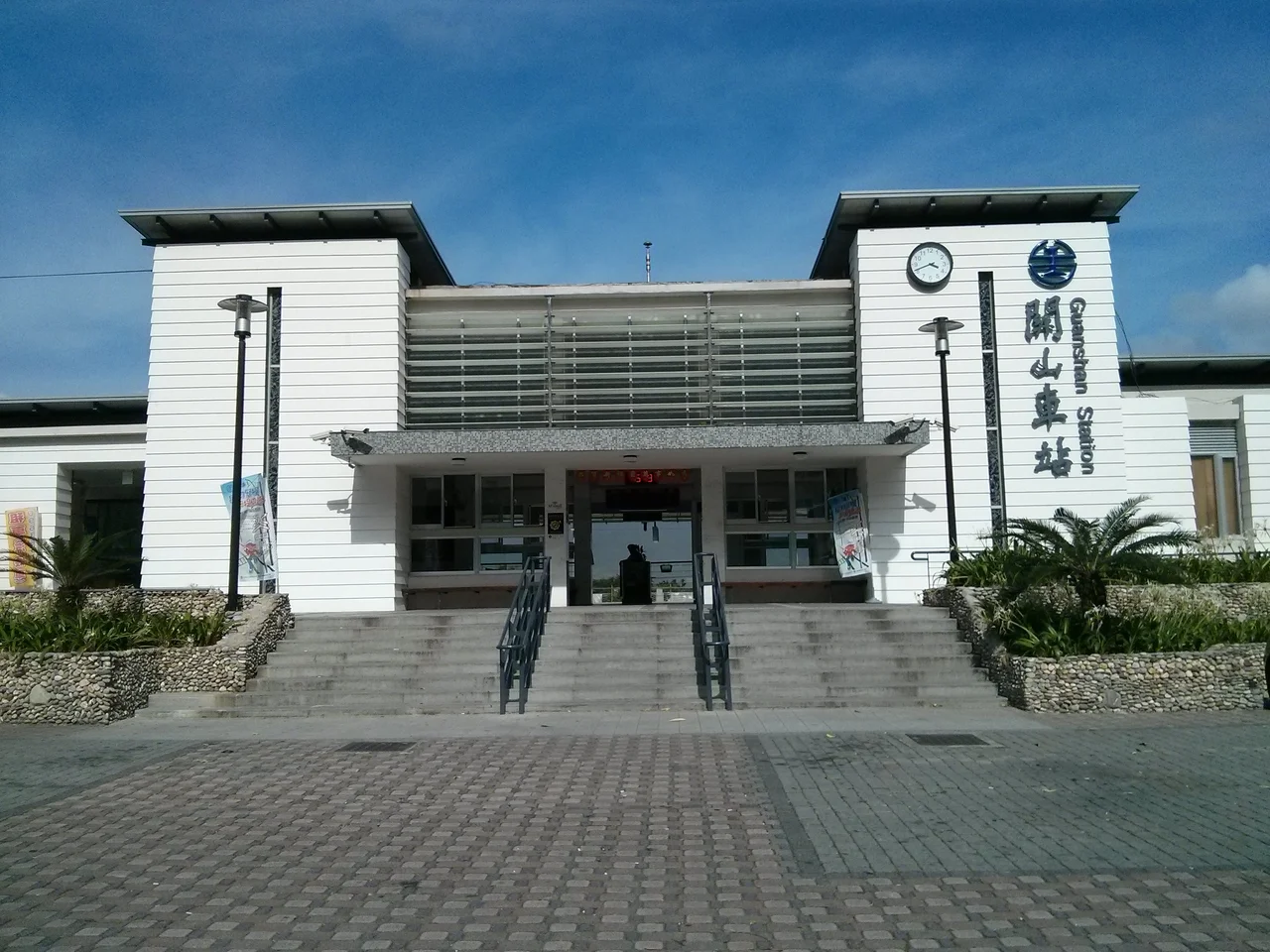

Guanshan, Taitung
The town's original name was Lilong — an Amis word meaning "red worms," rendered in Hokkien as A-lí-lóng. It is not the kind of name that appears in tourism brochures. But it is honest, rooted in the observation of a particular creature in a particular place, and it tells you something important about Guanshan: this is a town that has been named by people who paid close attention to the ground beneath their feet. Today the name is more formal, the rice fields are famous, and the cycling loop along the Beinan River draws visitors from across Taiwan. The red worms are still there, presumably.
Walls of Mountains, Floor of Green
Guanshan occupies the southern portion of the Huatung Valley, a long agricultural corridor that runs between two of Taiwan's major mountain ranges. To the east, the Hai'an Range forms a barrier between the valley and the Pacific coast. To the west, the Central Mountain Range rises toward the island's spine. The Beinan River threads through the middle of this enclosed world, keeping the paddy fields below reliably watered. With annual rainfall reaching 2,000 millimeters and an average temperature of 23.7 degrees Celsius, the valley floor is among the more productive rice-growing environments in eastern Taiwan. Guanshan Township covers 58.735 square kilometers — not large, but dense with cultivated green in the growing seasons.
From Lilong to Kanzan to Guanshan
The layering of names in Guanshan's history maps onto the layering of its political history. The Amis called it Lilong. Hokkien-speaking settlers rendered that name phonetically as A-lí-lóng. Japanese colonial administrators, consolidating the town's administrative identity by 1920, renamed it Kanzan Town under Kanzan District within Taitō Prefecture — a Japanization of the Mandarin characters that would later become Guanshan. Each renaming left traces: the village of Lilong still exists within the township, one of its seven administrative villages, and the name has never entirely disappeared. Today Guanshan Township comprises those seven villages — Chungfu, Fengchuan, Hsinfu, Lilong, Tekao, Tienkuan, and Yuemei — and 135 smaller neighborhoods, with a population of about 8,160 people as of February 2023.
The Cycling Loop That Made Guanshan Famous
Ask a Taiwanese traveler what they know about Guanshan and the answer is almost always the bike trail. The Guanshan Bike Trail is a dedicated cycling path that loops around the rice paddies along the Beinan River, offering a largely flat, paved circuit through agricultural landscapes that look in the growing season like a green mosaic hemmed in by distant mountains. This kind of scenery — wide open valley floor, dramatic backdrop, slow pace — has made the trail a popular weekend destination for cyclists from Taitung City and beyond. The trail connects with Guanshan Waterfront Park, a riverside leisure area that gives non-cyclists another reason to stop. The Old Guanshan Rail Station, a remnant of an earlier era of valley transportation, sits nearby as a quieter historical counterpoint to the recreational energy of the trail.
A Town That Grows Rice and Notable People
Rice defines Guanshan's economy as much as its scenery. The relatively flat terrain of the valley floor is ideal for paddy cultivation, and the township's rice has developed a regional reputation for quality — a product of clean water, clean air, and agricultural practices refined over generations. But Guanshan has also produced people who left the valley and made names elsewhere. Singer Donna Chiu is among the township's notable natives. Kong Jaw-sheng chaired Taiwan's Financial Supervisory Commission from 2004 to 2006. Lo Hsien-che, a military intelligence figure, and taekwondo athlete Tseng Li-cheng round out an unusually varied list for a small rural township. The variety itself seems fitting for a place that has quietly occupied an important geographic position — the valley's crossroads, the river's bank — for centuries.
Temples in the Valley
Like most Taiwanese townships, Guanshan's spiritual life is embedded in its physical landscape. Guanshan Tianho Temple and Nanshan Temple are the main religious sites, their incense and festivals anchoring the calendar of a community whose daily rhythms still follow the agricultural year. The Guanshan Hongshi Trail adds a hiking dimension to the township's offerings, climbing into the forested slopes that separate the valley floor from the higher terrain on either side. The train is still the easiest way in: Guanshan Station and Haiduan Station both serve the township on the Taiwan Railway network, placing this rice-paddy valley within easy reach of the island's rail passengers — though the town gives back, slowly and quietly, exactly as much as visitors are willing to take time to receive.
From the Air
Guanshan sits at approximately 23.018°N, 121.194°E in the Huatung Valley, Taitung County. The valley is clearly visible from altitude as a flat agricultural corridor flanked by two mountain ranges — look for the patchwork of rice paddies and the glint of the Beinan River. Taitung Airport (RCFN) is approximately 35 kilometers to the south, making it the nearest airport. Approach from the south along the valley floor gives the best view of Guanshan's agricultural landscape; from the air, the town itself is a modest cluster of buildings at the river's edge, easily identified by the loop of the cycling trail around the paddy fields. Best viewed at 2,000 to 3,000 feet on a clear day when both bounding ranges are visible simultaneously.
Nearby Stories
- Liudui Hakka Cultural Park 3.3 km away
- 2025 Tainan–Chiayi Earthquake 3.4 km away
- Meinong Hakka Culture Museum 4.3 km away
- Chiaming Lake 13 km away
- Taimali 13 km away
- 1951 East Rift Valley Earthquakes 78 km away
- 2021 Hualien Train Derailment 142 km away
- Mavulis Island 176 km away