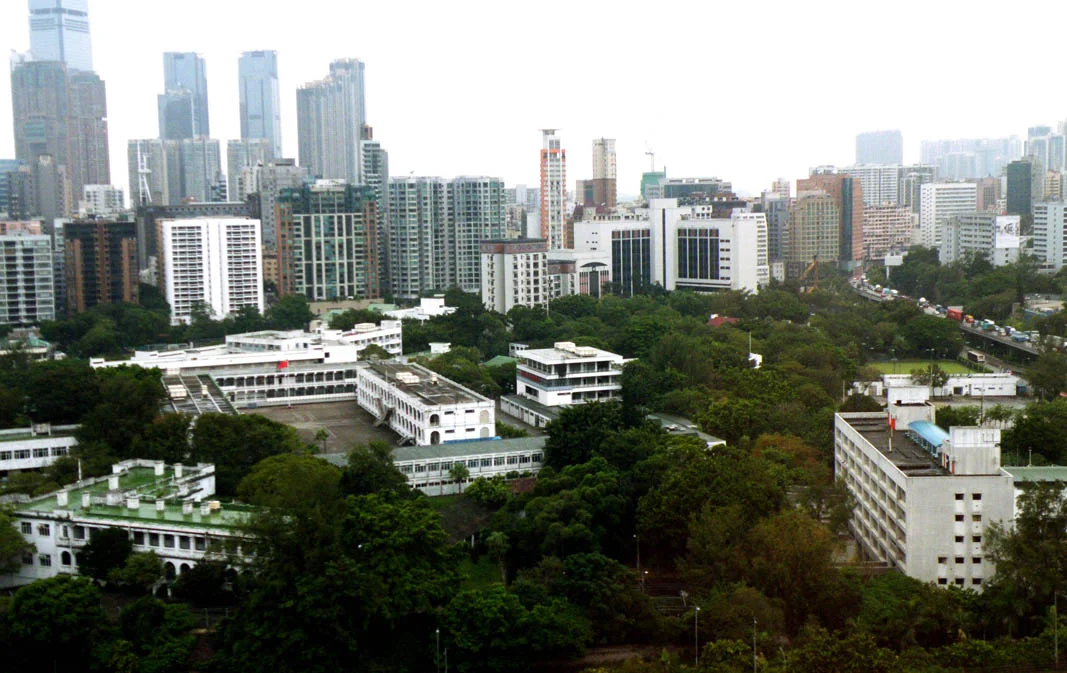

Gun Club Hill Barracks
The name may have come from the birds. Before the British Army arrived in the King's Park area in the 1860s, the land was dotted with gardens, streams, and paddy fields — a popular spot for hunting, according to Sinologist R.G. Horsnell, who considers it plausible that the shooting ranges established after the military moved in gave the hill its name. That reading has never been verified. But the detail captures something true about the place: it has always been defined by the armed presence, and the name has outlasted every change in who is doing the occupying.
Kowloon After the Second Opium War
The cession of the Kowloon Peninsula to Britain under the Convention of Peking in 1860 — following the Second Opium War — created an immediate military problem. The peninsula needed garrisoning, and the Victoria and Wellington Barracks on Hong Kong Island could not stretch across the harbour. The British scouted the King's Park area and found what they needed: open ground away from the civilian shoreline, suitable for training, with enough space for encampments. Tents and matsheds went up first. Soldiers carried out rifle and artillery practice on the ranges that gave the compound its eventual name. Horse trails connected the military encampments to the civilian roads around Chatham Road. Over time, the temporary accommodations were replaced by permanent structures, and what began as a field encampment became a proper garrison — one that would remain in continuous military use for the next 130 years.
The Regiments That Passed Through
The roster of units that served at Gun Club Hill Barracks reads as a roll call of the Victorian and twentieth-century British Army's colonial postings. The 91st Argylls arrived in 1888. The 1st Battalion King's Shropshire Light Infantry followed in 1892. The Second Royal Welch Fusiliers came in 1899. Artillery regiments, infantry battalions, intelligence units — they rotated through across the decades, cycling back and forth with the Wellington and Victoria Barracks on Hong Kong Island. The Gurkha Transport Regiment and 248 Gurkha Signal Squadron were among the last British units to leave, staying until 1997. Sikh and Punjabi Mussulman Companies also served at the barracks during the colonial period. The compound they occupied was roughly 10 hectares — a fraction of the larger military footprint that had once extended across what is now Kowloon Park and King's Park.
Handover and a New Garrison
On July 1, 1997, the transfer of sovereignty over Hong Kong passed the barracks from the British Army to the People's Liberation Army. The PLA moved in and the facility adapted around them. A new hospital was constructed for the garrison — a multi-functional complex of nearly 17,000 square metres, including six buildings: a crescent-shaped Low Block and an L-shaped 11-storey High Block for the hospital itself, plus a multi-purpose building, a restaurant, two staff quarter blocks, and a changing facility. The compound today includes a primary school and grocery stores, the full infrastructure of a self-contained military community embedded in the middle of a densely populated city. In 2015, lawmaker Albert Chan Wai-yip proposed decommissioning the barracks to create additional residential space; the suggestion did not advance.
A Name That Has Outlasted Its Origin
Gun Club Hill sits between Jordan and Austin Road, bounded by Gascoigne Road and Chatham Road South — streets that themselves carry the layered nomenclature of Hong Kong's colonial history. The original military encampment stretched much further; what survives is a smaller parcel, whittled down over the decades as the city grew around it. The name persists, even though no gun club operates here and the hill is now a PLA garrison hospital and housing complex. Kowloon has built itself right up to the perimeter wall. The barracks remain one of the few large open compounds in a district where land pressure is relentless — a military island in a sea of high-rise blocks, as it has been, in one form or another, since the British first arrived with their tents.
From the Air
Gun Club Hill Barracks are located at approximately 22.30°N, 114.18°E in the Jordan district of Kowloon. From the air at 2,000–3,500 feet, the compound is visible as one of the few open green spaces in the densely built-up Kowloon interior, bounded by Austin Road to the north, Chatham Road South to the east, Gascoigne Road to the south, and Jordan Path to the west. Kowloon Park lies to the northwest. Victoria Harbour and the Hong Kong Island skyline are visible to the south. Hong Kong International Airport (VHHH) is approximately 20 km to the west. The 11-storey High Block of the PLA hospital is the most prominent structure within the compound.
Nearby Stories
- Lok Ma Chau Loop 2.3 km away
- Portas do Cerco 2.3 km away
- Kweilin Incident 17 km away
- Wanshan Archipelago Campaign 34 km away
- Nanxiong Formation 115 km away
- Battle of Nanpeng Island 148 km away
- Heyuan 169 km away
- Cape Maobitou 632 km away