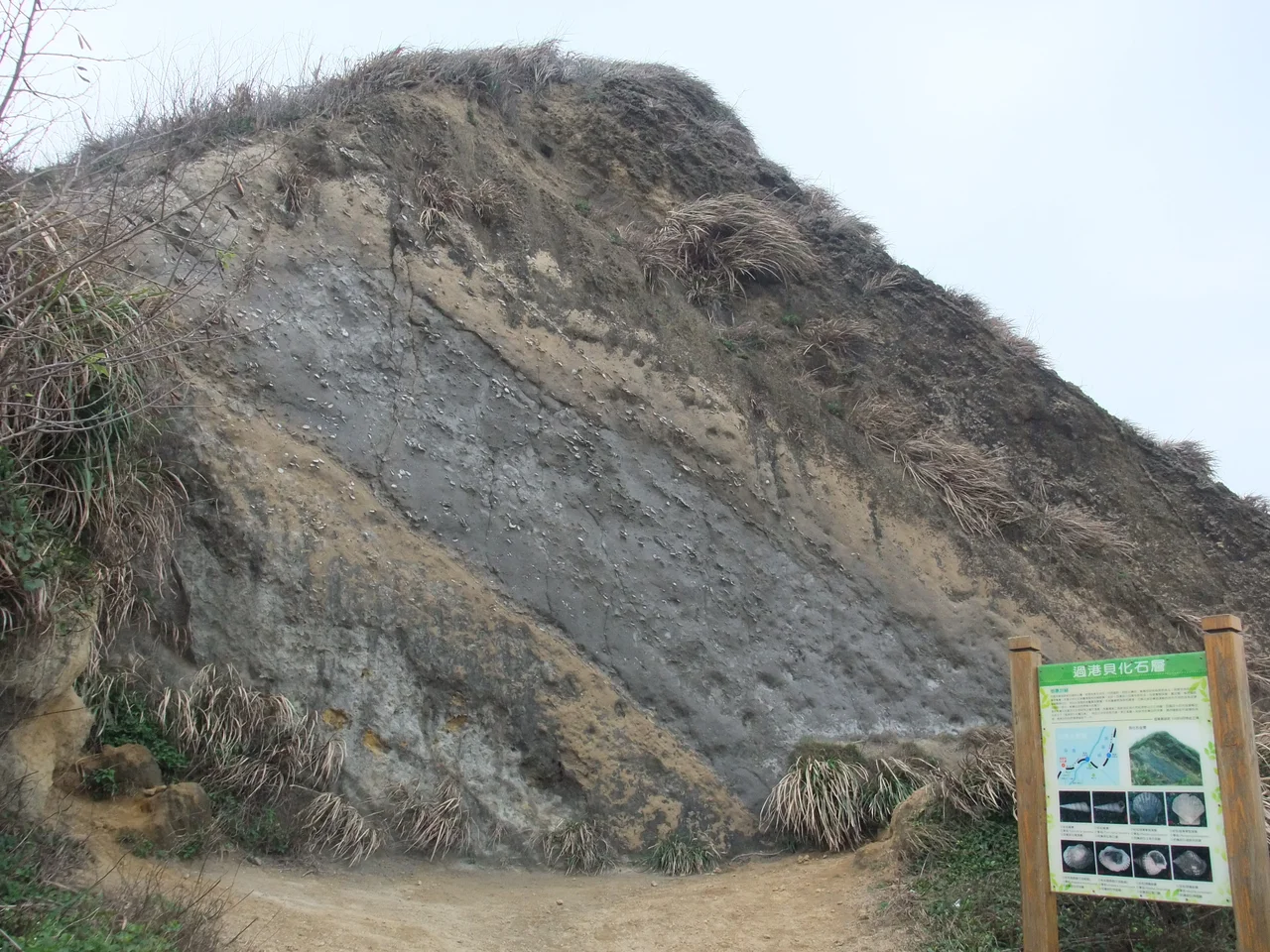

Guogang Shell Fossils
Railway workers found the sea inside the cliff. In 1921, construction crews building Taiwan's Coastal railway line cut through the hillside near Houlong and exposed a wall of stone packed with shells — scallops, cockles, murex, turritella — layer after layer of them, pressed into gray shale like a pantry left by a vanished ocean. The shells were not scattered. They were dense, almost violent in their concentration, suggesting repeated storms over millennia that swept the seafloor creatures into this hollow and buried them under silt before they could scatter. What the workers uncovered was a record of the Pleistocene, frozen in stone on a hillside in Miaoli County.
Half a Million Years Compressed into Shale
The Guogang Shell Fossils belong to the Toukeshan Formation, a widespread Pleistocene geological layer that underlies much of western Taiwan. The fossils embedded here date from between approximately 1,030,000 and 460,000 years ago — a span of more than half a million years during which the creatures that would become these shells lived, died, and accumulated on a shallow seafloor that sat roughly 20 to 50 meters underwater. Over time, tectonic uplift and erosion raised that former seafloor into the hills of Miaoli County, and the shells came with it. The shale that holds them is fine-grained and dark, the kind of rock that forms slowly in still, deep water. The density of the fossils is striking even to trained geologists: 135 species have been identified in a relatively small outcrop, a concentration that some researchers attribute to repeated storm events that herded shellfish populations into this particular basin before burial.
A Census of the Pleistocene Sea
Running your eye across the exposed face of the fossil bed is something like reading a catalog of an ancient reef. The most numerous shells belong to the Pecten genus — fan-shaped scallops whose ribbed surfaces are recognizable even in stone. Alongside them: Chlamys, a close scallop relative; Anadara and Arca, the ark clams with their heavy, boat-shaped shells; Eucrassatella, a thick-valved clam from deep, cold water; the slender spires of Turritella; the knobbed forms of Nassarius and Niotha; the spiky, architectural Murex; and Bursa, the frog shells. Together they represent a snapshot of an entire community — predators and prey, filter feeders and scavengers — coexisting on a Pleistocene seafloor that stretched across what is now the western lowlands of Taiwan. The variety speaks to a rich, diverse habitat. The sheer number speaks to catastrophe: something ended their world suddenly enough to preserve it whole.
Protected, Then Threatened, Then Protected Again
The Japanese colonial government recognized the site's significance quickly. In 1935, just fourteen years after the railway workers' discovery, the Government-General of Taiwan designated the fossil bed as a natural monument — one of the few geological sites to receive that status during the colonial period. After Taiwan's handover to the Republic of China government in 1945, the Miaoli County Government installed a protective plaque in 1955 prohibiting disturbance of the fossils. The protection was necessary: the site is accessible, the fossils are tangible and visually striking, and collectors periodically chipped away at the outcrop over the decades. Between 1995 and 1999, the Forestry Bureau conducted a comprehensive survey and elevated the site's status to a provincial-level protected geological landmark. The challenge of balancing public access with preservation continues; a 2014 news report noted significant damage to portions of the bed from illegal collection.
The Living Cliffs of Houlong
The Guogang fossil site sits along the coast near Houlong in northern Miaoli County, where the hills come close to the Taiwan Strait before the land flattens into agricultural lowlands. The setting is unexpectedly dramatic for a spot that rarely appears on international tourist itineraries. The outcrop rises from the earth like a page torn from a geology textbook — except that you can reach out and touch what you are reading. Visiting in the right season, with the afternoon light catching the surface of the exposed shale, the shells glint faintly even in their fossilized state, their original mineral structure altered over hundreds of thousands of years but their forms intact. Nearby, the Houlong coast offers a different kind of time scale: fishing boats come and go on the same waters that once buried these creatures. The sea that made these fossils is still there, just a few kilometers west, carrying on.
From the Air
The Guogang Shell Fossil site is located at 24.6048°N, 120.7301°E near Houlong, Miaoli County, Taiwan. From the air at 2,000–4,000 feet, the Taiwan Strait coast is visible to the west, with the low hills containing the fossil outcrop identifiable just east of the coastal plain. The nearby Houlong River mouth is a useful aerial landmark. Nearest major airport: RCMQ (Taichung International Airport), approximately 55 km to the south-southwest. The Western Trunk Line railway, whose 1921 construction crews first discovered the fossil bed, is visible running along the coastal margin below.
Nearby Stories
- Fengyuan Museum of Lacquer Art 1.6 km away
- Chiang Kai-shek Statues 6.3 km away
- Smangus 7.6 km away
- Taroko National Park 11 km away
- Hsinchu Museum of Military Dependents Village 21 km away
- Taiwan Strait 31 km away
- Taixi, Yunlin 62 km away
- China Airlines Flight 611 82 km away