
Gweesalia
In January 1907, a riot broke out in Dublin's Abbey Theatre. The audience was attending the premiere of a new play by John Millington Synge called The Playboy of the Western World, and they did not like what they were watching. They tore up the seats. They shouted down the actors. They drowned out the dialogue with hisses and stamping. The line that ignited the worst of it - 'a drift of chosen females, standing in their shifts itself' - referenced women's undergarments and was, by the standards of 1907 Catholic Dublin, an outrage. The play's setting was a small unlicensed pub in a remote village in County Mayo, modelled on a real place that Synge had visited on the road to Belmullet. That place was Gweesalia.
The Real Playboy
The plot of Synge's play turns on a young man named Christy Mahon who arrives at a Mayo shebeen - an unlicensed country pub - claiming to have killed his own father with a spade. Far from being horrified, the locals are thrilled; the news spreads through the village, the girls find him fascinating, and Christy is feted as the 'playboy' of the western world. The real story that inspired Synge was darker. He had been told on the Aran Islands about a man from Achill who, in 1894, had assaulted a woman. The crime was treated, in some quarters of rural Connacht, with less horror than one might expect; Synge took the underlying psychological observation - that audiences and communities can romanticise transgression when it arrives wrapped in the right story - and built a comedy around it. Local memory in Gweesalia is divided on whether the connection is a source of pride or embarrassment. The village pub is still open. The Synge connection still draws the occasional literary tourist.
Boxers from the Boxing Club
Gweesalia is the kind of village where you would not necessarily expect to find a serious boxing tradition, but the village community centre includes a boxing club that has, over the years, produced fighters of genuine international standing. Henry Coyle was an Irish Olympic boxer. Jimmy Monaghan won world youth titles. The club has produced students who have gone on to win at the highest levels in the lightweight and bantamweight divisions. Pipe band music is rural Mayo's most familiar export; boxing is its less obvious one. Both require discipline, repetition, and the ability to keep showing up to a small concrete-block building on a wet Tuesday night when no one is watching.
Built Heritage
Before the village had a Synge connection or a boxing club, it had ringforts and crannogs - circular earthen enclosures and lake-dwelling artificial islands that mark the prehistoric and early-medieval settlement of Erris. Several survive in the neighbouring townlands of An Ráith, Tulachán Dubh and Dumha Locha. Within Gweesalia itself, the most prominent building is St Columkille's Catholic Church, designed by the Dublin architect Ralph Henry Byrne and opened in 1932. Byrne was one of the most prolific Irish ecclesiastical architects of the early twentieth century, responsible for churches across the country; the Gweesalia commission gave the village a substantial stone building that still anchors the centre of the community ninety years later.
Saturday Buses and Sunday Football
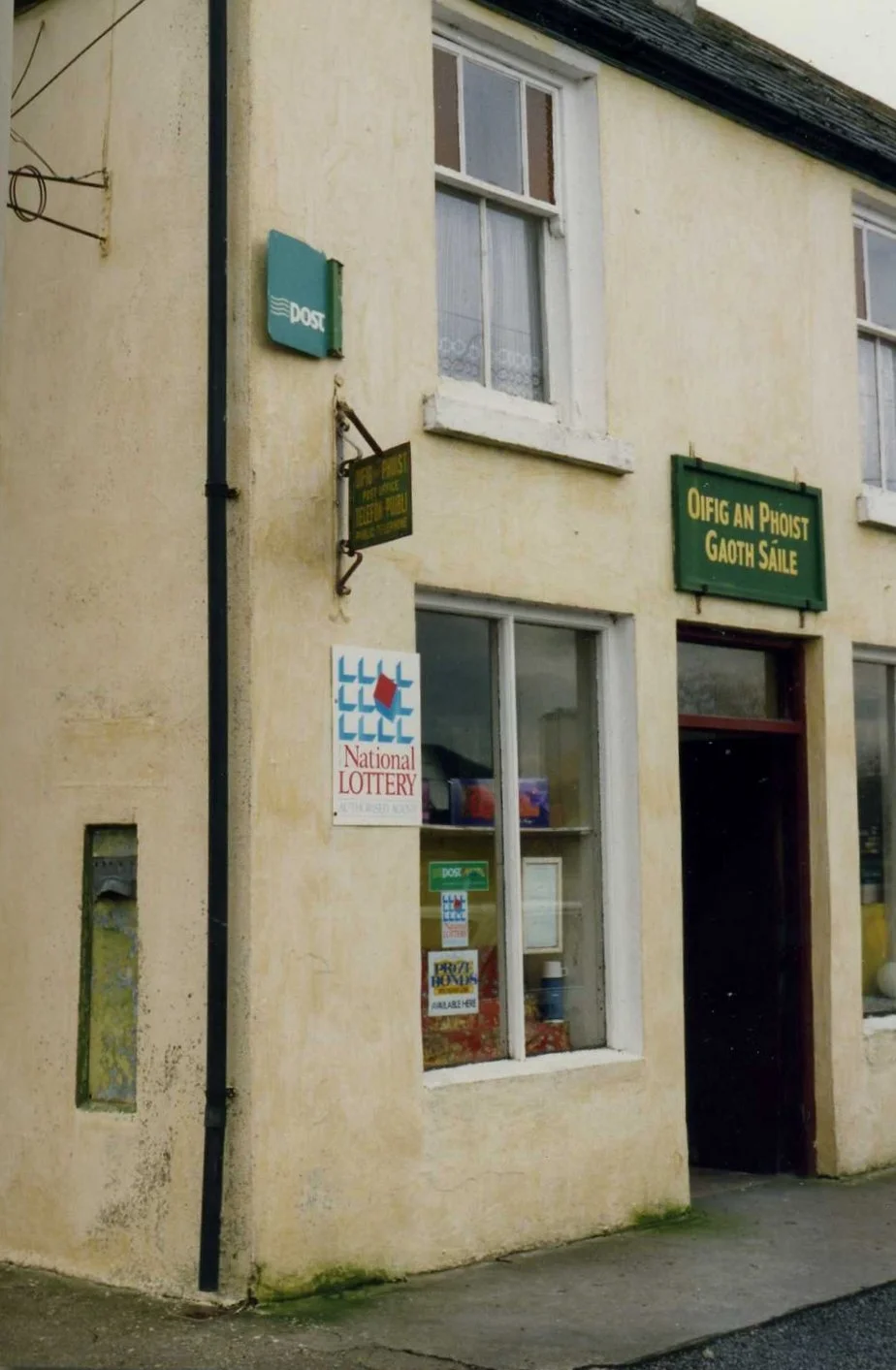
Gweesalia has a general store, a pub, a community centre with both the boxing club and a café, a post office, a playground, and a hotel. The Geesala National School - the local primary - has built a substantial reputation in Gaelic football, winning multiple county titles at minor, U-21 and senior levels. The Bus Éireann route 446 runs to Belmullet, Blacksod and Ballina, but only on Saturdays - one outbound, one inbound - and so for the rest of the week the village functions mostly under its own steam. The Irish form of the name - Gaoth Sáile, 'wind of the sea' - is a perfectly accurate weather report. The wind almost never stops. The villagers don't seem to notice it any more.
From the Air
54.11N, 9.90W. Gweesalia sits on a small peninsula on the eastern shore of Blacksod Bay in Erris. From the air it is a compact cluster of buildings between the bay to the west and the bogs of inland Erris to the east; the village of Doolough lies 3 km south, and Doohoma's peninsula is visible across the bay to the southwest. Best viewed at 2,000-3,500 ft. Ireland West Airport Knock (EIKN) is approximately 80 km east-southeast. Atlantic winds are persistent and strong; expect rapidly changing weather and frequent low cloud.
Nearby Stories
- Aughagower 3.4 km away
- Caher Island 8 km away
- Enaghbeg 10 km away
- Action of 7 May 1794 21 km away
- Lissadell House 59 km away
- RMS Carinthia (1925) 64 km away
- Glencolmcille 95 km away
- Inishtooskert 214 km away