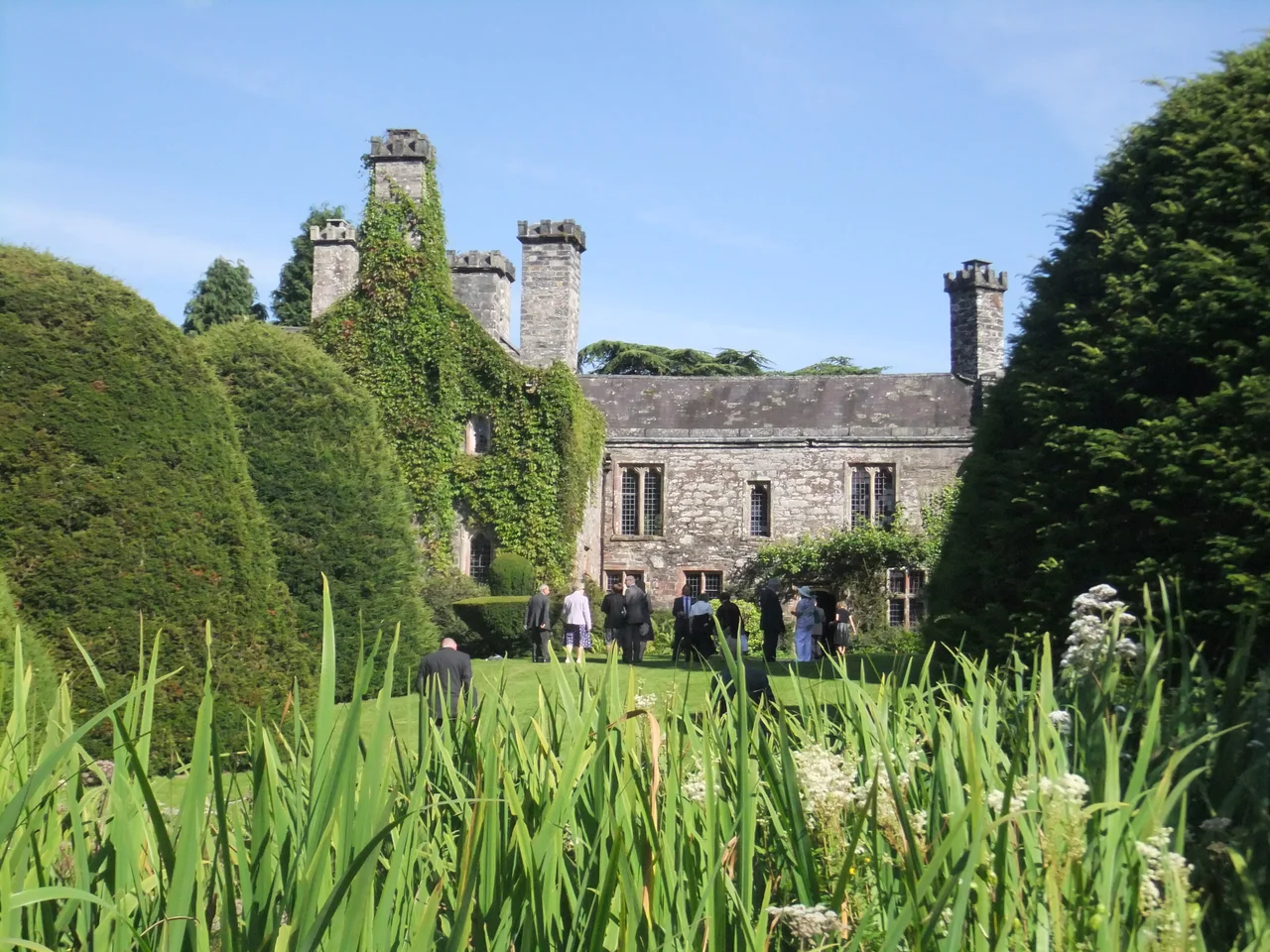

Gwydir Castle
When Peter Welford and Judy Corbett bought Gwydir Castle in 1994, they were tracing not just rooms but missing rooms. The 1640s panelled dining room had been stripped in 1921 and sold at auction to William Randolph Hearst, the American newspaper magnate, who in turn bequeathed his treasures to the Metropolitan Museum of Art in New York. The carved panelling sat in storage. The Corbetts found it, negotiated for years, and brought it home. In July 1998 the restored dining room was reopened in its original setting with the Prince of Wales among the guests. The panels had been gone for seventy-seven years. They now hang where they were carved to hang.
Layers of Time
Fortifications have stood on this floodplain west of Llanrwst since around AD 600. The river Conwy curves past, and the slopes of Gwydir Forest rise behind. Llywarch Hen, a bardic prince of Rheged, fought a bloody battle nearby in AD 610. The kingdoms of Gwynedd and Deheubarth clashed again here in AD 954. By the fourteenth century, the Welsh knight Hywel Coetmor owned the first manor house on the site. He had commanded longbowmen under Edward, the Black Prince at Poitiers in 1356, and later supported the rising of Owain Glyndwr against English rule. The Wynn family, descendants of the Kings of Gwynedd, took possession in the sixteenth century. Meredith ap Ieuan ap Robert, the dynasty's founder, rebuilt the castle around 1500 using stone from the dissolved Maenan Abbey. The spiral staircase in the Solar Tower turret came from the Abbey. So did the carved stones that catch the morning light in the courtyard. The date 1555 and John Wyn ap Maredudd's initials are still legible above the main gatehouse.
The Wynns and Their Visitors
Through the Tudor and Stuart periods the Wynns were among the most powerful families in north Wales. Gwydir was the seat of the Gwydir estate, a holding that at its peak spread across thirty-six thousand acres of deer park and quarry and mountain. Katheryn of Berain, the formidable Welsh aristocrat sometimes called the Mother of Wales for her many marriages and descendants, lived here. King Charles I is said to have visited in 1645 as the guest of Sir Richard Wynn, the second baronet, who served as Treasurer to Queen Henrietta Maria and Groom of the Royal Bed Chamber. In April 1899 the future King George V and Queen Mary, then Duke and Duchess of York, stayed at Gwydir during a tour of north Wales. The cedars on the lawn were planted to mark the wedding of Charles I and Henrietta Maria in 1625, and they are still standing. The Lovers' Tree, an ancient yew in the gardens, is somewhere between six hundred and a thousand years old. It is older than the castle in its present form.
Decline, Fire, Abandonment
In 1678 Mary Wynn married Robert Bertie, Lord Willoughby de Eresby and later first Duke of Ancaster, and Gwydir passed by marriage into a Lincolnshire-based dynasty that visited rarely. The eighteenth century brought neglect. The early nineteenth century brought selling off. The thirty slate quarries on the estate produced mostly poor-grade stone, more suited to slabs than roofing, and over a century and a half their total output equalled just two years of production from the Blaenau Ffestiniog quarries. Mortgages multiplied. In 1894 Dolwyddelan was sold. In 1921 the castle itself was sold by the Earl Carrington, ending more than four hundred years of inherited ownership. The dining room panels went to Hearst that same year. In 1922 fire gutted the Solar Tower, leaving it roofless. A second fire in the West Wing finished the job, and Gwydir stood empty for twenty-two years.
Restoration
Arthur Clegg, a retired bank manager, bought the castle in 1944 and spent the next twenty years on it with his wife and son. Peter Welford and Judy Corbett bought it from Clegg's heirs in 1994 and continue the work today. Judy Corbett's book Castles in the Air, published by Ebury Press in 2004, tells the story of two young restorers who slept rough in unheated rooms, fought wild animals nesting in the walls, and slowly recovered a house that had been collapsing for decades. The panels came back. The Solar Tower was reroofed. The rooms came back to life one at a time. The castle now opens to visitors and operates as a small hotel, and weddings happen here, and the gardens are open most of the year.
Gardens and Chapels
The ten-acre garden is Grade 1 listed. The Old Dutch garden holds ancient yew topiary and an octagonal fountain. A 1590s Renaissance arch rises from the terrace. The Royal and Statesman's gardens contain Welsh oaks planted to mark the 1899 royal visit and another in 1911. An Elizabethan causeway, the Chinese Walk, runs across the fields toward the river where the remains of the Gwydir Quay can still be seen, though silting has long since stopped the tide reaching this far. The chapel question can confuse first-time visitors. Gwydir Uchaf Chapel, in the woods above the castle, was built in 1673 by another Sir Richard Wynn as a family memorial, and its modest exterior conceals a painted ceiling depicting the Creation, the Trinity, and the Last Judgement. Gwydir Chapel, attached to St Grwst's Church in Llanrwst across the river, is the older one, built in 1633 and said to have been designed by Inigo Jones, with elaborate wood panelling and the stone coffin of Llywelyn the Great inside, brought from Maenan at the Dissolution. Two chapels, four hundred years apart, both memorial, both still standing.
From the Air
Gwydir Castle sits at 53.13 north, 3.80 west, on the floodplain of the river Conwy a mile west of Llanrwst in the Conwy valley. The grounds cover ten acres set against the slopes of Gwydir Forest. Recommended viewing altitude 2,000 to 4,000 feet to take in the castle, gardens, the river, and the town across the water. The slopes of the Carneddau lie further west. Nearest airports EGCK Caernarfon to the west, EGOV Valley on Anglesey to the northwest, and EGNR Hawarden further east toward Chester.
Nearby Stories
- Menai Strait 1.2 km away
- Battle of Ewloe 7 km away
- New Brighton Lifeboat Station 7.7 km away
- Butlin's Pwllheli 7.7 km away
- Battle of Oswestry 9.1 km away
- Cymer Abbey 22 km away
- Celtic Array 39 km away
- New Brighton Lighthouse 43 km away