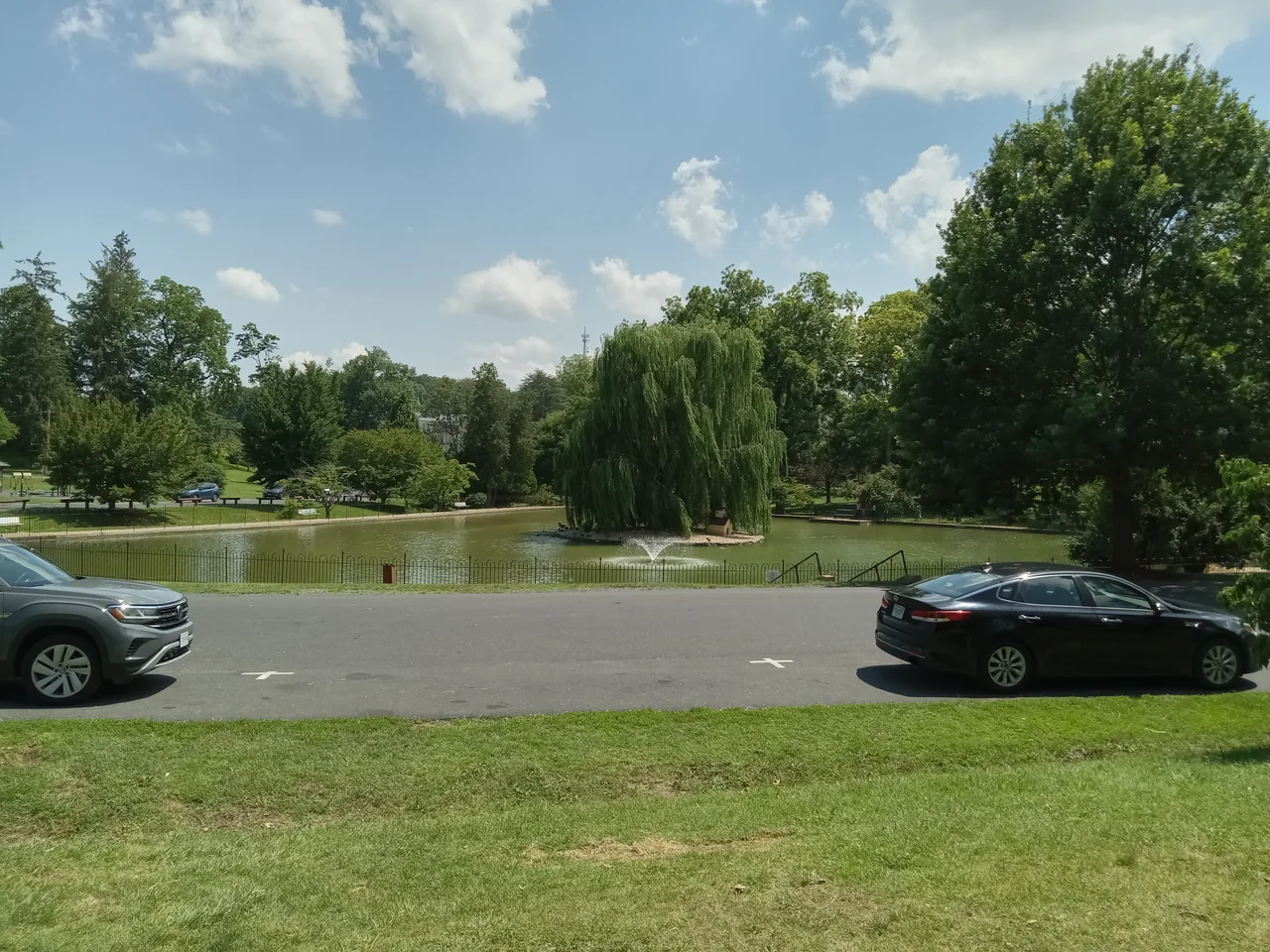

Gypsy Hill Park
Every Monday night from May through August, the Stonewall Brigade Band plays at the bandstand in Gypsy Hill Park. The band traces its lineage to the mid-1850s - it was active during the Civil War as the 5th Regiment Band, and it once performed for President Ulysses S. Grant during his visit to Staunton. It has been performing somewhere in this town, more or less continuously, for over 170 years. That is a fact most American cities cannot match. Stand on the lawn at 8 p.m. on a summer Monday and you are listening to one of the oldest community bands in the country play in a park that started life as the city's water supply.
From Water Source to Park
The land that became Gypsy Hill Park began as Staunton's drinking water. In the mid-1800s, springs beneath the hill fed a pumping plant that supplied the growing city. To protect the watershed, Staunton bought 30 acres by 1876 and another 60 acres by 1890. Captain William P. Tams led the planning that turned the property into a public park, expanded with the purchase of the Baldwin Fairgrounds nearby. The park's name has carried since the 1800s and refers to Romani people who once camped on the hill. The term itself - applied in that era and by extension to the park - is one Romani communities increasingly reject as a slur; the park's name preserves an older usage Staunton has not changed. Today the park covers roughly 200 acres of lawns, sports fields, and the central duck pond crowned by an island with a weeping willow.
Segregation in the Park
For decades, Gypsy Hill Park was a segregated space. Black residents of Staunton were barred from entering on most days; the park was open to them just one day a year. Rita Wilson, who later served sixteen years on the Staunton City Council, recalled growing up under this restriction. A 2008 documentary about Jim Crow Staunton brought her account and others into wider view. Since 1988, the city has held an annual African American Heritage Festival in Gypsy Hill Park - a deliberate reclamation of public space that for most of its history did not belong to all of the public. The festival features live music, crafts, and presentations focused on Black culture and history in the Shenandoah Valley.
Music, Trains, and Statler Brothers
Gypsy Hill Park is one of those rare municipal parks that programs free entertainment most nights of summer week. Mondays belong to the Stonewall Brigade Band; Tuesdays to Praise in the Park; Wednesdays to bluegrass; Thursdays to jazz. Every other Friday, a family-friendly movie projects onto the pavilion at dusk. Each Fourth of July, the Happy Birthday USA festival fills the park. The Statler Brothers - Staunton's most famous musical export, the close-harmony country quartet who recorded with Johnny Cash - performed there annually for years. The park also hosts the Gypsy Express, a miniature train that has run since 1958, operated by volunteers; rides cost a dollar. The L-shaped Olympic-size pool with a double slide handles August. None of this is fancy. All of it is heavily used.
What Grandma Moses Saw
Anna Mary Robertson Moses - Grandma Moses, the self-taught folk painter who didn't take up painting seriously until her seventies - lived in Augusta County for eighteen years before her national fame, and she painted Gypsy Hill Park. Her composition catches the park's mix of small ponds, summer crowds, white pavilion, and rolling lawns the way only an outsider-insider can: someone who lived there long enough to see ordinariness clearly. The painting sold in 2016 at the Augusta Expo in Fishersville for nearly six thousand dollars. The painting has long since moved on. The park she painted is still there. The band still plays Mondays at eight.
From the Air
Located at 38.1606N, 79.0867W in the center of Staunton, Virginia, where Churchville Avenue and Thornrose Avenue intersect. Recommended viewing altitude is 3,500 to 5,500 feet for a clear overhead of the park - look for the duck pond and the green wedge of open space cut by Constitution Drive. Nearest airport is Shenandoah Valley Regional (KSHD) about 4 nm north; Charlottesville-Albemarle (KCHO) is 30 nm east. Watch for valley haze in summer.
Nearby Stories
- Rockingham County 4.8 km away
- Shenandoah: The Skyline Drive Through America's Oldest Mountains 5.6 km away
- 2023 Virginia Cessna Citation Crash 16 km away
- Highland County, Virginia 16 km away
- Montpelier 20 km away
- Fork Union Military Academy 26 km away
- Battle of Greenbrier River 28 km away
- Alleghany County, Virginia 53 km away