
Haarlemmermeer
On the seventh of January, 1629, Frederick Henry of the Palatinate, son and heir of the deposed Winter King, tried to cross a lake in North Holland and drowned. The lake was called Haarlemmermeer. Two centuries later it did not exist anymore. Where Frederick Henry sank, planes now take off and land. Schiphol Airport, one of the busiest in Europe, sits roughly four meters below sea level on the floor of what used to be an inland sea. Three steam-driven pumping stations drained the water out between 1849 and 1852, and what emerged underneath was rich, dark, fertile clay. The pumping never stopped. It still has not stopped. Turn the engines off for a week and the lake comes back.
The Waterwolf
The Dutch had a word for what was happening to their coast in the late medieval centuries: waterwolf. Lakes, hungry from storm tides and the slow shrinking of drained peat, ate at their edges and grew. In 1531 the Haarlemmermeer was only 26 square kilometers, one of four small lakes in this part of North Holland. Successive floods joined the four into one. Villages disappeared into the new water, including a place called Vennep, which would eventually give its name to the modern town of Nieuw-Vennep, built on dry land where the lake once swallowed the original. By 1647 the lake covered 150 square kilometers. By the mid-eighteenth century it was over 170. Ships sank in its storms. Naval battles were fought across its waves: the Battle of Haarlemmermeer in 1573 saw a Spanish fleet defeat the Sea Beggars, the Watergeuzen, who had been trying to break the siege of Haarlem from across the open water. The lake was a strategic liability. It also threatened, in bad years, to chew its way through the dikes into Leiden and Amsterdam.
Three Steam Engines and a Ring Canal
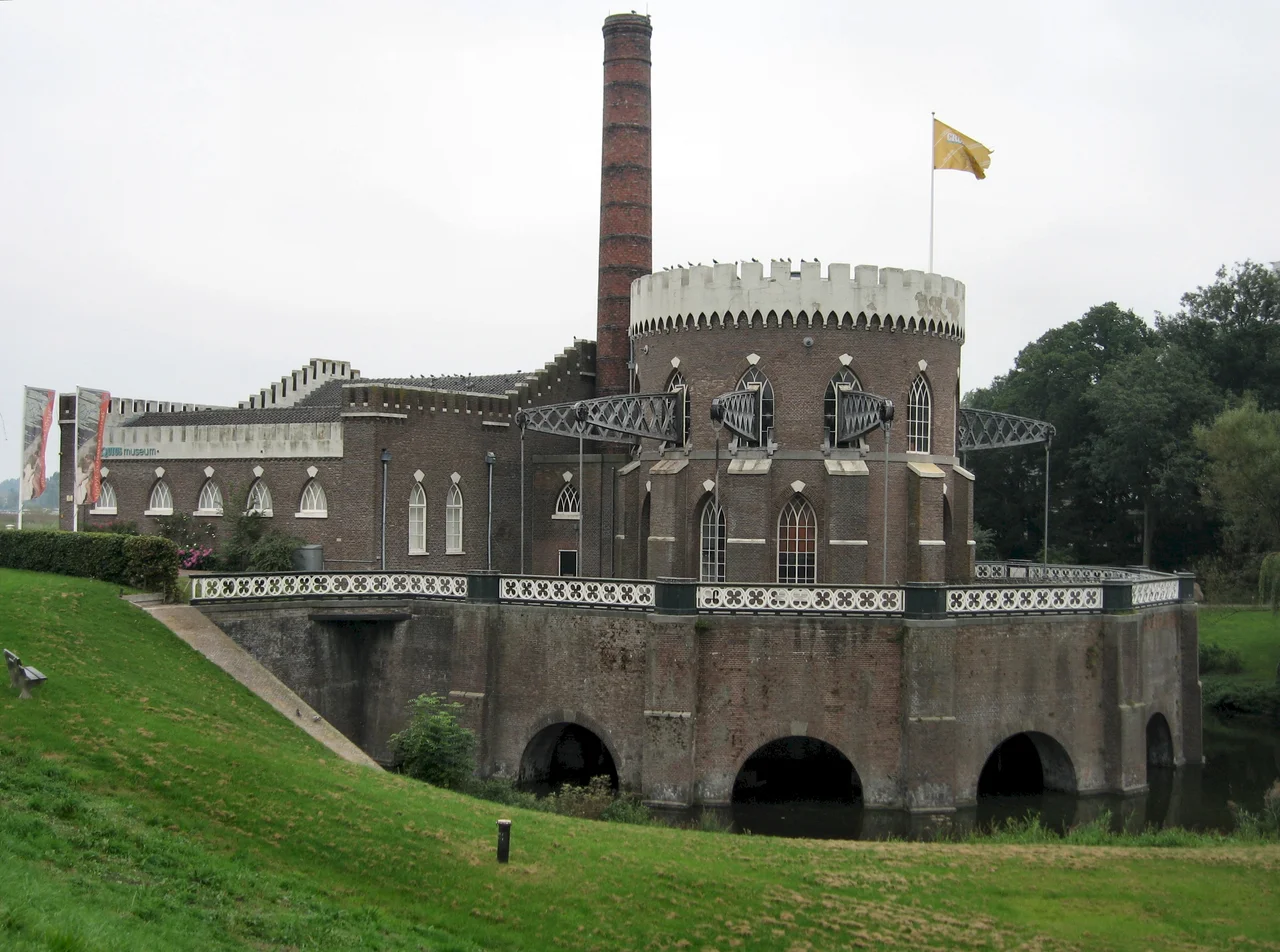
Plans to drain the Haarlemmermeer had been proposed since the seventeenth century, most famously by the engineer Jan Adriaanszoon Leeghwater in 1641. He calculated that 160 windmills, working in shifts, could do it. He was right in principle, but no one wanted to pay. King Willem I finally authorized the project in the 1830s. The new ring canal, the Ringvaart, was dug around the entire perimeter of the lake to take the pumped water out toward the IJ and the sea. Three pumping stations were built, each housing the largest steam engines of their kind in the world: the Leeghwater at the north end, the Lijnden on the east, and the Cruquius on the south. The Cruquius engine, with eight cylinders and a beam balanced on a central column, was the largest steam engine ever built. It still stands today, its rods and beams quiet now, preserved as the Museum De Cruquius. Pumping began in 1848. By July 1852 the lake bed was dry, and surveyors started laying out a grid of roads and canals across nearly two hundred square kilometers of new Dutch land.
The Airport on the Lake Floor
Schiphol took its name from a sandbank in the old lake where, in 1573, the Sea Beggars are said to have wrecked Spanish ships during the Battle of Haarlemmermeer. Schip-hol, ship hole. In 1916 the Dutch military opened a small airfield there on the new polder. Today it is the second-busiest passenger airport in Europe, and it sits four meters below sea level. The fact that pilots are landing on what was, within living memory of recent ancestors, the floor of an inland sea is not signaled at the gate but is hard to forget once you know it. KLM, Martinair, Transavia, and TUI fly Netherlands all keep their headquarters on airport grounds. The Civil Air Navigation Services Organisation, the global body for air traffic controllers, is here too. Beyond the runways, the municipality of Haarlemmermeer holds Hoofddorp, Nieuw-Vennep, Badhoevedorp, and a constellation of smaller villages on the polder grid.
Living Below the Waterline
Three Calatrava bridges, opened by Queen Beatrix in 2004 and named for stringed instruments, the Harp, the Cittern, and the Lute, span the Ringvaart with their white masts and stays. Within two years some of them showed corrosion and had to be repaired. The 40-meter Spotter's Hill rises out of the Haarlemmermeer Woods, a manmade hill in a flat country, hosting the Mysteryland music festival every summer. The polder has produced its own people: the astronomer Tom Gehrels who hunted asteroids from Arizona; the prime minister Hendrikus Colijn; the army officer Machiel van den Heuvel who organized escapes for Dutch POWs from Colditz Castle; the racing driver Rinus VeeKay competing in IndyCar; the footballer Sven Botman now playing for Newcastle United. People who live in Haarlemmermeer rarely think about the lake under their feet. The pumps keep running. The dikes hold. And the planes lift off the bottom of the sea twenty-four hours a day.
From the Air
Located at 52.301N, 4.665E in the province of North Holland, southwest of Amsterdam. The polder is a vast flat rectangle below sea level, bordered by the Ringvaart canal which is clearly visible from cruising altitude as a thin water ring around the green agricultural grid. Schiphol Airport (EHAM) occupies the eastern portion of the polder and is itself the most prominent visual feature, with its six runways arranged in a distinctive open pattern. The Cruquius pumping station museum stands on the southern Ringvaart edge.
Nearby Stories
- Polanen Castle 1.6 km away
- Gouda 2.6 km away
- Princess Amalia Wind Farm 3.5 km away
- The Green Cathedral 4.2 km away
- Egmond Abbey 7.1 km away
- Dorestad 7.7 km away
- Hollandse Kust Zuid Offshore Wind Farm 11 km away
- Enkhuizen 16 km away