.jpg)
Hadrian's Library
Imagine walking out of the Athenian sun and through a single grand doorway into a vast rectangular court, a hundred columns of imported marble running along the walls, a long ornamental pool catching the light at its center, and gardens softening the heat. This was the gift the Roman emperor Hadrian gave Athens in AD 132 - the largest building he raised in the city he loved. Today its weathered facade stands a short walk north of the Acropolis, a quiet field of stone in the middle of the modern bustle of Monastiraki.
An Emperor's Grand Gesture
Hadrian adored Greek culture, and Athens received the fullest expression of that love. Completed around AD 132, his library was less a single room than an entire monumental enclosure built in the manner of a Roman forum: one entrance, a Corinthian propylon, a high wall lined on its long sides with niches and recessed halls, and an inner courtyard wrapped in colonnades. The traveler Pausanias, who saw it in the second century, described it as the building with a hundred columns of Phrygian marble, halls with painted ceilings and alabaster walls, and niches holding statues - in which the books were kept. The whole complex measured roughly 122 by 82 meters, a footprint to rival the great civic monuments of Rome itself.
Where the Scrolls Were Kept
The library proper occupied the eastern wing. There, in cupboards and tiers of shelves, lay rolls of papyrus - the codices and scrolls that made this a true center of learning, not merely a showpiece. Adjoining rooms served as reading halls, and the corners functioned as lecture rooms where teachers and students gathered. The ceilings were gilded wood; the walls were sheathed in marble and painting. At the center of the court, the long oblong pool and surrounding gardens offered shade and reflection, turning study into something close to leisure. It was a place designed not just to store knowledge but to make dwelling among it a pleasure.
Layers of Worship
The library outlived the empire that built it. Drawn into the Roman city walls and battered by the centuries, its courtyard became sacred ground in the Christian era. Three churches rose on the site in succession, and their traces survive: a four-apsed tetraconch from the fifth century, a three-aisled basilica from the seventh, and a modest cathedral from the twelfth - the Megali Panagia, the first cathedral the city of Athens ever had. A scholarly building meant to hold the wisdom of the ancient world had become, layer by layer, a place of prayer, each generation building its faith atop the marble of the last.
What Stands Today
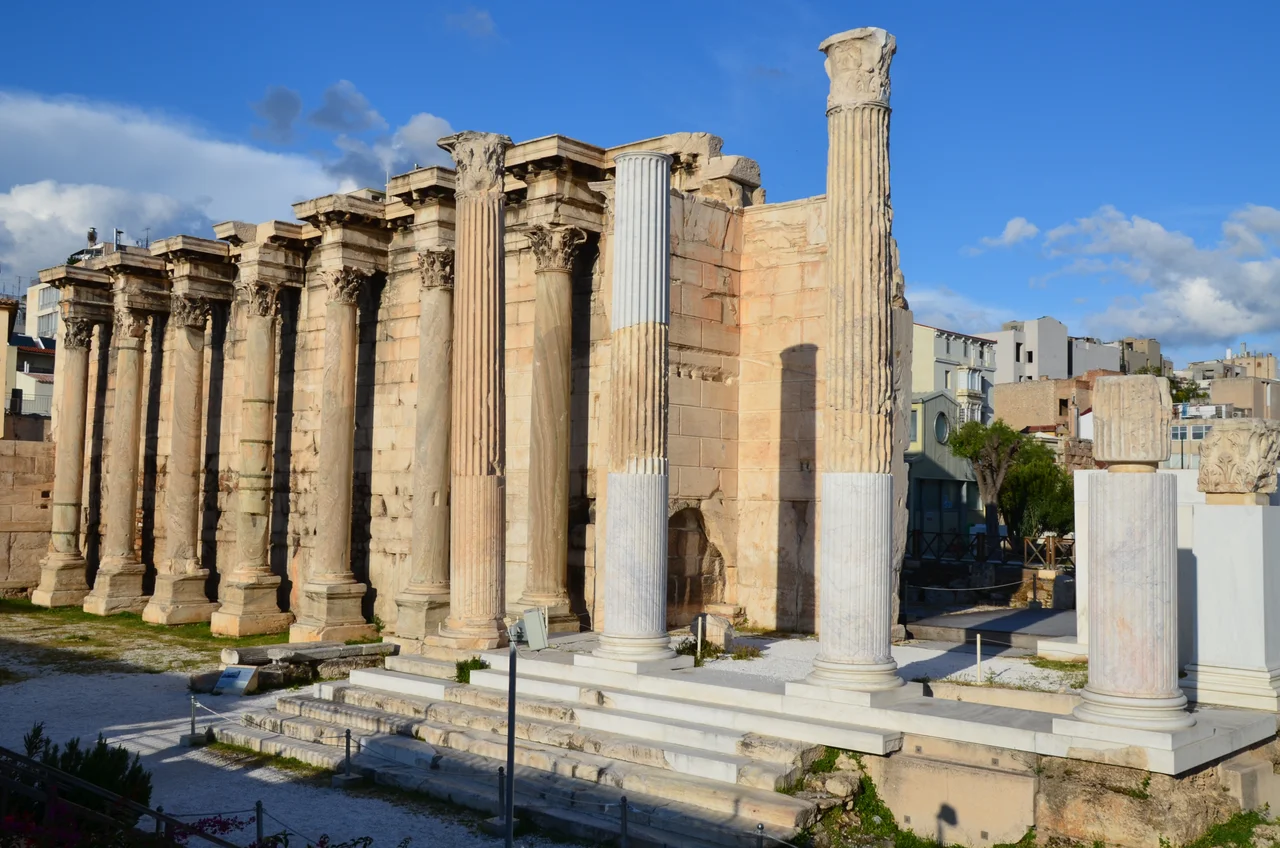
Excavation has slowly given the ruin its dignity back. Among the finds is a colossal statue of Nike, the goddess of victory, unearthed within the library in 1988 and housed in an exhibition room on site. The piece that still stops visitors, though, is the western facade, where a row of seven Corinthian columns in green Karystian marble survives beside the ancient doorway - enough to summon the scale of the original entrance. Stand before it with the Acropolis rising just to the south, and the centuries seem to compress. Hadrian wanted Athens to remember him. Eighteen hundred years on, beneath those green columns, it still does.
From the Air
Located in the historic center of Athens at 37.976°N, 23.726°E, immediately north of the Acropolis and beside the Roman Agora in the Monastiraki district. Athens International Airport (LGAV) lies about 33 km east-southeast. From the air the rectangular walled enclosure reads clearly against the dense old town, with the Acropolis and Parthenon as the unmistakable landmark just to the south. Best viewed at lower altitudes in the clear, dry conditions typical of the Attic basin.
Nearby Stories
- Great Sand Beach 5 km away
- Battle of Delium 7.7 km away
- Tower of Aliartos 9 km away
- HMHS Britannic 10 km away
- Saronic Gulf 15 km away
- Sousaki Volcano 17 km away
- Sanctuary of Apollo Maleatas 24 km away
- Skyros 66 km away